
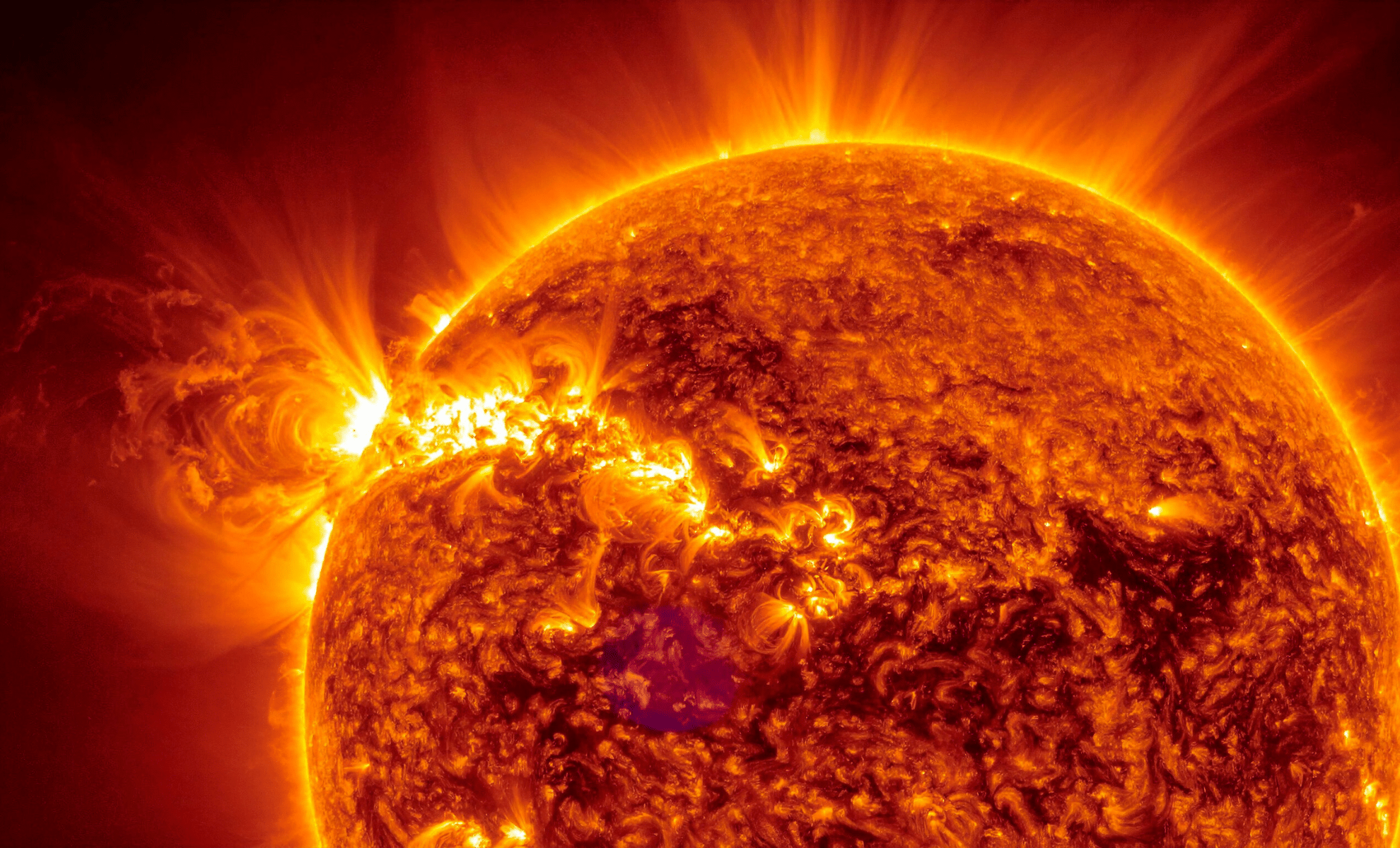
Although the Sun appears serene from our viewpoint on Earth, the region around it is filled with intense activity. A recent investigation conducted by researchers at the Leibniz Institute for Astrophysics Potsdam explores the behavior of high-energy particles emitted during solar flares and coronal mass ejections (CMEs). Utilizing data from the European Space Agency’s Solar Orbiter, the team has revealed critical information about these energetic particles and their influence throughout the solar system. Their complete findings are published in Astronomy & Astrophysics, highlighting variations in particle streams and Solar Orbiter’s crucial role in advancing solar science.
How the Sun Accelerates Particles to Extreme Energies
Our star serves as an immense nuclear engine, continuously emitting energetic particles into space. Often described as the most powerful natural particle accelerator within our Solar System, its activity is especially evident during solar flares and coronal mass ejections. These events propel particles at extraordinary velocities, far beyond everyday human comprehension. Though appearing infrequent from Earth’s perspective, these phenomena are normal and recurrent aspects of the Sun’s evolving behavior. However, the exact processes generating these particles have long been unclear until now.
Understanding the role of energetic particles is vital for studying space weather, which influences satellite systems, astronaut health, and communications. The Solar Orbiter spacecraft, by venturing as close as 42 million kilometers to the Sun, has captured unparalleled data detailed enough to identify specific patterns in how these particles are emitted.

Distinct Classes of Particle Emissions: Impulsive and Gradual
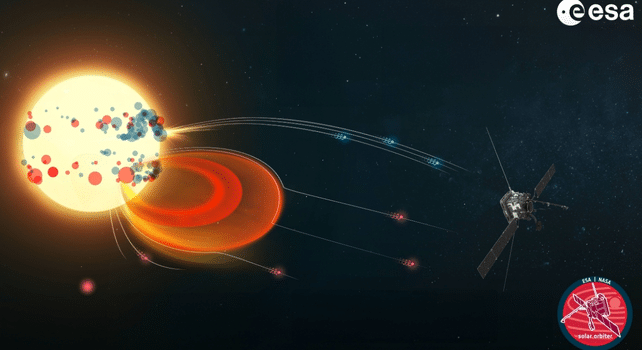
A key breakthrough from analyzing the Solar Orbiter’s measurements is the ability to categorize particle events into two primary groups: impulsive and gradual. As Alexander Warmuth, the lead researcher, describes, "We observe a pronounced division between impulsive events, marked by swift electron bursts launched through solar flares, and gradual events, which are connected to prolonged CMEs." Impulsive emissions feature fast, concentrated surges of particles, whereas gradual emissions unfold over longer durations.
This classification highlights the intricate complexity of solar eruptions and the diverse methods by which the Sun discharges energy into space. While impulsive events tend to generate sharp, intense bursts, gradual events linked to CMEs result in a more extended particle outflow that spreads over wider angles. Both types have distinct consequences for space weather, affecting satellites and orbital technologies in unique ways.
Decoding Solar Particle Emissions Through Solar Orbiter’s Unique Observations
The ability to distinguish these particle classes comes exclusively from the advanced observations made by the Solar Orbiter. “Our understanding was unlocked by tracking hundreds of solar particle events at varying solar distances using several instruments simultaneously — a capability unique to Solar Orbiter,” Warmuth notes. The spacecraft’s orbit is strategically designed to capture vital insights not only about the Sun but also about the evolving behavior of energetic particles as they move outward.
Solar Orbiter is the pioneer mission capable of studying solar energetic particles (SEPs) directly—flying through these particle streams and measuring them near their source. This real-time, in situ approach enables scientists to trace the precise origins and launch times of the particles as they depart the Sun.
“By detecting particles at an early stage in a relatively unaltered state, we were able to pinpoint their exact emission time and location on the Sun,” says Warmuth. This unprecedented detail opens new avenues in heliophysics, boosting our comprehension of solar particle acceleration methods.
Explaining the Detection Delay: A Matter of Journey, Not Emission
A compelling finding from this research addresses the apparent time delay between solar flare occurrences, particle release, and their later detection. Co-author Laura Rodríguez-García explains, “The lag does not stem from delayed particle emission but rather from the complex journey electrons undergo through space before reaching instruments.”
As emitted particles travel outward, they experience scattering and turbulence caused by interactions with the space environment, which disperses them and slows their direct arrival at detectors. This scattering effect increases with distance, causing the perceived detection delay after their initial release from the Sun.
This discovery revises earlier models, clarifying that the delayed observations are due to particles’ passage through fluctuating space conditions, not a staggered release from the Sun itself.
Implications of Solar Orbiter’s Discoveries for Future Space Exploration
The new insights gleaned by Solar Orbiter extend beyond scientific understanding; they hold practical importance for safeguarding space missions. “Solar Orbiter is enhancing our knowledge of the Sun’s behavior more than ever before,” explains Daniel Müller, ESA’s Solar Orbiter project scientist. Improved comprehension of solar energetic particles and their effects on space weather allows for the development of advanced protection measures for satellites, astronauts, and other space assets.
With expanding ambitions for deep space missions, understanding solar particle dynamics becomes increasingly critical. “This knowledge from Solar Orbiter will aid in shielding spacecraft and protecting astronauts from hazardous solar radiation,” Müller adds. Ultimately, these advances could lead to superior defensive technologies that reduce the dangers posed by solar activity for future explorers.
- Categories:
- News






0 comments
Sign in to Comment