

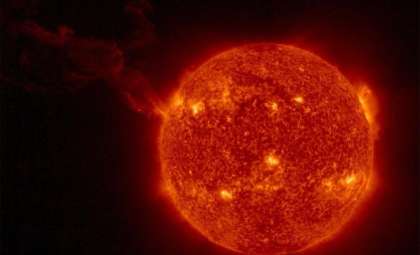
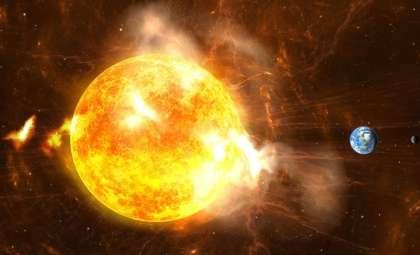
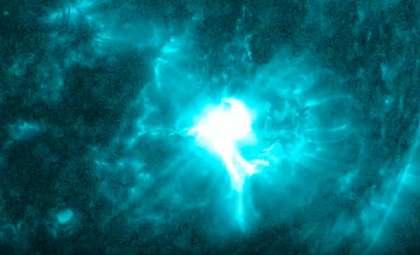
On August 5, 2024, NASA’s Solar Dynamics Observatory (SDO) detected two massive solar flares. These paired X-class flares, representing the highest intensity of solar flares, burst from the Sun, showcasing heightened solar activity as it nears its peak cycle.
Insights into the Dual Solar Flares
NASA’s SDO, which continuously tracks solar behavior, captured the eruptions of both flares. The initial flare, rated X1.7, reached its zenith at 9:40 a.m. ET, followed by a secondary flare, rated X1.1, which peaked at 11:27 a.m. ET.
These fierce energy releases were recorded in extreme ultraviolet wavelengths, highlighting the scorching plasma within the flares. The false-color images, shaded in teal and gold, illustrate the vibrant and energetic characteristics of these solar phenomena.

Solar flares emerge from the sudden liberation of magnetic energy linked to sunspots, unleashing radiation across the electromagnetic spectrum, from radio frequencies to gamma rays. When aimed toward Earth, they can disrupt ionospheric conditions, affecting satellite stability, radio transmissions, and electrical grids.
“Solar flares rank among the most potent solar events and can last several minutes to hours,” a NASA scientist noted. The twin flares documented on August 5 highlight the Sun’s capability to shape space weather and affect Earth’s technological systems.
Consequences for Earth and Aurora Activity
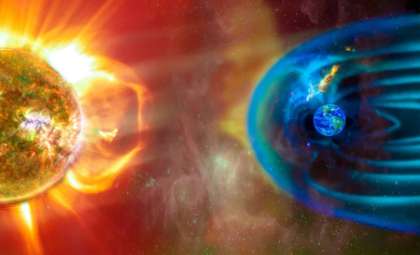
The effects of these solar flares on our planet are under evaluation, but they hold the potential to trigger auroras seen unusually far south. Auroras, the shimmering lights in polar skies, result from charged particles from the solar wind colliding with Earth’s magnetic field.
When these energetic particles interact with atmospheric gases, they produce vibrant light shows near the poles. The recent dual flares might enhance auroral displays, making them visible in regions where they’re rarely seen.
In the days before these flares, a milder M8-class solar flare caused a robust G3-class geomagnetic storm, lighting up skies as far south as central California.
These geomagnetic disturbances, often driven by coronal mass ejections (CMEs) following solar flares, journey towards Earth, intensifying the solar wind and causing vivid aurora effects. “The past G3 event allowed viewers in unexpected locations like California to experience the Northern Lights,” remarked a space weather specialist. The recent twin X-class flares may similarly boost auroral activity, delighting observers.
Decoding Solar Flares and Their Impact on Space Weather
Solar flares are graded by strength, from Class A (weakest) through to Class X (strongest), with subdivisions from 1 to 9. The pair of flares on August 5 fall within the X-class, indicating their tremendous power. Such occurrences are crucial for comprehending space weather, giving clues about the Sun’s magnetic dynamics and their possible repercussions for Earth.
NASA’s SDO, launched in 2010, supports space weather investigations by delivering detailed solar images taken at various wavelengths with advanced tools such as the Helioseismic and Magnetic Imager (HMI) and Atmospheric Imaging Assembly (AIA).
These observations enable researchers to decode solar changes and forecast space weather events that might disrupt satellite functionality, communication networks, and energy systems on Earth. “Continuous solar surveillance by SDO is key to predicting and managing the effects of solar phenomena,” a NASA researcher stated.
SDO’s Essential Role in Solar Monitoring
The mission of SDO centers on examining the Sun’s impact on Earth and the surrounding space environment. By probing solar magnetic fields, flares, and CMEs, SDO supplies crucial information to anticipate space weather and shield technological infrastructure. The recent intensity of twin X-class flares underscores the vital need for ongoing solar tracking and sophisticated forecasting methods.
As solar activity progresses toward its approaching solar maximum, the period marking the peak of its 11-year cycle, more frequent and more powerful solar flares are expected. Grasping these phenomena is essential to prepare for potential disturbances and safeguard critical Earth-based systems. The August 5 flares serve as a vivid illustration of the Sun’s restless energy and its global impacts.
To conclude, NASA’s SDO captured twin X-class flares on August 5, 2024, emphasizing the importance of solar observation and research. These formidable solar events enhance understanding of the Sun’s magnetic activity and potential effects on space weather surrounding Earth. As solar maximum nears, persistent study and monitoring remain indispensable for anticipating and alleviating the consequences of solar flares and related space weather challenges.
- Categories:
- Astronomy ,
- News ,
- Space ,
- Nasa



0 comments
Sign in to Comment