
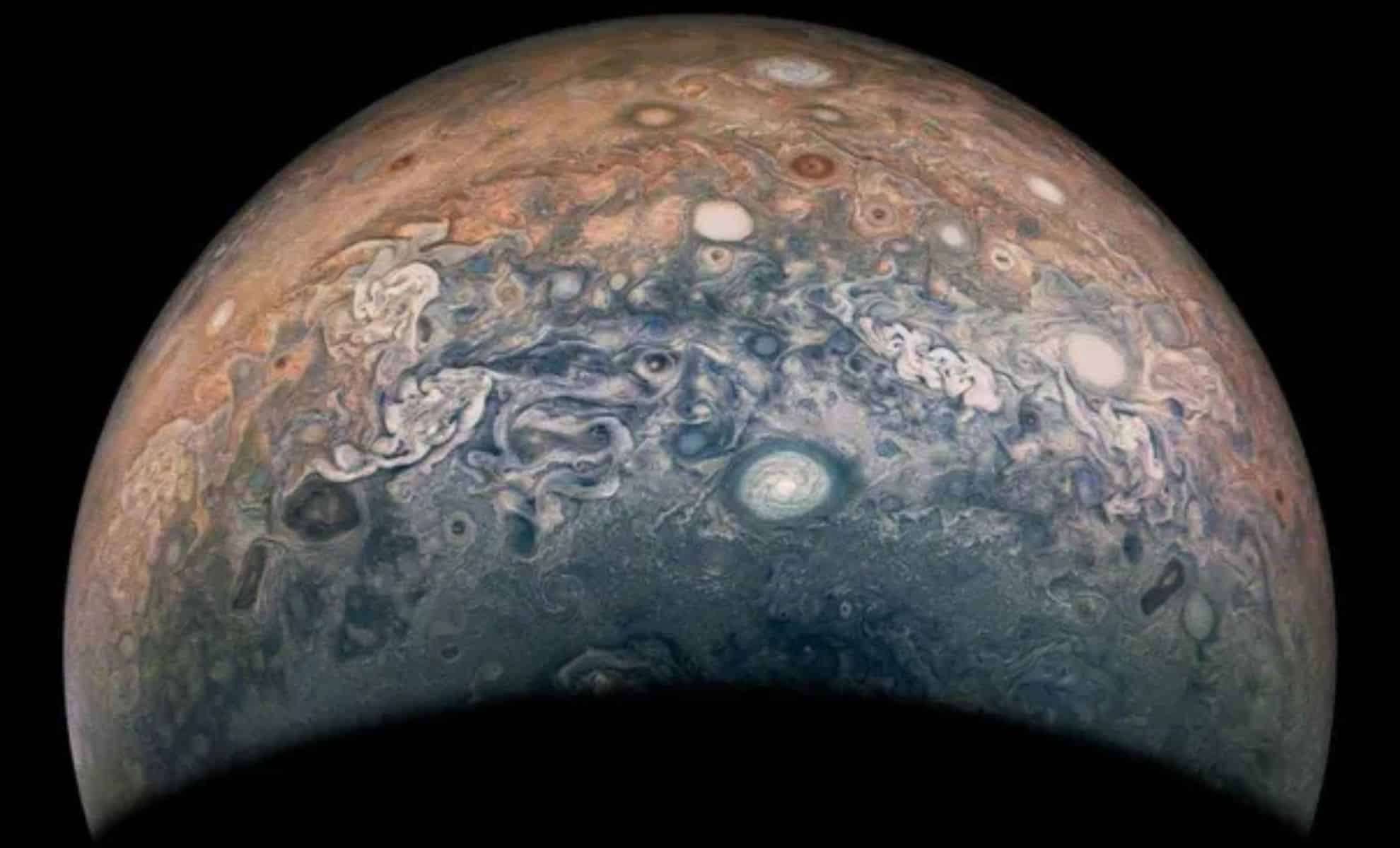
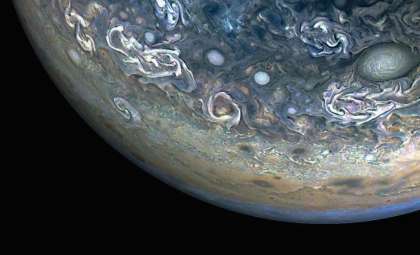
On October 23, 2023, NASA’s Juno spacecraft conducted its 66th close pass, or perijove, providing breathtaking perspectives of Jupiter’s turbulent atmosphere and one of its lesser-known satellites, Amalthea. After over 3,000 days orbiting the gas giant, Juno captured intricate details of Jupiter’s vigorous storm activity as well as striking images of this irregularly shaped moon.
Shortly after data reception, citizen scientists worked swiftly to process JunoCam’s raw imagery, producing enhanced visuals that uncover new atmospheric features. These observations showcase Jupiter’s complex weather systems and surface irregularities on Amalthea, offering scientists valuable information to deepen our knowledge of the largest planet in the Solar System as the mission approaches its final stages.
Exploring Jupiter’s Turbulent Weather Patterns
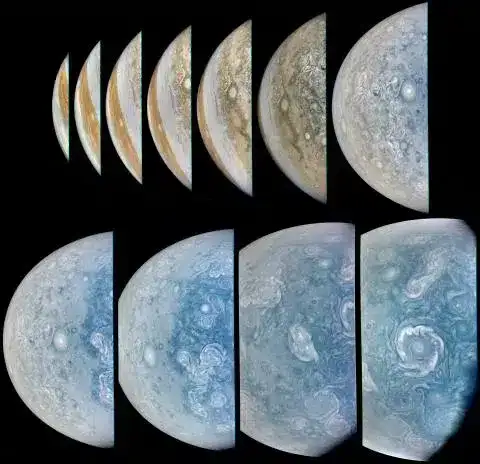
Juno’s images of Jupiter display a captivating mosaic of swirling vortexes that highlight the planet’s intense atmospheric motion. Thanks to the efforts of citizen scientists who refine contrast and color parameters, the photographs reveal a multitude of dynamic storm structures, ranging from compact whirlpools to extensive, interconnected systems.

Of particular interest is a feature called the Folded Filamentary Region (FFR), where dense, dark cloud formations interact in complex, folding patterns near the poles. This region exemplifies Jupiter’s extraordinary meteorological activity, featuring atmospheric turbulence far exceeding anything observed on Earth. As IFLScience notes, although artistically enhanced, these images provide important scientific insights into the varied and chaotic nature of Jupiter’s atmosphere.
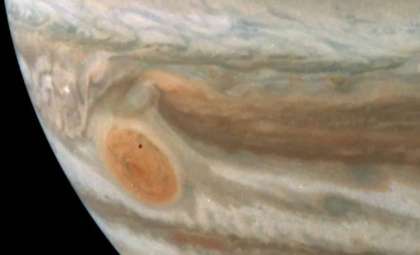
The images from Juno do not replicate what a human observer would see up close; instead, enhancement techniques highlight the dynamic interactions among atmospheric layers. Each successive perijove expands the data archive used by researchers to understand the longevity and interaction of storm systems, including the iconic Great Red Spot. The vivid swirling formations are vital for studying how energy and heat circulate through Jupiter’s atmosphere, influencing everything from weather phenomena to the planet’s immense magnetic field.
Spotlight on Amalthea, Jupiter’s Oddly Shaped Moon
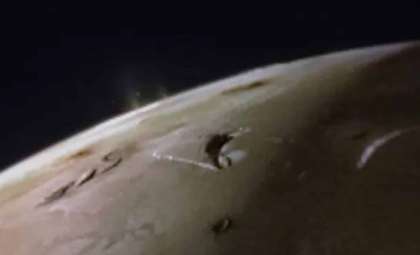
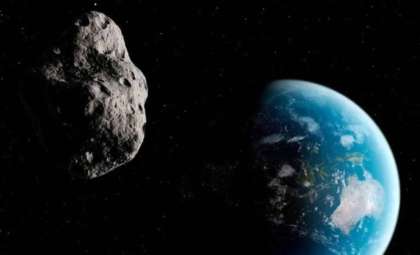
In addition to planetary storms, Juno’s pass provided rare imagery of Amalthea, a small, irregularly shaped satellite of Jupiter. Measuring about 52 miles in radius, Amalthea appears as a miniature, potato-like body set against the blackness of space. It belongs to Jupiter’s inner moons and orbits close to the planet within its faint ring system. Unlike Jupiter’s major moons, which have been extensively studied, Amalthea remains relatively mysterious because of its size and unique form.
The detailed photos help scientists reconstruct the moon’s geological background, revealing a surface marked with numerous impact craters. This record indicates a long history of collisions. By examining Amalthea and similar small satellites, researchers hope to gain insights into the variety and development of Jupiter’s moon family. Additionally, studying Amalthea aids understanding of the dynamics within Jupiter’s delicate ring system, where the moon’s gravity influences particle distribution.
Juno’s Continued Contributions to Jupiter Science
Since entering orbit in 2016, Juno has revolutionized our understanding of Jupiter by conducting multiple close flybys and gathering comprehensive data about its atmosphere, gravitational field, and magnetosphere. Though initially intended as a brief mission, its duration has been extended repeatedly due to the richness of its findings. In February 2023, the spacecraft’s orbit was shortened, enabling more frequent trips around Jupiter every 33 days, which increases the number of close encounters and scientific opportunities.
Juno’s instruments do more than capture images; they measure Jupiter’s magnetic environment, contributing to studies on its internal composition. These observations offer critical clues to the forces shaping the gas giant’s magnetic personality, one of the most powerful in the Solar System. Juno’s unique dataset continues to enhance our comprehension of the planet’s atmospheric mechanics, temperature fluctuations, and complex magnetic interactions.
The Mission’s Closing Chapter: Controlled Descent into Jupiter
Juno’s journey will culminate in a planned termination in September 2025, when the probe will intentionally dive into Jupiter’s dense atmosphere. This controlled end is designed to avoid contaminating Jupiter’s icy moons, some of which may contain subsurface oceans potentially capable of supporting life. Prior to this final descent, Juno is expected to complete ten more flybys, each yielding fresh data and captivating images.
NASA and its partners will continue to analyze the vast array of information Juno has collected, ensuring the mission’s discoveries will influence planetary science for years ahead. Representing one of the most detailed explorations of an outer planet to date, Juno’s legacy will deepen scientific understanding of Jupiter and contribute to broader knowledge of atmospheric dynamics, planetary formation, and gas giant systems throughout the universe.
- Categories:
- News






0 comments
Sign in to Comment