
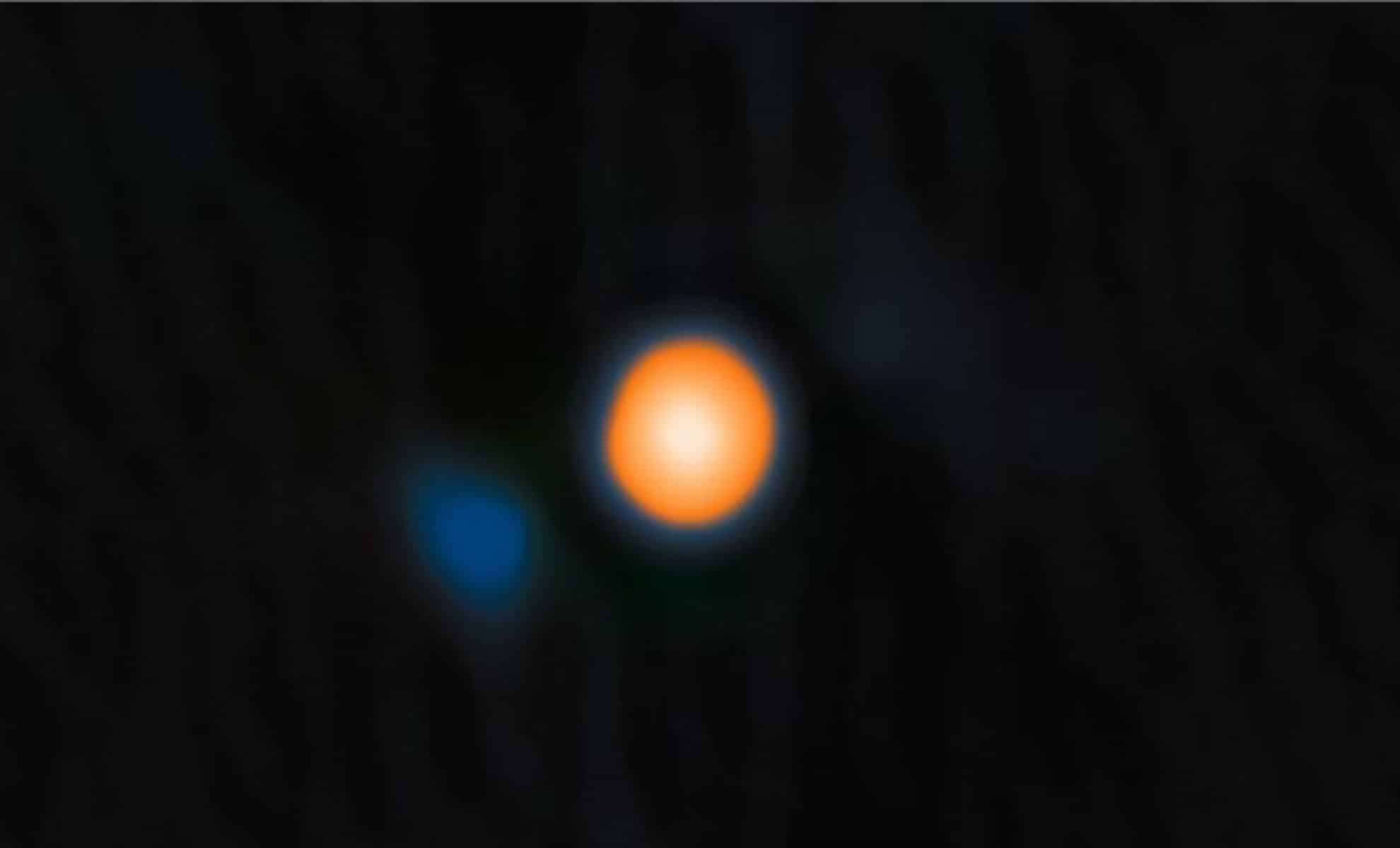
In a remarkable breakthrough, scientists have identified that the renowned red supergiant Betelgeuse is accompanied by a binary partner. This hidden star, called Siwarha, accompanies Betelgeuse in its orbit but faces a grim fate as it is destined to perish when Betelgeuse eventually explodes in a spectacular supernova. This pivotal finding offers valuable clues to understanding Betelgeuse's unusual activity and its ultimate fate. The research, outlined in a study The Astrophysical Journal Letters, highlights innovative observation methods that revealed this elusive stellar companion within one of our galaxy’s most intriguing systems. Utilizing Gemini Observatory’s advanced high-angular resolution imaging, astronomers succeeded in detecting this faint partner despite the overwhelming brilliance of Betelgeuse.
Tracking Betelgeuse’s Hidden Star: An Astronomical Breakthrough
For years, astronomers aimed to discover a secondary star orbiting Betelgeuse, located roughly 548 light-years away in the Orion constellation. As a gigantic star nearing the close of its life cycle, Betelgeuse exhibits unpredictable brightness variations, including the puzzling “great dimming” event, fueling ongoing speculation about an unseen companion. These mysterious brightness shifts lacked a definitive explanation until recent observations strongly indicated the presence of a binary partner.
NASA Ames Research Center astrophysicist Steve Howell remarked, “Detecting this companion pushed Gemini’s high-angular resolution imaging to its limits, and it succeeded.” This pinpointing of Siwarha's position marks a major advancement in observational astronomy. Howell emphasized that this achievement “sets the stage for similar observational efforts,” potentially unlocking further discoveries in the study of massive stellar systems.

Revealing Siwarha: Speckle Imaging’s Critical Contribution
The detection of Siwarha wasn’t a matter of chance but was enabled by sophisticated imaging technologies. Betelgeuse’s intense luminosity complicates the identification of nearby faint objects, prompting researchers to employ speckle imaging: a technique using rapid, brief exposures to minimize atmospheric distortion. With this approach, the team successfully distinguished the faint companion star orbiting Betelgeuse.
Despite technical challenges, the team confidently confirmed the existence of Siwarha. Their paper cautions that “the results are not absolute, given the instrument’s sensitivity limits,” yet affirms that their findings offer “the clearest and most compelling proof of a stellar companion to Betelgeuse and its characteristics.” While additional observations are necessary for refinement, the evidence affirming Siwarha’s existence is effectively conclusive.
Fate of the Twin Stars: A Shared Catastrophe Awaits
Siwarha is classified as an F-type star, still in an early evolutionary phase, with hydrogen fusion not yet initiated in its core. This contrasts sharply with Betelgeuse, which is approaching the final stages of its lifespan. Born likely around the same time, Betelgeuse’s enormous mass has accelerated its development, leading to a predicted explosion within the next 100,000 years. This supernova event may leave behind a neutron star or possibly a black hole.
The proximity of Siwarha to Betelgeuse means it is unlikely to survive the impending explosion. When Betelgeuse detonates, Siwarha will probably be engulfed by the blast, sharing an intertwined destiny with its massive, doomed counterpart. Their intertwined life cycle and contrasting states of evolution add profound depth to the story of this compelling stellar system.
- Categories:
- News











0 comments
Sign in to Comment