
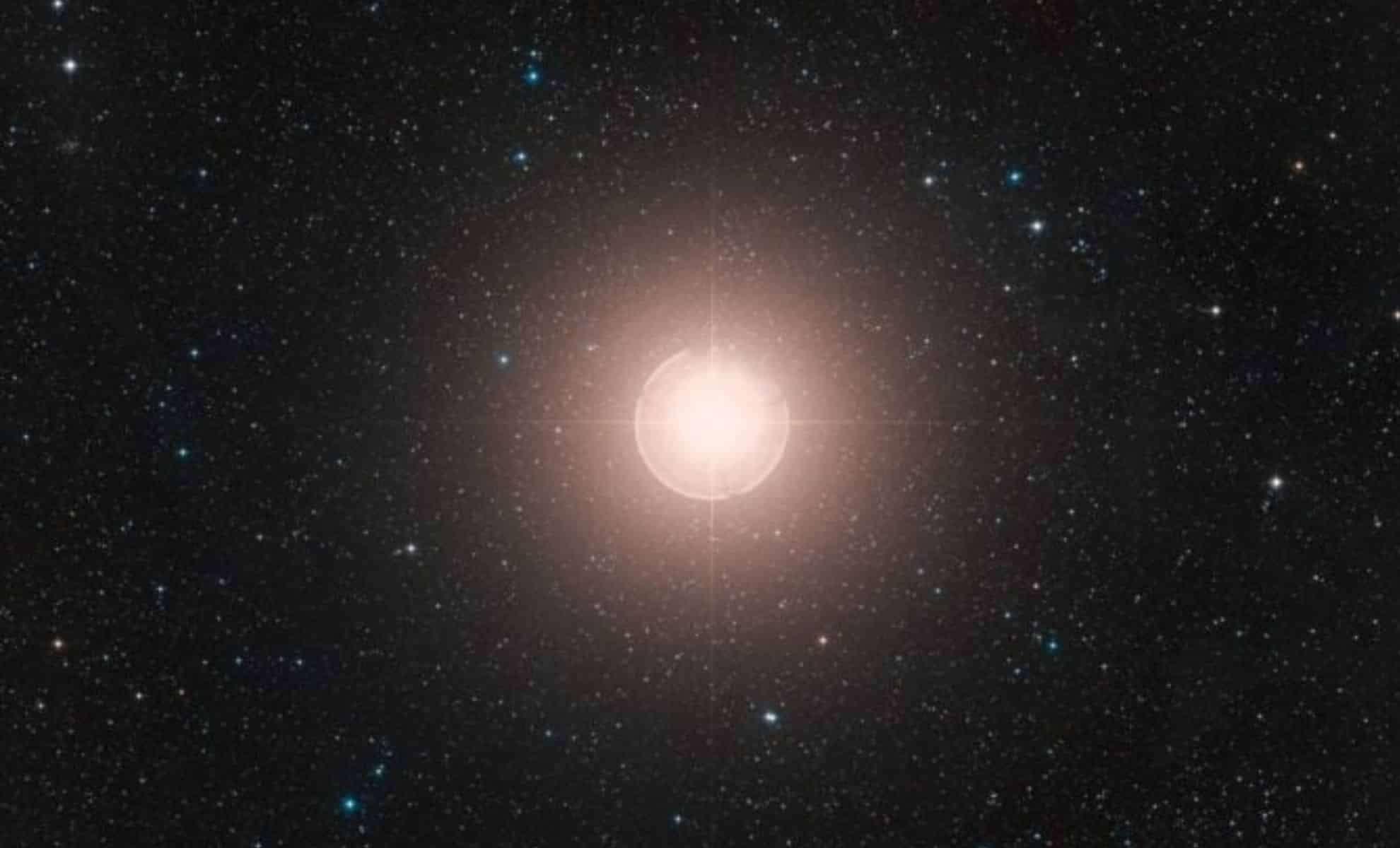
New research challenges previous beliefs about Betelgeuse, the famed red supergiant star, suggesting it may actually be part of a binary star system.
This study puts forth the idea that Betelgeuse could be accompanied by a smaller, sunlike star, which might clarify some of the star’s enigmatic behavior, including its cyclical variations in brightness. Verifying this would dramatically shift our understanding of massive stars approaching the end of their lifespans.
Could an Unseen Partner Explain Betelgeuse's Brightness Variations?
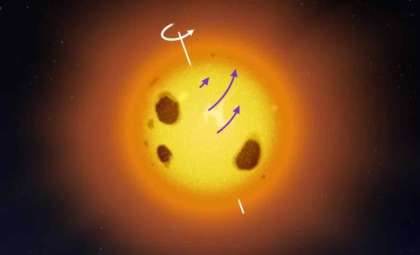
The theory of a companion star has been introduced to account for Betelgeuse’s intriguing long secondary period (LSP) phenomenon. While Betelgeuse pulses every 400 days, leading to phases of dimming and brightening linked to its expansion and contraction, it also exhibits a longer cycle of about six years (2,170 days) that has remained mysterious. The star’s significant Great Dimming event in 2020 has further prompted scientists to investigate whether a secondary, smaller star might be causing these phenomena.

The study, spearheaded by astronomers Jared Goldberg from the Flatiron Institute and Meridith Joyce from the University of Wyoming, suggests that this unseen companion—nicknamed “Betelbuddy”—could be influencing the star’s surrounding dust environment. Joyce explains that as the companion moves into view from Earth, it disrupts the dust shells enveloping Betelgeuse, increasing the star’s apparent brightness. This interaction might be the key to understanding the irregular luminescence patterns during the LSP cycle.

Is Betelbuddy a Solar Analog or Something More Exotic?
Although the companion is hypothesized to be a star similar to our Sun, some researchers, including Joyce, consider the possibility it might be a neutron star—a compact remnant from a supernova explosion. Nonetheless, this scenario faces difficulties, as expected X-ray radiation signatures typical of neutron stars haven’t been detected. Joyce remarked, “We would expect to observe X-rays if that were the case, but none have been found,” casting uncertainty on this interpretation.
Current models estimate Betelbuddy’s mass could reach around twice that of the Sun, though this is inconclusive. Betelgeuse itself has an estimated mass between 15 and 20 times solar mass and is nearing the end of its stellar life. Clarifying whether it hosts a companion adds vital insight into its evolutionary status. Joyce notes, “If Betelgeuse is undergoing core helium burning, it likely has approximately 100,000 years before it erupts as a supernova.” This suggests it is in a relatively stable phase, contradicting earlier suggestions of an imminent explosion within a few centuries.
Challenges in Spotting Betelbuddy
Discovering this potential companion star remains technically demanding due to Betelgeuse’s blinding brightness. Located nearly 642 light-years away, Betelgeuse is one of the night sky’s most luminous stars, which can overshadow any faint nearby companion. László Molnár, astronomer at Hungary’s Konkoly Observatory and co-author, commented on the difficulties, calling Betelgeuse “incredibly, stupidly bright.” This overwhelming brightness hampers efforts to detect a dimmer star in close proximity, particularly one comparable to the Sun.
Nonetheless, Molnár remains hopeful that advanced methods, akin to those used in exoplanet hunting, could unveil Betelbuddy. These strategies track subtle dips in brightness as smaller objects transit in front of their larger counterparts. Lead author Jared Goldberg expressed enthusiasm: “Using techniques designed to image faint planets near bright stars could be the key to uncovering companions around stars like Betelgeuse.”
Verifying the presence of a solar-like companion would resolve long-standing questions about Betelgeuse’s irregular luminosity and enhance understanding of its inner workings. Though the star’s current stage has been extensively studied, recognizing the influence of another star may transform how we interpret the final phases of massive stars on the verge of a supernova.
Broader Insights on Red Supergiant Evolution
Finding a companion star orbiting Betelgeuse would significantly impact our knowledge of red supergiants and the last stages in the life of massive stars. These stars are known for their instability as they approach supernova, but a binary partnership could add new complexity to their behavior. Miguel Montargès of Sorbonne Université, who was not involved in the study, remarked, “It wouldn’t be surprising if Betelgeuse had a companion. Massive stars typically form in multiples.”
Montargès also underscored that despite previous unsuccessful attempts to locate a companion, this new approach sheds fresh light on Betelgeuse’s peculiarities. “Everyone hopes to identify Betelgeuse’s companion,” he said, noting that such a discovery could deeply influence theories about red supergiants.
Beyond explaining Betelgeuse’s puzzling brightness shifts, confirming a partner would improve predictions on when it might explode. While the companion likely wouldn’t directly trigger the event, its presence could refine models for the star’s remaining lifetime. Goldberg summarized, “Locating the companion enhances our ability to estimate when Betelgeuse will go supernova.”
Future Prospects for Observing Betelgeuse
The binary nature of Betelgeuse is currently a hypothesis that requires further verification through ongoing observations. Joyce and her team are preparing to propose additional studies, aiming for new data collection possibly as early as December. These efforts hope to deliver conclusive proof of Betelbuddy’s existence, a breakthrough that would significantly advance research on massive stellar bodies.
For now, Betelgeuse remains an enigmatic giant, with the question of a hidden companion continuing to captivate astronomers worldwide. As observational technology progresses, detecting faint objects near intense stars like Betelgeuse grows more feasible, bringing us closer to unraveling some of stellar astrophysics’ greatest mysteries.
- Categories:
- Astronomy ,
- News






0 comments
Sign in to Comment