
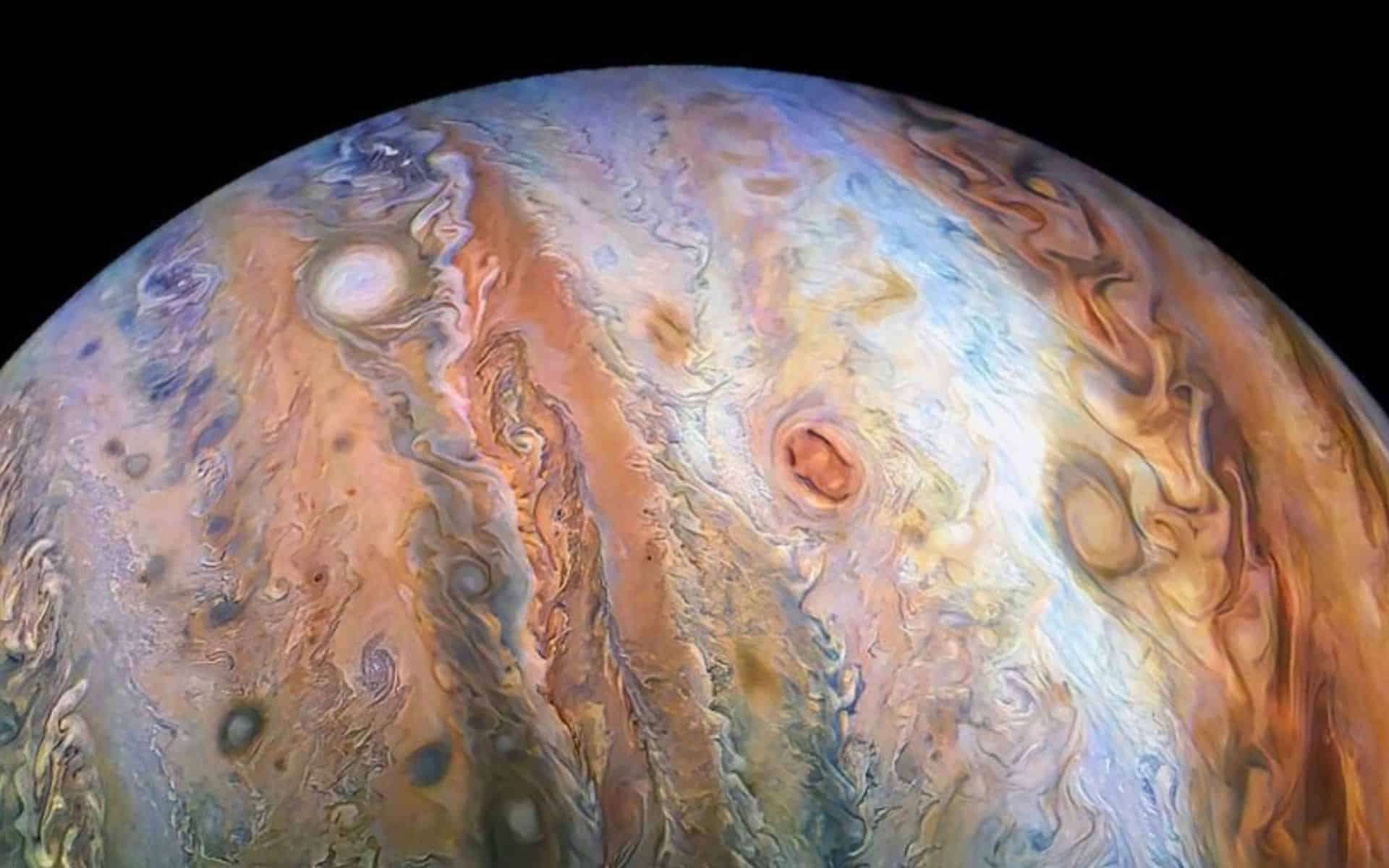
Jupiter, the colossal giant of our solar system, challenges our usual understanding of what a planet is by lacking a solid surface. Unlike Earth’s rocky crust and solid ground, Jupiter is a vast turbulent gas sphere with no firm terrain. What holds this enormous planet together, and what exists beneath its chaotic skies?
Jupiter’s Composition: A World Without Land
Positioned as the fifth planet from the sun, Jupiter dwarfs all others in size, capable of containing over a thousand Earth-sized planets within its volume. Unlike the terrestrial planets made mainly of rock and metal, Jupiter’s makeup is dominated by hydrogen and helium, resembling the sun’s composition.
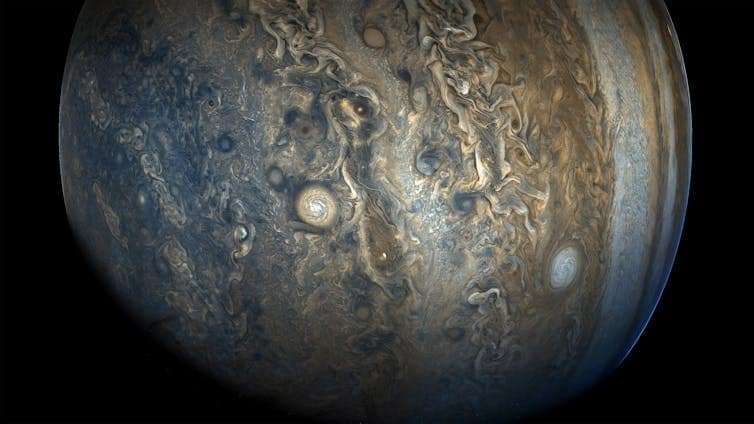
The planet’s atmosphere is a fierce realm of gas and wind, with storm speeds surpassing 400 miles per hour (643.74 km/h), outpacing the strongest hurricanes on Earth.

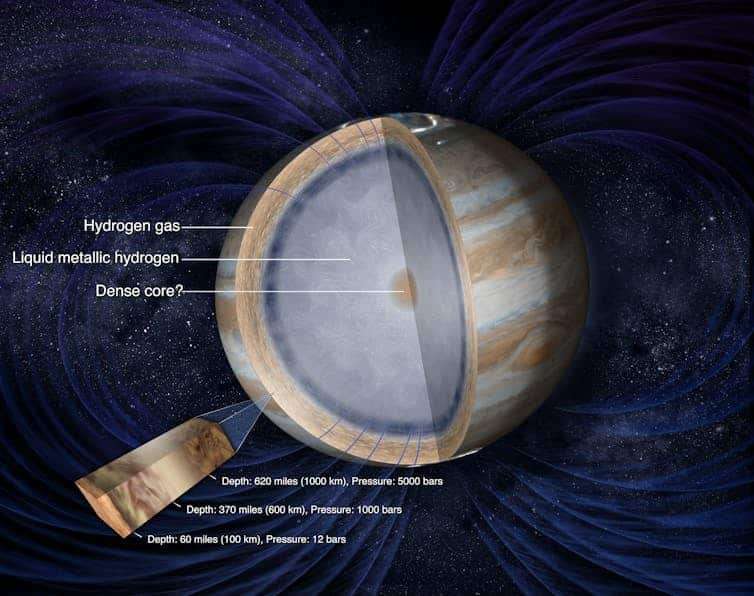
Diving deeper into Jupiter’s layers, the atmospheric pressure rises sharply, forging conditions that far exceed anything on Earth. Instead of a solid crust, Jupiter’s layers shift through phases of exotic matter driven by immense pressure and heat.
An Ocean Unlike Any Other
On Earth, descending through the atmosphere eventually leads to solid ground or oceans. Jupiter, however, presents a vastly different scenario. As one moves down into Jupiter’s dense gaseous envelope, pressure intensifies so greatly it would be fatal to humans.
At roughly 1,000 miles (1,609.34 km) beneath the cloud tops, the hydrogen gas transitions into a thick, dense liquid. This layer can be considered Jupiter’s "ocean," except it is composed entirely of liquid hydrogen rather than water, forming a planetary-scale liquid zone unlike anything on Earth.
Proceeding even deeper, near 20,000 miles (32,186.88 km) down, hydrogen takes on a remarkable form known as liquid metallic hydrogen, a conductive state of the element that scientists have only recently created under laboratory conditions. This transformation happens gradually across layers, with no defined surface separating the gas, liquid, and metallic hydrogen phases.
The Mysterious Core and Extreme Conditions
Approaching Jupiter’s center, there’s no solid core as found on Earth. Researchers hypothesize that the innermost region consists of a dense, scorching blend of rock, metallic hydrogen, and possibly other exotic materials in a hot and partially molten state.
The pressure near the core is staggering—about 100 million times Earth’s atmospheric pressure—while temperatures can soar to an intense 35,000 degrees Fahrenheit (19,426.67 °C), exceeding the sun’s surface temperature. Any probe venturing this deep would be destroyed instantly by the crushing environment.
This extreme environment may hold vital clues about Jupiter’s origin but remains inaccessible for direct exploration due to its hostile nature.
Jupiter’s Role as Solar System Guardian
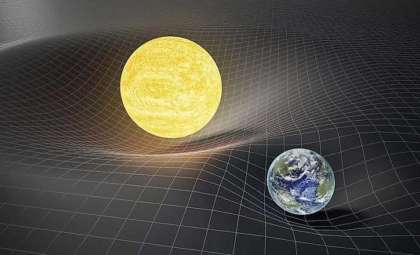
Despite its inhospitable nature, Jupiter plays a fundamental role in maintaining stability in our cosmic neighborhood. Its strong gravitational field deflects or captures numerous asteroids and comets that might otherwise pose a threat to the inner planets, including Earth. This protective effect has likely prevented multiple catastrophic collisions that could endanger life here.
In this way, Jupiter’s presence has been a shield, indirectly contributing to the conditions that allow life to thrive on Earth.
Europa: A Potential Habitat in Jupiter’s Orbit
While Jupiter’s environment is extreme, its moon Europa offers a potential sanctuary for life. Beneath a thick icy crust lies an enormous underground ocean, rich in water, that could support forms of life ranging from microbes to more complex organisms.
NASA’s Europa Clipper, launched in October 2024, aims to explore this moon closely, examining its icy surface and probing for signs of life below. Due to the vast distance, the spacecraft is expected to arrive at Europa around 2030. Discoveries made by this mission might revolutionize our understanding of life beyond Earth.
- Categories:
- Astronomy ,
- Space








0 comments
Sign in to Comment