

On September 4, 2024, the collaborative mission between the European Space Agency (ESA) and Japan Aerospace Exploration Agency (JAXA), BepiColombo, accomplished its fourth gravity assist flyby of Mercury.
Executing Precision Flybys to Harness Mercury’s Gravitational Pull
This fourth Mercury encounter was a pivotal step in BepiColombo’s intricate voyage to Mercury’s orbit. The spacecraft leverages a series of gravity assist flybys, using Mercury’s gravity to decelerate relative to the Sun and adjust its trajectory. Frank Budnik, Flight Dynamics Manager for BepiColombo, explained, “The primary purpose was to decrease the spacecraft’s velocity relative to the Sun, aligning BepiColombo’s solar orbital period to Mercury’s 88-day cycle.” Such precise gravitational maneuvers are essential for synchronizing BepiColombo’s path with Mercury’s orbit, demanding meticulous navigation based on detailed orbital mechanics.
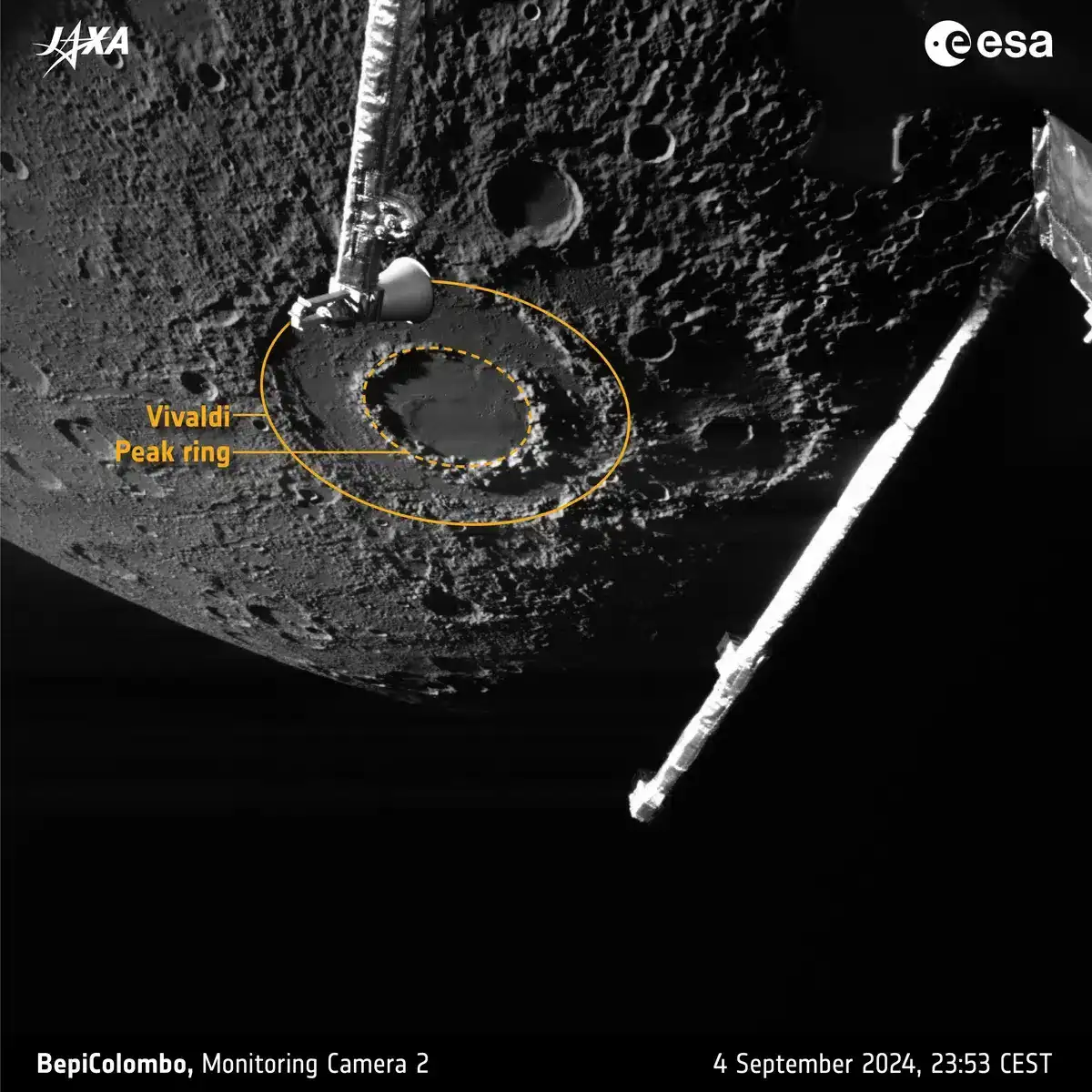
Daringly passing just 165 kilometers above Mercury’s surface, the spacecraft traveled over the planet’s nightside to avoid intense solar heating. This close approach not only achieved key orbital adjustments but also allowed BepiColombo’s three monitoring cameras to capture remarkable photos of Mercury’s terrain gradually illuminated by sunlight. The images revealed fresh insights into the planet’s cratered landscape, showcasing features never before viewed at such proximity.

New Visual Perspectives on Mercury’s Cratered Terrain
Though not originally intended for scientific imaging, BepiColombo’s monitoring cameras delivered some of the sharpest images to date of Mercury’s southern hemisphere. As the spacecraft journeyed from darkness into daylight, it captured vivid depictions of Mercury’s pockmarked surface. Noteworthy is the Vivaldi crater, a 210-kilometer-wide basin named for the celebrated Italian composer. Illuminated by the low sun angle, the crater’s central peaks and surrounding rings were accentuated by shadow, revealing intricate geological structures.
Another key discovery was the Stoddart crater, a 155-kilometer feature named after New Zealand artist Margaret Olrog Stoddart. This well-preserved crater captivates scientists due to its distinct formation characteristics. David Rothery, a planetary scientist from the BepiColombo imaging team, remarked, “Mercury’s peak ring basins present many unanswered questions about their origins.” Evidence of volcanic processes, including lava-filled floors, speaks to the complex geological narrative of this crater and Mercury itself.

Advancing Toward BepiColombo’s Science Mission
The photos taken during this flyby are a preview of the mission’s capabilities once it enters its orbital phase at Mercury in 2026. While the monitoring cameras provide monochrome visuals, the dedicated main science camera will capture high-resolution, full-color images from orbit. Additionally, BepiColombo carries a comprehensive suite of scientific instruments poised to investigate Mercury’s magnetic properties, surface geology, and its broader evolutionary story.
The full scientific mission will commence in 2027, following the deployment of two orbiters—ESA’s Mercury Planetary Orbiter and JAXA’s Mercury Magnetospheric Orbiter. Together, these spacecraft will analyze the planet’s interior, surface, and magnetic environment. As Jack Wright, ESA Research Fellow and planetary scientist, stated, “The flyby images and data offer just a glimpse of what lies ahead. BepiColombo’s orbital science will unravel Mercury’s secrets, from its beginnings to its extreme conditions.”
Mission Outlook: Upcoming Flybys and Goals
BepiColombo’s expedition to Mercury is ongoing, with two more gravity assist flybys scheduled for December 2024 and January 2025. These maneuvers will further refine its trajectory, ensuring successful orbital insertion planned for November 2026.
As one of the least explored planets in the inner solar system due to its proximity to the Sun and travel challenges, Mercury has only been visited twice before by NASA’s Mariner 10 and Messenger missions. BepiColombo offers an unprecedented chance to expand our understanding of this enigmatic planet, addressing key questions about its origin, magnetic environment, and role in solar system development.
Every flyby enriches the mission with fresh imagery and data, steadily advancing toward comprehensive scientific exploration once BepiColombo settles into its Mercury orbit.
- Categories:
- Astronomy ,
- News ,
- Science ,
- Space










0 comments
Sign in to Comment