
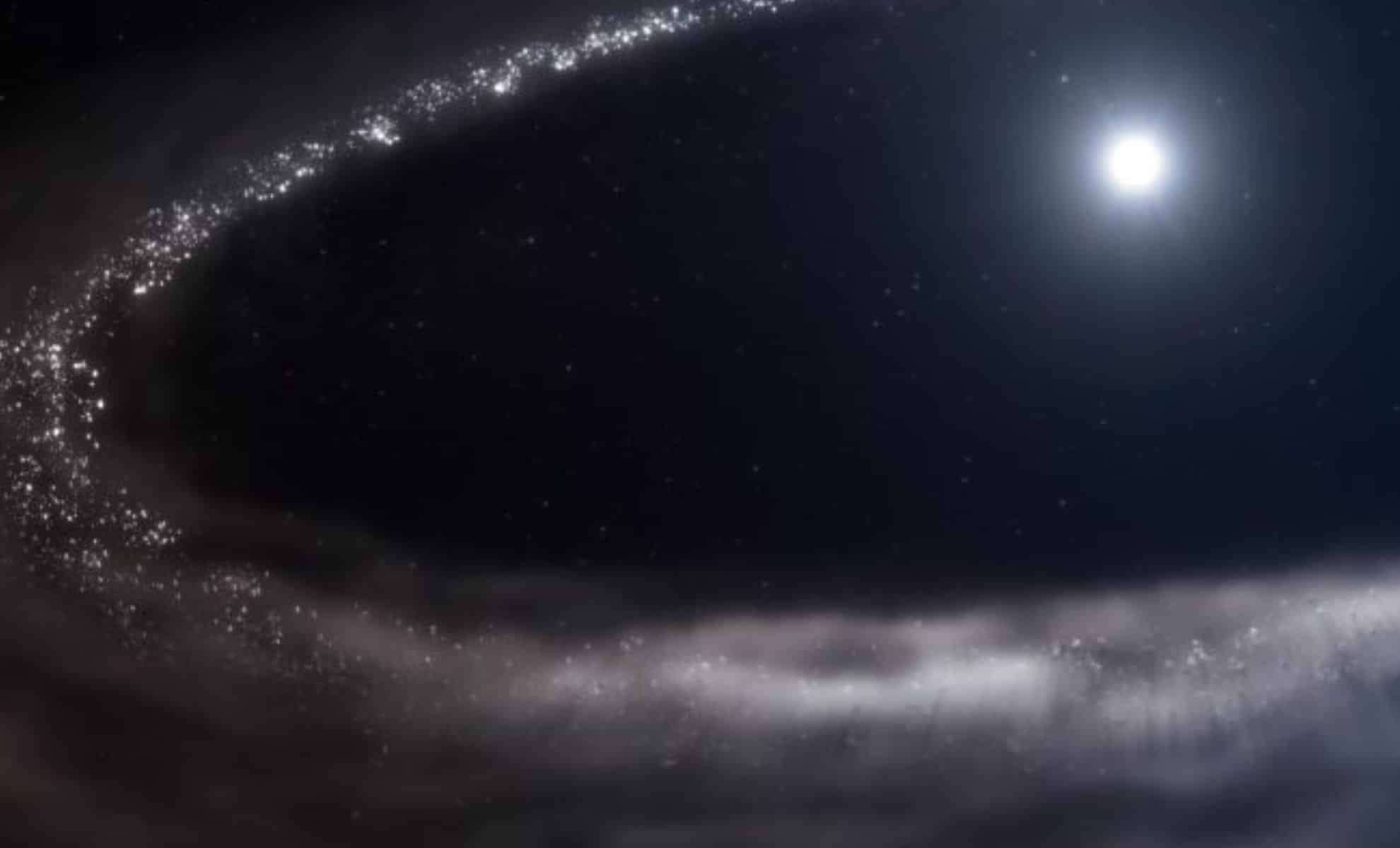
Utilizing the advanced capabilities of the James Webb Space Telescope (JWST), astronomers have identified water ice within a dusty debris ring orbiting a distant star strikingly similar to our Sun. This finding represents both a technological milestone and an important advance in exploring how vital compounds for life, such as water, are spread throughout other planetary systems.
A Young Star’s Disk Resembles Early Solar System
The stellar object, HD 181327, positioned about 155 light-years from Earth in the constellation Telescopium, is a youthful star with an age of roughly 23 million years. It offers a window into what our own solar system might have been like during its formative period. Surrounding this star is a broad debris disk filled with numerous icy bodies—the fundamental building blocks necessary for planet formation.
Christine Chen, a research scientist at Johns Hopkins University, describes this as an “active environment” where ongoing collisions among these icy objects continuously create tiny particles of dusty water ice. These particles fall within the ideal size range for Webb’s sensors to detect, allowing astronomers to produce a detailed compositional map of the disk.

Implications for Water and Life Beyond Earth
The presence of frozen water in this system carries profound implications for understanding how life-essential ingredients might be transported across space. Scientists have theorized that ice could be widespread in the frigid outer regions of planetary systems. This is reinforced by observations within our own system, where icy moons such as Europa, Ganymede, and Enceladus harbor significant reservoirs of frozen and even liquid water hidden beneath their surfaces.
Published on May 15 in the journal Nature, the results from JWST support the theory that icy “dirty snowballs” in these outer zones could play a vital role in delivering water to newly forming rocky planets via high-speed impacts, a process thought to have contributed to seeding Earth’s water supply in its distant past.
An Icy Formation Analogous to Our Kuiper Belt
JWST’s infrared observations uncover that the majority of water ice is confined to the star’s outer disk regions, where cold temperatures allow the ice to endure. In closer proximity to HD 181327, ice becomes scarce likely because of ultraviolet radiation that causes sublimation or because water is locked inside larger planetesimals that remain undetectable by Webb’s instruments.
The debris disk shows remarkable resemblance to the Kuiper Belt — the ring of icy objects beyond Neptune in our solar system. Chen highlights the importance of such comparative studies, noting that the observations align closely with JWST’s imaging of Kuiper Belt entities in our own solar system, shedding light on the mechanisms of planetary genesis.
Early Stages of Planet Formation Revealed
HD 181327, still in the infancy of its planetary development at just a few million years old, exhibits a debris environment rich with clues regarding the distribution of water and other critical materials. The constant collisions and icy fragments within the disk create conditions suitable for gradual planet formation and the potential introduction of life-sustaining substances.
JWST’s unparalleled ability to discern such intricate details in far-away star systems paves the way for ground-breaking research in astrobiology and planetary science. Mapping the movement and whereabouts of water throughout the universe takes a significant leap forward with the telescope’s examination of HD 181327, marking a key moment in humanity’s quest to comprehend life’s origin beyond Earth. JWST's observations thus represent not only a technological feat but a pivotal advance in our understanding of planetary and cosmic evolution.
- Categories:
- Space







0 comments
Sign in to Comment