
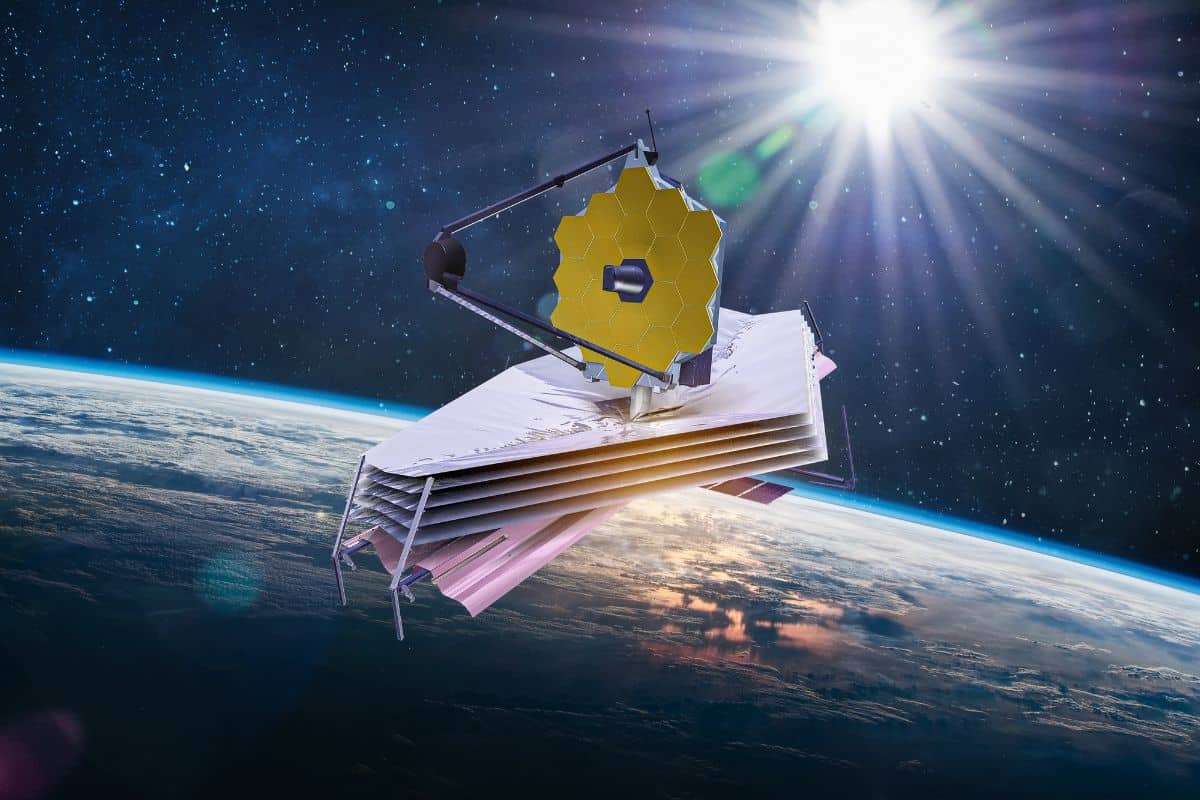
The James Webb Space Telescope (JWST) has delivered an extraordinary view of the environment encircling a nascent star, identifying minuscule dust particles that hold the potential to evolve into planets.
The celestial formation, called Herbig Haro 30 (HH 30), exemplifies how young stars influence their surroundings and how planet development can arise from cosmic dust and gas.
Birth of a Star
Situated within the Taurus constellation, HH 30 is an extremely young star, merely about half a million years old. At this early phase, it remains obscured by a thick disk of gas and dust, with only indirect signs, such as intense energy bursts, being visible. The star unleashes powerful jets and stellar winds that collide with nearby matter, generating shockwaves that heat and illuminate the surrounding material.

These phenomena, vividly captured by the JWST, provide crucial data for scientists investigating how planets are born. The star’s protoplanetary disk—a rotating ring of dust and debris—plays a vital role in planet formation. As the dust consolidates into a thin layer, it undergoes essential changes over time.
Planet-Building Cosmic Dust
As stated by the European Space Agency (ESA), the dust particles found in HH 30 are remarkably tiny, measuring just about one micron in diameter, comparable in size to bacteria. Despite their microscopic scale, these grains are fundamental in the creation of planets.
Within the densest portions of this disk, the particles begin to cohere, gradually forming larger clumps that grow into pebbles and eventually serve as foundations for planets. This gradual accumulation, spanning millions of years, can result in complete planets similar to those in our solar system.
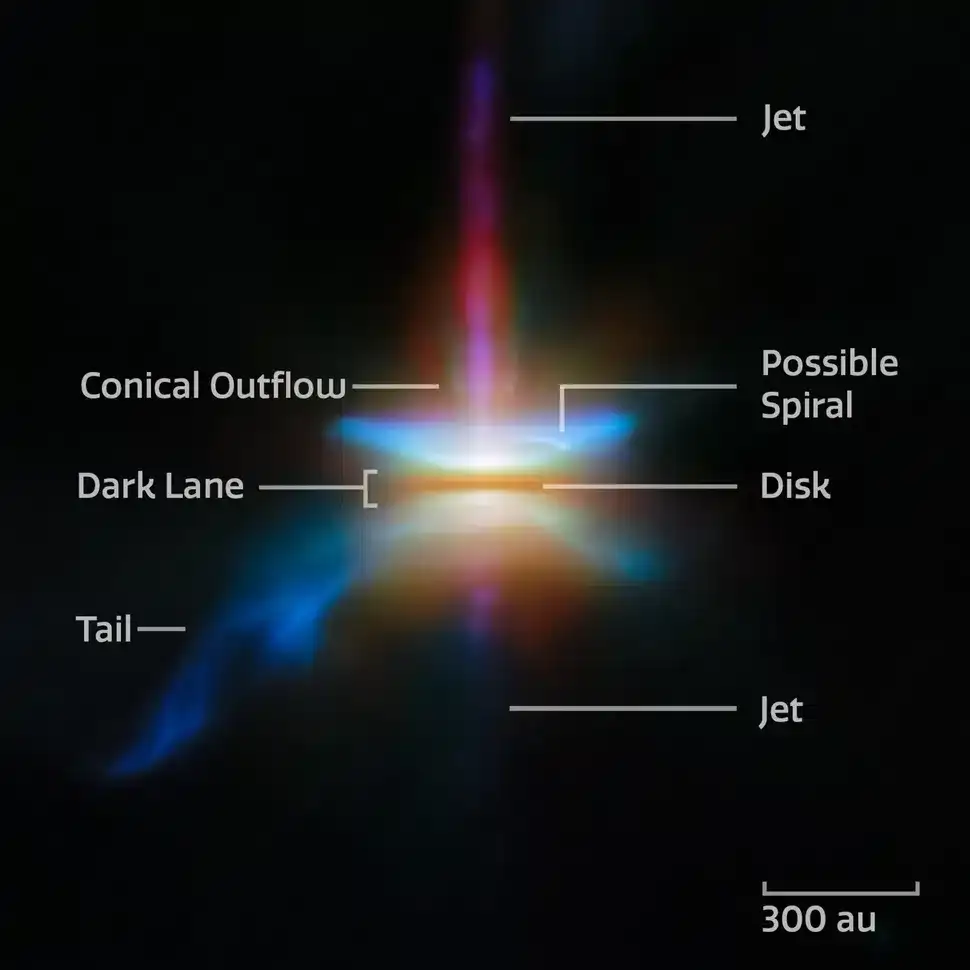
Jet Streams and Concealed Features
One remarkable characteristic of HH 30 is a rapid jet shooting out at a right angle from the disk’s core. This jet is encompassed by a broader, cone-shaped outflow molded by the star’s formidable forces.
By integrating JWST data with insights from the ALMA (Atacama Large Millimeter Array) and the Hubble Space Telescope, a team led by Ryo Tazaki at the University of Tokyo has identified additional concealed formations within the disk. Notably, they detected a subtle spiral pattern that resembles those in other young planetary environments.
The origin of this spiral feature is still unknown. Researchers propose it may result from a wobbling jet that influences the dust arrangement, producing a dynamically shifting pattern.
Another theory is that an unseen companion star within the disk could be exerting gravitational forces that shape the dust into this spiral form.
A Complex System Driving Planet Creation
HH 30 presents a highly energetic theater where microscopic dust, forceful jets, and stellar interactions collaboratively contribute to planet formation. With the advanced infrared sensing capabilities of JWST, astronomers can examine how light interacts with distinct disk layers, offering fresh perspectives on dust movement and the early stages of planet genesis.
- Categories:
- Space








0 comments
Sign in to Comment