
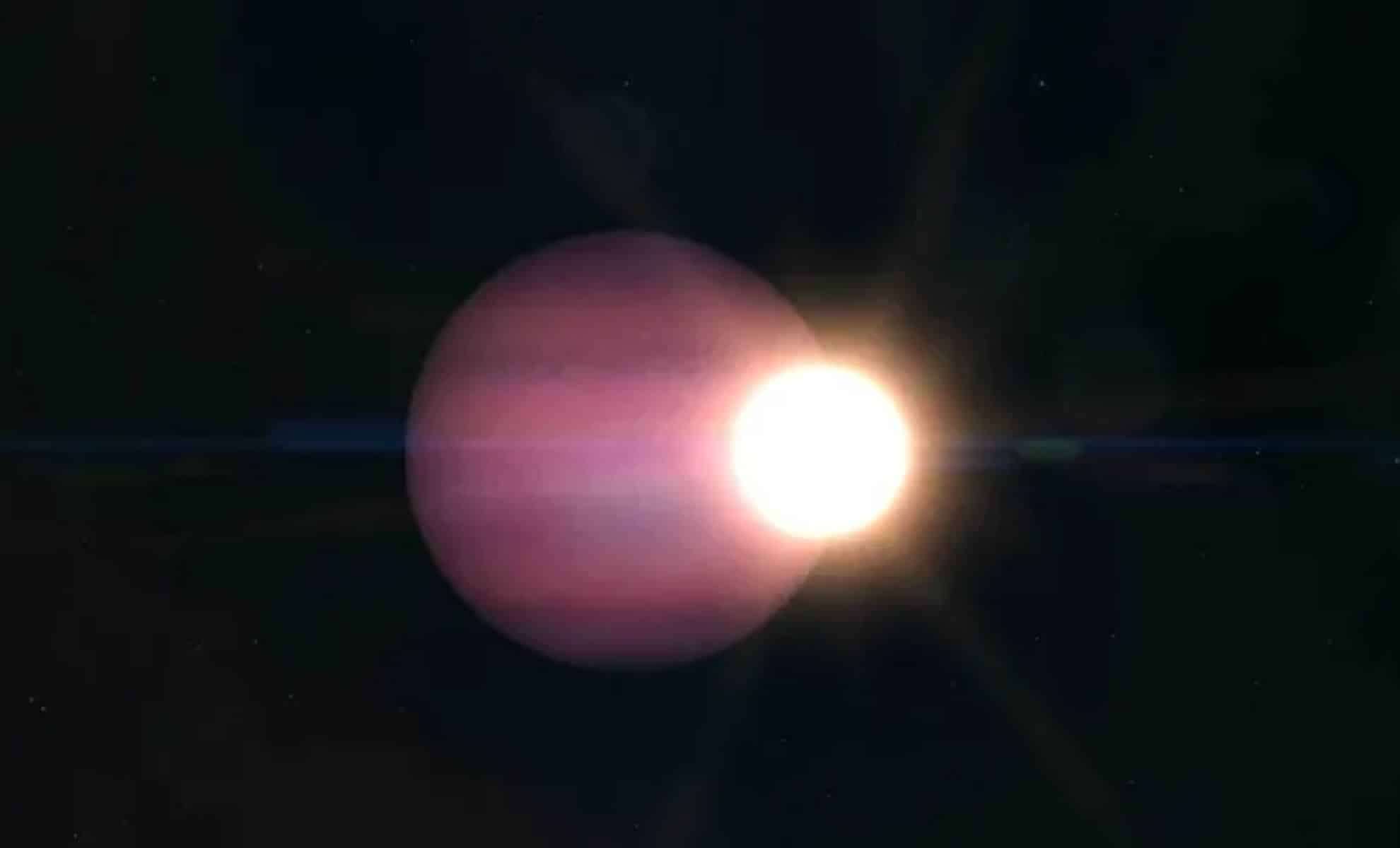
Using the powerful James Webb Space Telescope (JWST), scientists have uncovered a truly remarkable exoplanet discovery that challenges current views on planetary system formations.
The exoplanet WD 1856+534 b, situated roughly 80 light-years away from Earth, has been recognized as the coldest planet observed beyond our solar system.
First identified in 2020, this extraordinary world orbits a white dwarf—the compact core leftover after a star has burnt through its nuclear fuel and collapsed.

An Unusually Cold Planet in a Hostile Orbit
WD 1856+534 b stands out because it occupies what astronomers call the ‘forbidden zone’ around its dead star.
Typically, stars become red giants and engulf nearby planets during their late evolutionary phases, making such orbits unlikely for survival.
Yet, this gas giant planet has defied those odds, enduring the tumultuous transformation of its host star and settling into an orbit previously thought unreachable.
A recent preprint on arXiv highlights how this planet’s close orbit provides evidence that planets can migrate into regions once considered uninhabitable.
The Coldest Exoplanet Recorded
Measured at a frigid -125°F (-87°C), WD 1856+534 b sets a new record as the chilliest exoplanet detected to date.
It outclasses the previous coldest, Epsilon Indi Ab, which maintains a more temperate average temperature near 35°F (2°C).
The JWST’s infrared instruments enabled precise measurements of the planet’s thermal emission, mass, and reflected light, confirming its planetary nature and revealing details about its atmosphere.
Implications for Planetary Movement and Survival
The existence of WD 1856+534 b raises important questions about planetary evolution, particularly regarding how planets can endure or relocate following the death of their stars.
While many planets are consumed during their star’s expansion into a red giant, this discovery suggests that planetary migration mechanisms may be more influential than previously recognized.
Scientists consider that such planets could shift inward after the host star’s demise, occupying orbits potentially more conducive to life or unique environmental conditions.
Advancing the Frontier of Exoplanet Exploration
The discoveries made with the JWST mark a new chapter in exoplanetary science.
Continued observations aim to identify even colder worlds, possibly with temperatures plunging to -324°F (-198°C).
These findings will broaden knowledge about gas giants and their atmospheres, offering deeper insights into planetary formation and lifecycle dynamics.
An upcoming observation session of the WD 1856+534 b system is scheduled for July, expected to shed further light on the evolution of planets in extreme environments.
What This Planet Reveals About Our Solar System’s Destiny
The identification of WD 1856+534 b offers scientists a rare perspective to examine our own solar neighborhood within the wider galaxy.
Tracking planetary behavior around stars at the end of their life cycles helps refine models predicting the future of our planetary system.
Through continued exoplanet studies, new clues emerge about how Earth and its neighbors might evolve as the Sun eventually expands into a red giant and finally stabilizes as a white dwarf.
“That’s a big step forward,” remarked University of Michigan astronomer Mary Anne Limbach. “It’s a rare opportunity to place our own solar system in a broader galactic context.”
Each breakthrough underscores the immense diversity and complexity that define our universe.
- Categories:
- Space










0 comments
Sign in to Comment