

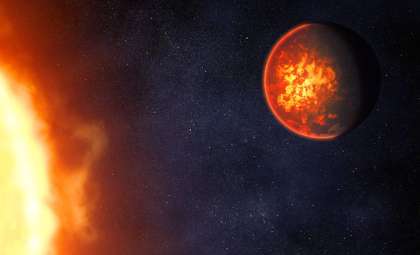
The James Webb Space Telescope (JWST) has achieved a remarkable feat by uncovering an atmosphere enveloping the rocky exoplanet 55 Cancri e. This discovery represents the first confirmed detection of an atmosphere around a terrestrial planet beyond our solar system, opening new pathways for exoplanetary science.
A Pioneering Achievement in Astronomy
JWST’s identification of an atmospheric layer around 55 Cancri e is a transformative event in astronomy. This super-Earth, situated roughly 41 light-years away in the Cancer constellation, experiences extraordinary environmental extremes. Orbiting exceptionally close to its star, the planet’s surface remains so hot that a molten lava ocean is sustained.
The floor is lava! 🔥
Add Cosmo Herald as a Preferred SourceWebb may have detected atmospheric gasses around molten 55 Cancri e, 41 light years from Earth. It’s the best evidence to date for a rocky planet with an atmosphere outside our solar system! https://t.co/8pl9VAIS1M pic.twitter.com/BYmC3K5reC
— NASA Webb Telescope (@NASAWebb) May 8, 2024

Probing the Enigmatic Atmosphere of 55 Cancri e
Researchers analyzing data from JWST have detected molecules such as carbon monoxide and carbon dioxide within the atmosphere of 55 Cancri e. These gases hint that despite the planet’s intensely hot environment, it maintains a substantial atmosphere capable of affecting thermal regulation and offering clues about its geological and atmospheric processes.
Significance for Rocky Planet Research
This finding offers crucial insights into the development of rocky worlds, including familiar planets like Earth, Venus, and Mars. Studying the atmospheric composition and dynamics of 55 Cancri e may enhance our understanding of how volatile geological activity and atmospheric conditions influence planetary evolution and potential habitability.
This landmark discovery advances our grasp of planetary formation and atmosphere development, paving the way for future examinations of exoplanets with similar characteristics. As JWST continues its cosmic survey, it promises to reshape our comprehension of the universe's diverse planetary environments.
- Categories:
- Astronomy ,
- Science ,
- Space ,
- Physics






0 comments
Sign in to Comment