
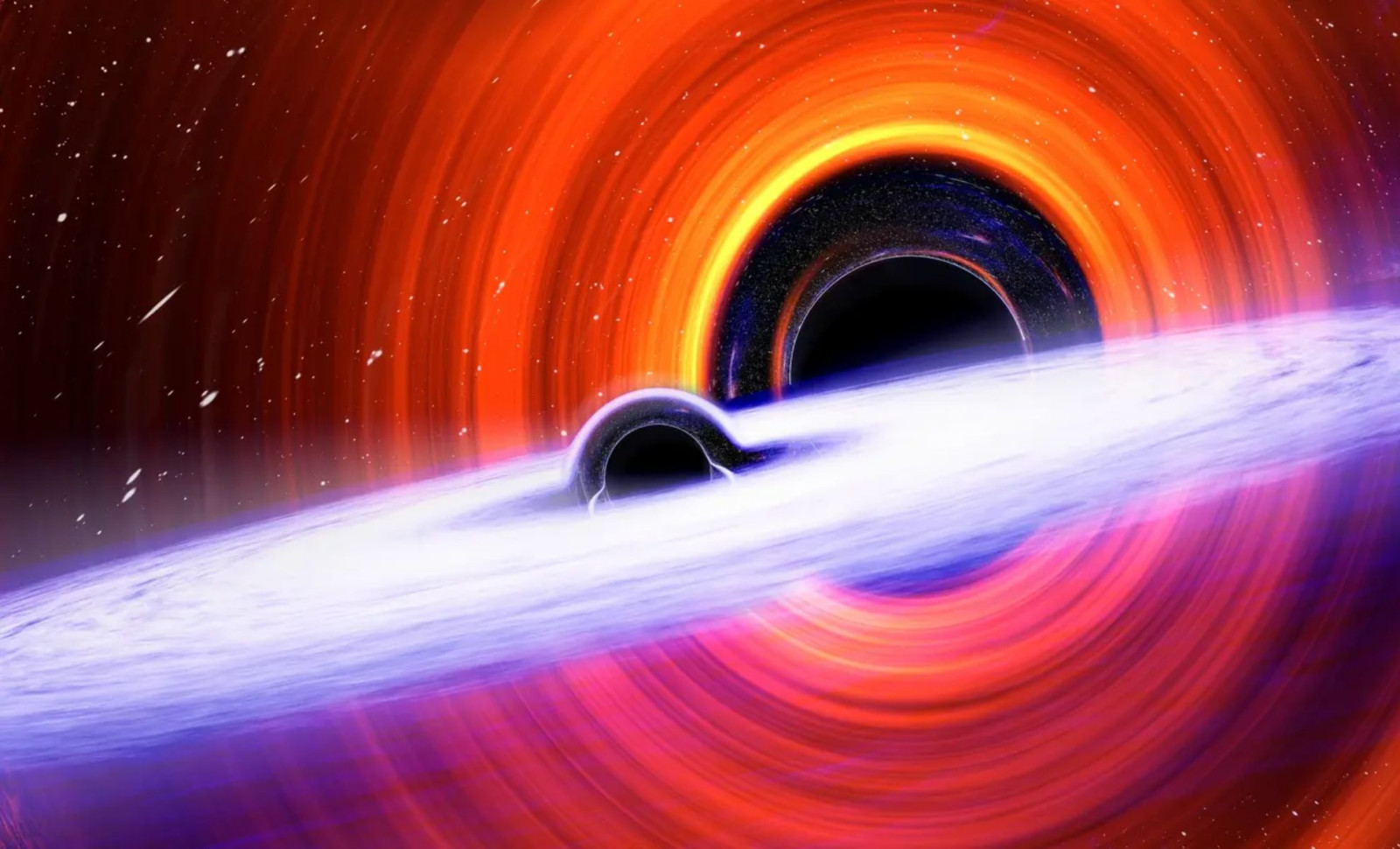
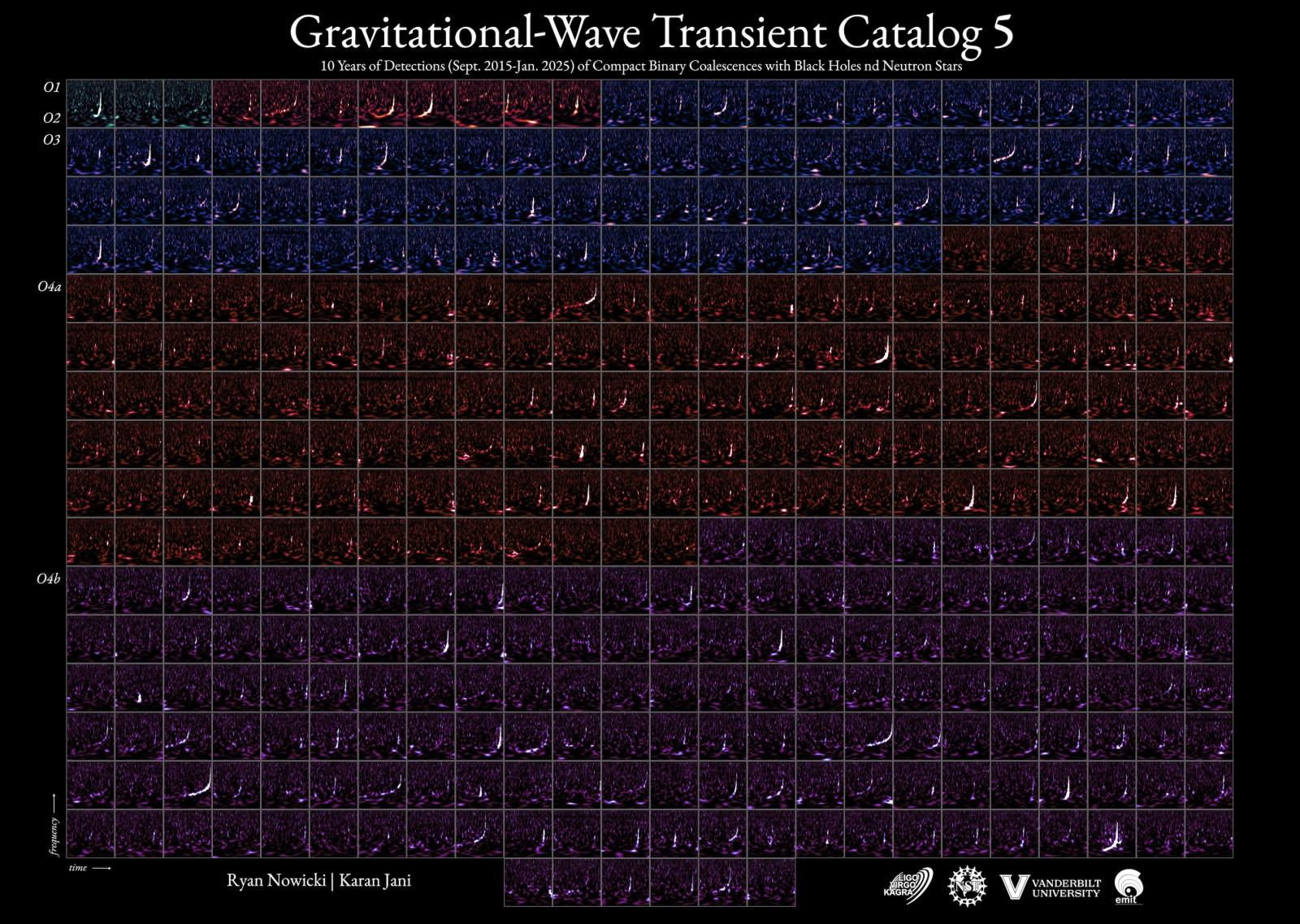
Astronomers have unveiled the most extensive gravitational wave compilation yet, increasing the tally of verified events to 390. This new collection includes 161 newly identified black hole mergers and features several groundbreaking findings that enhance our understanding of black hole origins and their development.
Since the first direct observation of gravitational waves a decade ago, the landscape of this scientific field has undergone a significant transformation. Researchers now have access to hundreds of signals, enabling more comprehensive comparisons, thanks to the newly published Gravitational Wave Transient Catalogue-5 (GWTC-5).
The catalog aggregates data gathered from April 2024 through January 2025 by the LIGO facilities in the US, Virgo in Italy, and KAGRA in Japan. These observatories collectively make up the global LIGO-Virgo-KAGRA (LVK) network, which continuously expands the database of detected gravitational wave phenomena.

An Abundance of Breakthrough Findings
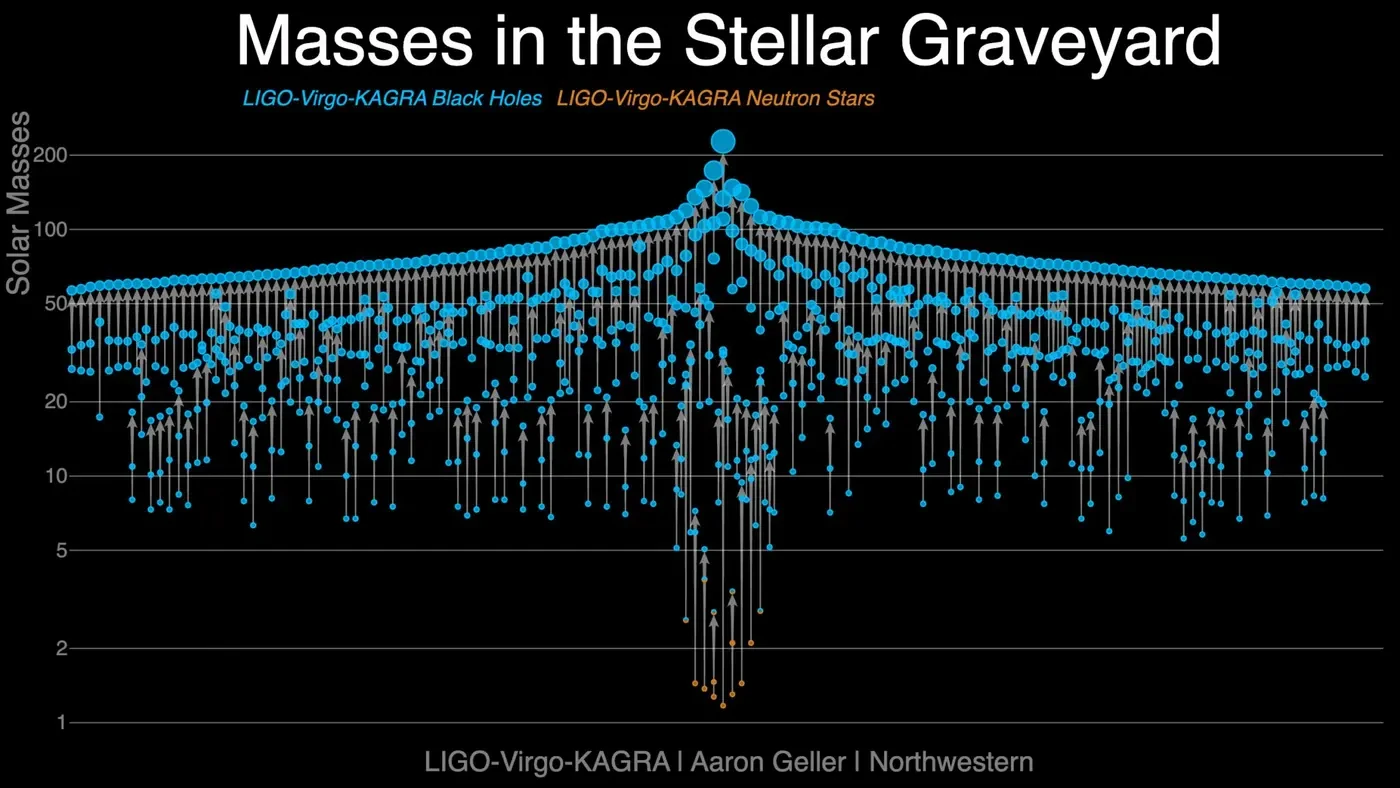
According to the University of Glasgow, GWTC-5 contributes 161 fresh gravitational wave detections, pushing the confirmed total to 390. Beyond just numbers, this release offers new proof of second-generation black holes, the most precise sky localization achieved for a gravitational wave to date, and the inaugural observation of three vibrational modes on a black hole.
The University of Glasgow has been integral to gravitational wave research since the 1970s. Its scientists contributed to developing the highly sensitive mirror suspension systems employed by NSF LIGO, crucial for detecting faint distortions in spacetime. Since the initial detection in 2015, the team has improved detector capabilities and enhanced signal analysis methods.
Dr. Daniel Williams, a research fellow at the Institute for Gravitational Research and co-chair of the LSC’s Compact Binary Science Working Group, emphasized the significance of this collaborative endeavor.
“Just ten years ago we made the first detection of gravitational waves from one of these events, and it’s a real testament to the work of hundreds of scientists around the world that we’re now detecting and analyzing hundreds of them.”
Remarkable Events Providing New Clues
Among the newly documented occurrences, some have broken records. The event labeled GW240615, detected on June 15, 2024, by LIGO’s twin detectors alongside Virgo, achieved the most accurate localization for a gravitational wave source yet. This collision involved black holes approximately 26 and 30 solar masses, pinpointed within a minimal sky area of just six square degrees, despite originating over three billion light-years away.
Another standout event, GW250114, holds the record for the strongest gravitational wave signal recorded so far, boasting a signal-to-noise ratio of 76.9. This event arose from the merger of black holes estimated to be 32 and 34 times the Sun’s mass, located more than a billion light-years distant.
Thanks to the exceptional quality of this signal, scientists conducted the most precise general relativity test using gravitational waves to date, confirming Stephen Hawking‘s black hole area theorem. Dr. John Veitch stated that their results demonstrated the total event horizon surface area increased post-merger, as predicted by Hawking.
Expanding the Dataset Uncovers New Trends
With such a large number of events cataloged, scientists are now examining black holes collectively rather than individually. One accompanying study analyzed 267 gravitational-wave events, including 104 fresh detections, investigating relationships between black hole masses, spins, and distances. This analysis revealed that black holes across various mass ranges tend to exhibit distinct spin characteristics, implying multiple formation scenarios.
The research also highlighted two mergers from late 2024, GW241011 and GW241110, whose spin data imply that the larger black holes involved might be products of earlier mergers rather than direct stellar collapse.
The enhanced catalog is also aiding cosmological studies by improving measurements of the Universe's expansion. Postgraduate researcher Alex Papadopoulos commented:
“The rate of this expansion is described by a value called the Hubble constant. Gravitational waves allow us to measure this by estimating how far away merging objects are, either directly from the signal itself or by identifying the galaxy where the merger took place.”
He added that Virgo’s resumed participation boosted the precision of event localization, and that software innovations at the University of Glasgow accelerated data processing by over 1,000 times, enabling more extensive scenario testing.
- Categories:
- Astronomy




0 comments
Sign in to Comment