
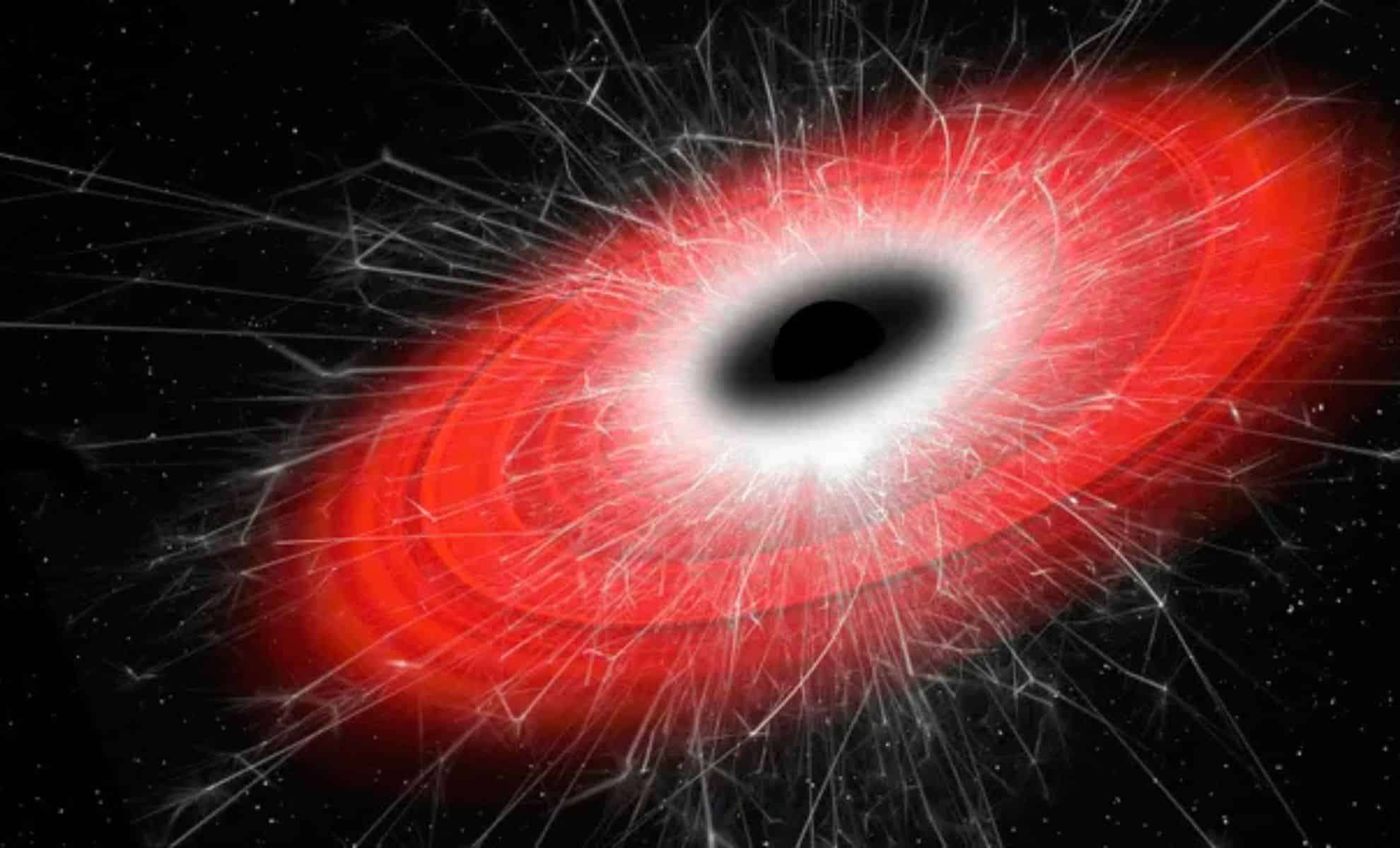
In February 2025, an underwater observatory detected an ultra-high-energy neutrino that might offer the first direct proof supporting one of Stephen Hawking’s landmark black hole hypotheses. The KM3NeT collaboration, a deep-sea array of detectors anchored off the shores of France, Italy, and Greece, observed a neutrino with an energy of 100 PeV—an extraordinary particle that has left scientists eager to uncover its origins.
A recent paper, published on arXiv in February 2025, posits that this neutrino could have been emitted by a primordial black hole explosion, an idea first proposed by Hawking nearly 50 years ago. Confirmation of this hypothesis would transform our comprehension of black hole physics, dark matter, and the early cosmos.
The study, currently undergoing peer review, argues that the neutrino is likely a byproduct of Hawking radiation—the gradual energy loss process predicted for black holes. This finding supports the notion that small black holes born shortly after the Big Bang might still linger today, eventually releasing bursts of high-energy particles as they decay.

Hawking Radiation and the Enigma of Primordial Black Holes
During the 1970s, Stephen Hawking introduced the revolutionary theory that black holes emit subtle energy emissions caused by quantum phenomena at their event horizons. Over vast timescales, this radiation causes black holes to diminish and disappear. Despite the theory’s significance, no definitive observational evidence had been found—until now.
The neutrino pinpointed by KM3NeT far surpasses the energy levels created by human-made particle colliders, prompting the question: what astrophysical event could generate such an immensely powerful particle?
The latest research proposes a primordial black hole source—tiny black holes theorized to form during the universe’s tumultuous start. Much smaller than stellar-collapse black holes, these primordial varieties would have gradually contracted until detonating in a burst of radiation and energetic particles—precisely the scenario that could produce the observed neutrino.
Yet, a challenge remains: a primordial black hole of roughly 10,000 kilograms (about 22,000 pounds), comparable to the mass of two elephants, would theoretically not survive all the way from the Big Bang. The study introduces an intriguing idea involving a quantum effect known as “memory burden,” which may slow down evaporation processes, enabling these black holes to last billions of years before their explosive end.
Primordial Black Holes as a Possible Source of Dark Matter?
Primordial black holes have been proposed as a leading candidate for dark matter—the unseen material accounting for about 85% of the universe’s mass. Should these relic black holes still exist and evaporate as modeled, scientists expect more detections of extremely energetic neutrinos in upcoming years.
The team’s estimates suggest that if primordial black holes represent dark matter, instruments like KM3NeT and the Antarctic IceCube detector should witness similar neutrino events roughly once every few years.
Another such detection in the near term could signify a profound advancement in astrophysics and cosmology by potentially confirming Hawking radiation, validating the presence of primordial black holes, and clarifying their role in cosmic history.
- Categories:
- News






0 comments
Sign in to Comment