
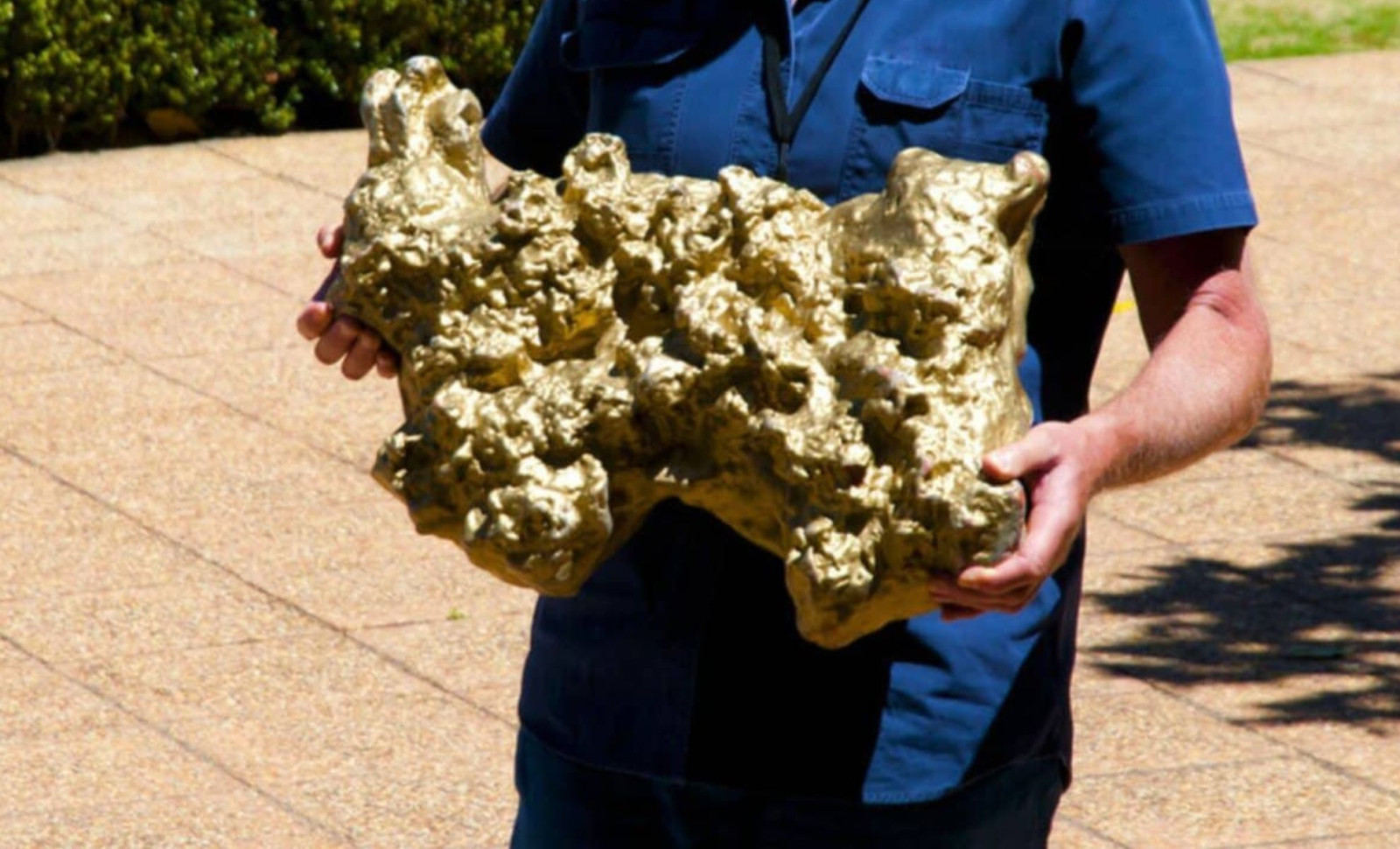
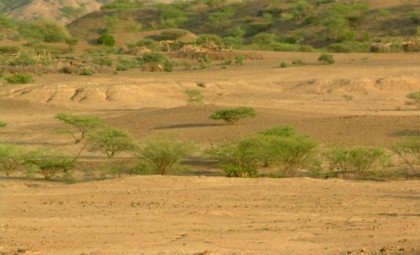
Back in May 2015, David Hole, a local from the quaint town of Maryborough in Victoria, was scanning the yellow clay of Maryborough Regional Park with his metal detector, located about two kilometers from town. A strong signal prompted him to dig, and he soon uncovered a heavy, reddish stone about the size of a shoebox, its surface uniquely pitted and textured in a way he hadn’t encountered before. Maryborough lies in the heart of Victoria’s historic gold rush region, famous for yielding countless gold nuggets over the decades.
Given the location, Hole naturally assumed his detector had led him to gold. He took the rock home, convinced a valuable nugget lay concealed within its rusty exterior. His determination grew as he noticed how unusually dense the rock was for its size, and the deeply sculpted surface only fueled his hopes.
Over months, Hole experimented with various tools—using saws, an angle grinder that couldn’t even scratch the stone, a drill, acid baths, and finally a sledgehammer that bounced off without causing damage, as detailed by ScienceAlert. This mysterious rock defied typical earthly properties and remained untouched on Hole’s property for years.

Melbourne Museum Unravels the Enigma
Driven by curiosity, Hole brought the rock to the Melbourne Museum in 2018, presenting it to their geology team. Such visits are common, with many hopefuls bringing in what they suspect to be meteorites. However, these often turn out to be ordinary terrestrial stones with unusual appearances, a category staff refer to as meteor-wrongs.
Experienced geologist Dermot Henry has examined rocks like these for 37 years, identifying only two genuine meteorites in that period. Remarkably, Hole’s rock became one of the rare authentic specimens.
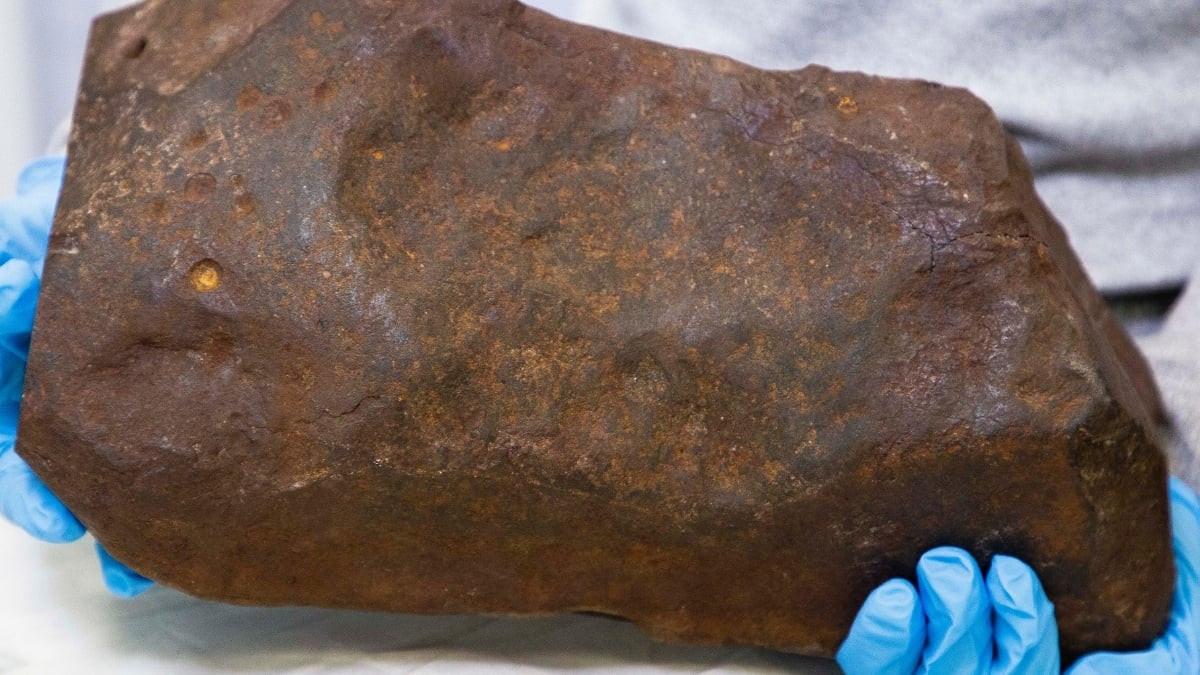
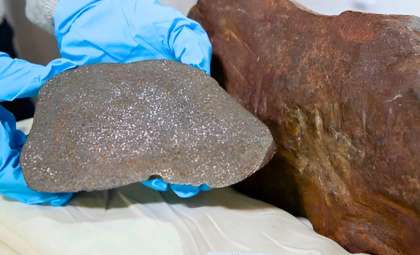
Henry and colleague Bill Birch quickly spotted the distinctive surface patterns known as regmaglypts, typical of meteorites heated and sculpted by Earth's atmosphere during entry. After detailed photography and molding, they weighed the meteorite, noting its impressive 17 kilograms weight and dimensions of 38.5 by 14.5 by 14.5 centimeters.
The rock’s unusually high density for its size hinted strongly at its extraterrestrial origin. This imbalance in weight and volume was key in shifting the geologists’ perspective far from mere gold prospecting.
Internal Structures and Metal Content Reveal Space Origin
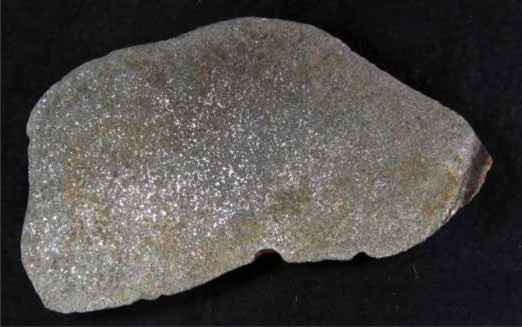
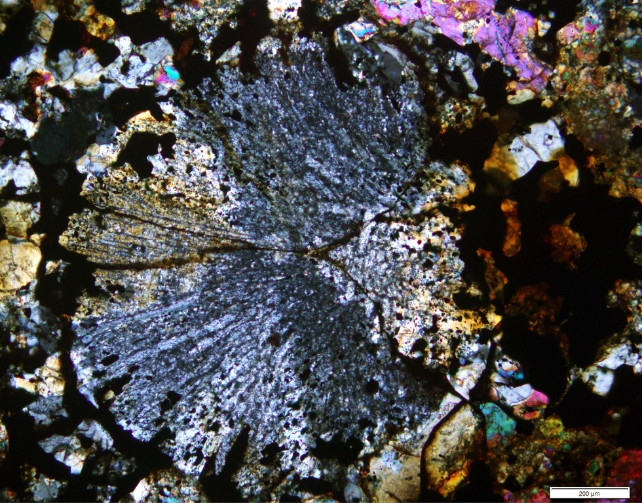
Using a diamond saw to cut through the extremely tough outer shell, the team revealed tiny spherical inclusions called chondrules. These features form when tiny dust particles in the early solar system were rapidly melted and cooled in microgravity. Chondrules are exclusive to meteorites and absent from Earth-formed rocks, confirming that the specimen was a chondrite, a primitive meteorite containing ancient solar system material.
Further lab tests identified it as an H5 ordinary chondrite. Here, ‘H’ denotes a high iron content between 25% and 30% by weight, and ‘5’ indicates the rock experienced considerable thermal metamorphism within its parent asteroid, causing partial recrystallization and mineral homogenization.
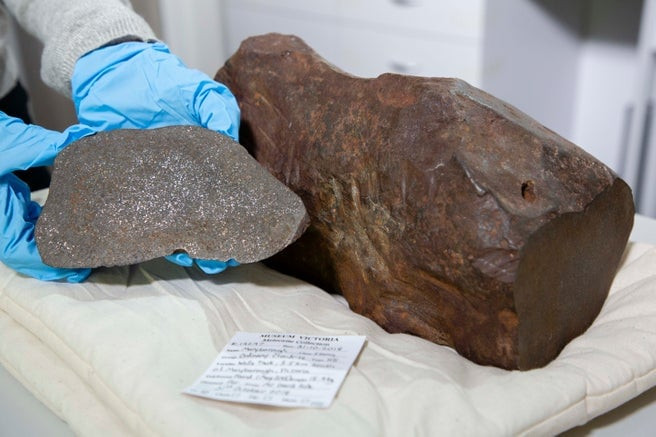
Analysis also detected minerals like kamacite and taenite, iron-nickel alloys typical in meteorites, plus traces of native copper. These metallic elements explain why Hole’s detector reacted so strongly to the rock years before.
This Space Rock Predates Earth
Dating back around 4.6 billion years, the Maryborough meteorite formed well before Earth coalesced, most probably originating from the asteroid belt between Mars and Jupiter. Asteroid collisions can send fragments coursing through space, eventually intersecting Earth’s path—likely the journey this meteorite undertook long before embedding itself in Victoria’s soil.
To pinpoint its arrival on Earth, scientists used Carbon-14 dating methods, carried out at the University of Arizona, measuring cosmogenic isotopes produced during space travel and decaying after landing. These tests estimated the rock landed on Earth between 100 and 1,000 years ago.
Historical sightings in local Maryborough records note multiple meteor appearances from 1889 through 1951. While definitive links between those sightings and the meteorite remain unproven, the timeline aligns well with the radiometric data, suggesting witnesses may have seen the meteor’s fall long before Hole discovered it.
More Extraordinary Than Regional Gold
Only the 17th meteorite ever documented in Victoria, the Maryborough specimen stands in stark contrast to the thousands of gold nuggets unearthed from Victoria’s Goldfields since the 19th century. This rarity underscores the find’s greater scientific value compared to common gold discoveries.
It joins a select group of meteorites recorded in Victoria, including the iron-nickel specimen found at Willow Grove in Gippsland in 1995, and the Ballarat meteorite discovered in the 1860s but only formally identified in 2002 as a fossil meteorite buried under basalt river gravels—currently exhibited in Melbourne Museum’s Dynamic Earth gallery.
According to Henry, “Meteorites are the most accessible form of space exploration,” offering a window into the solar system’s age, formation processes, and chemistry, deepening our understanding of Earth’s own origins.
Now part of Museums Victoria’s State Collection, alongside over 400 other specimens such as the notable Murchison meteorite, the Maryborough meteorite is on display at Melbourne Museum. It has been featured during public events like National Science Week, where Henry has shared insights about meteorites with visitors.
The meteorite continues to captivate visitors today, presenting the story of a space rock that withstood saws, grinders, acid, and hammers before revealing its secrets as a remnant from the dawn of the solar system.
- Categories:
- Science






0 comments
Sign in to Comment