
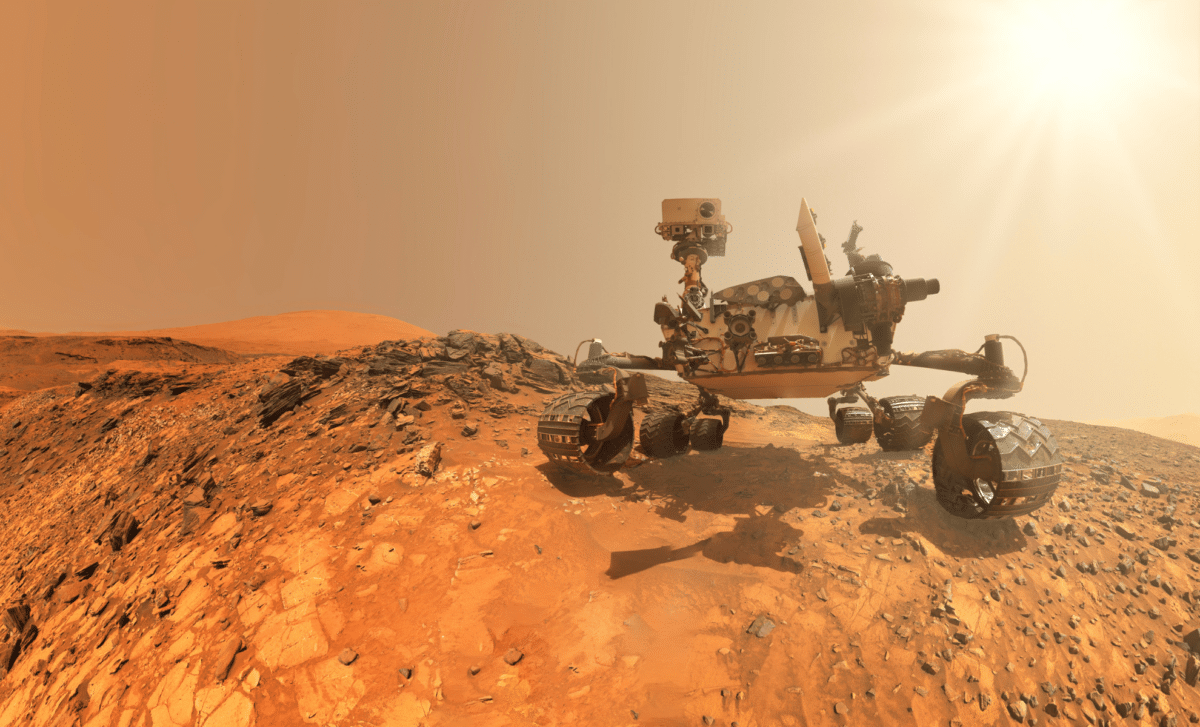
The Curiosity rover has uncovered a surprising geological find on Mars—pure elemental sulfur within a rock in a region where such a discovery was never anticipated. Announced by NASA, this breakthrough provides a unique chance to further explore the Red Planet’s intricate geological history and prompts new questions about the ancient Martian environment. What seemed to be an ordinary stone has turned into a milestone with potentially far-reaching scientific implications.
A Routine Drive Yields a Remarkable Find
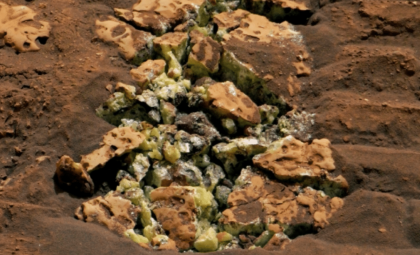
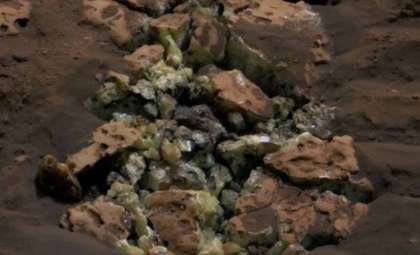
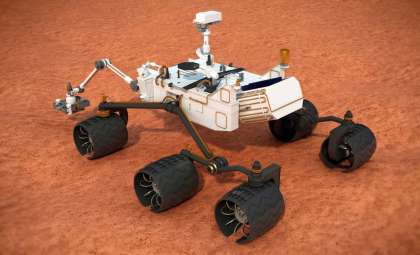
While traversing the lower slopes of Mount Sharp inside the Gale Crater, the rover accidentally cracked a rock under its wheel. Unexpectedly, this fracture revealed vibrant yellow crystals of elemental sulfur rather than the usual types of minerals found in this area.
This finding surprised scientists because elemental sulfur has not been encountered before in this geological context on Mars. Although sulfur-containing minerals like sulfates have often been detected by orbital and surface missions, pure sulfur forms only under distinct environmental scenarios. Its presence indicates previously unknown geological processes may have shaped this part of the planet.

Moreover, the nearby landscape is dotted with rocks resembling this sulfur-rich specimen, hinting that it may be part of a more extensive geological feature spanning this area of Gale Crater. Each additional rock the rover analyzes could help piece together a new chapter of Mars’ geological evolution that was not previously recognized.
As the mission advances, researchers aim to determine whether this sulfur deposit is a localized anomaly or evidence of widespread phenomena shaping the Martian surface.
The Significance of Elemental Sulfur’s Presence on Mars
While sulfur is abundant throughout the Solar System, its manifestations reveal much about environmental origins. On Mars, sulfur is generally found as sulfate minerals, which develop over long timescales from interactions involving volcanic activity and water.
Elemental sulfur, however, arises only under quite specific geochemical conditions, making its discovery within these fractured rocks particularly noteworthy. Scientists are now investigating which combination of volcanic events, groundwater chemistry, temperature variations, and atmospheric factors could have produced and preserved such deposits over eons.
This finding defies existing geological models, presenting a new scientific enigma. Instead of validating current theories, it challenges scientists to redefine our understanding of how this region of Mars formed and evolved. It exemplifies how Mars continues to surprise researchers despite decades of robotic exploration.
Additionally, the discovery underlines the critical role of in-situ surface missions, as many geological details remain hidden from orbiters and only become apparent through close-range robotic investigations.
Curiosity’s Role in Piecing Together Mars’ Environmental Timeline
NASA notes that this sulfur revelation adds another pivotal insight to Curiosity’s quest to reconstruct Mars’ environmental past. Since landing in Gale Crater in 2012, Curiosity has gathered evidence indicating that the area once featured lakes, flowing rivers, groundwater, and chemical settings that might have supported microbial life.
The rover’s advanced instruments enable detailed analysis of rock chemistry, mineralogy, sediment structure, and other factors, effectively reading Mars' ancient geological record layer by layer as it ascends Mount Sharp.
This newly identified sulfur-rich zone stands out as a critical target for study. It may contain clues about chemical processes previously unknown on Mars. By comparing these rocks to nearby formations, researchers aim to determine if these sulfur deposits resulted from isolated events or were part of larger geological phenomena.
- Categories:
- News




0 comments
Sign in to Comment