
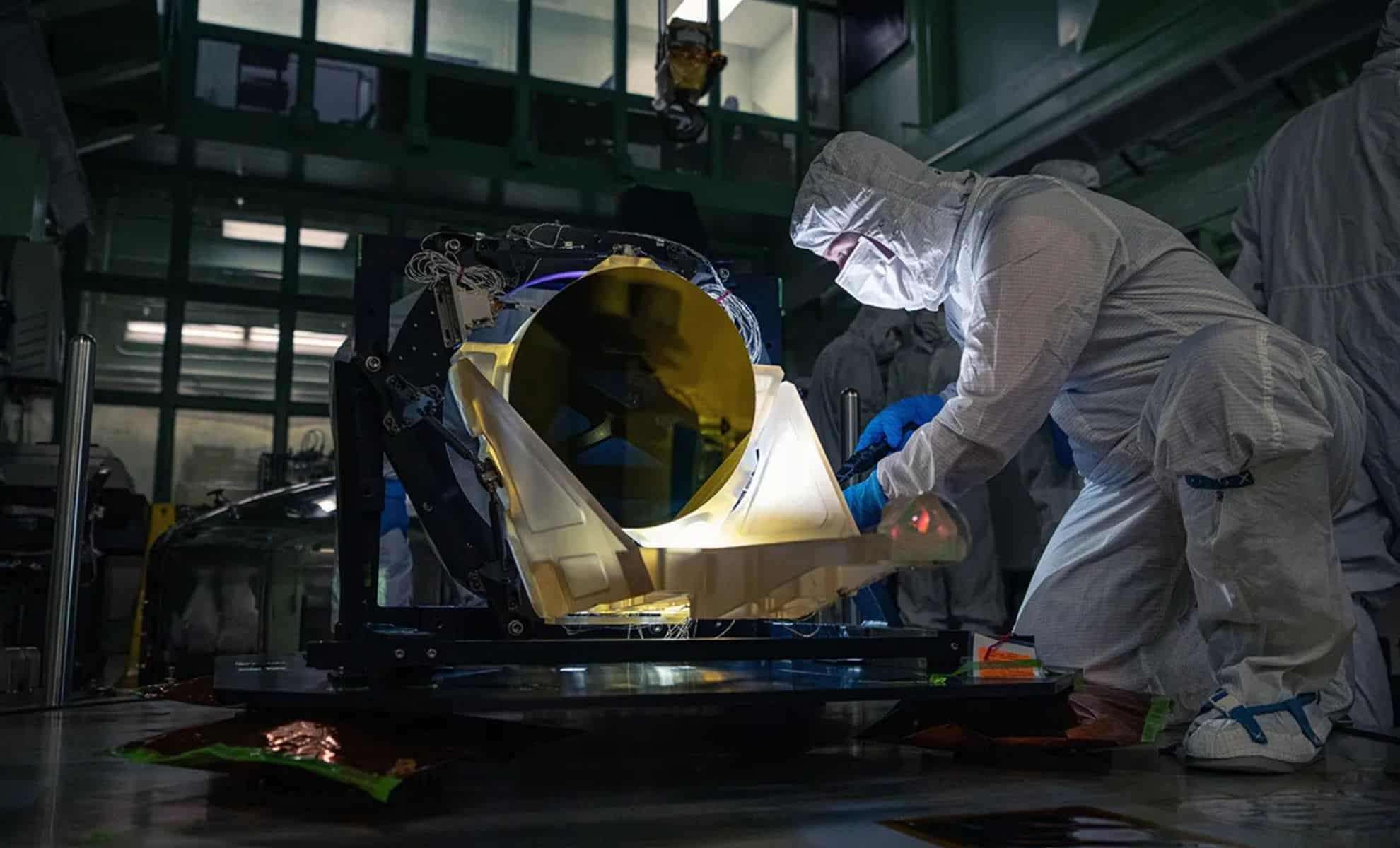
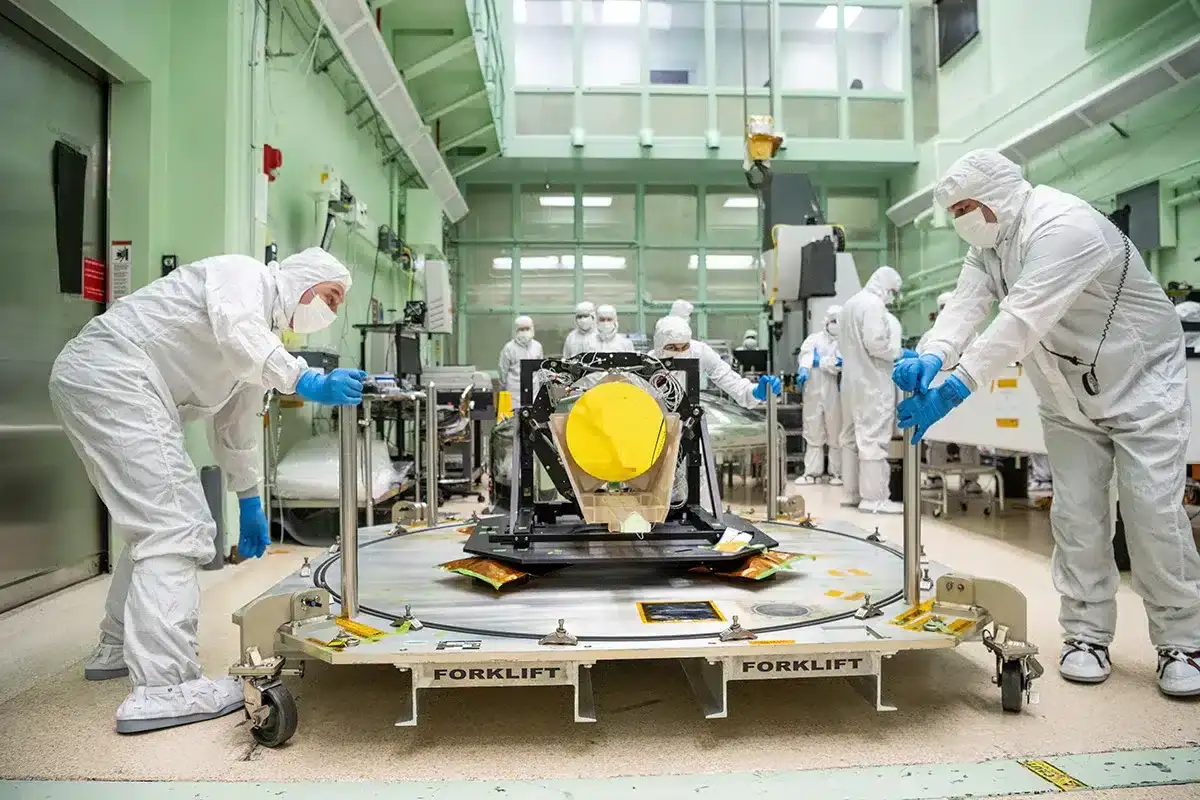
NASA has showcased a full-scale model of the telescope intended for the Laser Interferometer Space Antenna (LISA) mission, a joint venture with the European Space Agency (ESA) aimed at detecting gravitational waves from orbit.
Gravitational waves—disturbances in the fabric of space-time generated by colossal cosmic events like black hole collisions—offer a revolutionary perspective on the cosmos. The LISA mission, planned for launch in the mid-2030s, will become the first orbiting observatory dedicated to capturing these waves, marking a pivotal step forward in astrophysical research.
Shaping the Next Generation of Gravitational Wave Instruments
The debut of the Engineering Development Unit Telescope provides an initial look at the sophisticated technology enabling this mission. LISA will consist of a network of three spacecraft arranged in an equilateral triangle stretching 1.6 million miles (2.5 million kilometers) per side. These craft will be interconnected by infrared laser links capable of gauging minuscule shifts in space-time down to trillionths of a meter, unlocking gravitational wave data that will illuminate new cosmic phenomena. Each spacecraft is equipped with two telescopes, totaling six, designed to both send and receive these laser beams with unmatched accuracy.

Manufactured at NASA’s Goddard Space Flight Center, the prototype telescope employs Zerodur, a glass-ceramic noted for its exceptional thermal stability—key for sustaining precision in the space environment. Its primary mirror features a gold coating that not only enhances infrared reflection but also reduces thermal emission, allowing it to function near room temperature amid space’s extreme conditions.
“This prototype, known as the Engineering Development Unit Telescope, is a critical step toward producing the flight-ready hardware,” explained Ryan DeRosa, a scientist at NASA Goddard. The telescope’s precision and stability are essential to detect the subtle signals of gravitational waves and ensure the accuracy of the collected data.
LISA’s Quest to Probe the Universe’s Hidden Secrets
When operational, LISA will enable researchers to investigate some of the cosmos’s most mysterious and energetic phenomena. Gravitational waves provide unique information about events invisible to standard telescopes, including the collisions of supermassive black holes, the behavior of binary star systems, and potentially the elusive properties of dark matter. These waves circumvent obstacles like cosmic dust and gas, permitting LISA to detect low-frequency gravitational waves undetectable by ground-based detectors such as LIGO.
“LISA will capture spacetime ripples as tiny as trillionths of a meter,” DeRosa added. This incredible sensitivity will help scientists unravel complex cosmic dynamics and may unveil new clues about the universe’s origin. Beyond gravitational wave detection, the mission promises transformative discoveries regarding galaxy formation, universal structure, and the fundamental forces at play.
Advancing Toward the Frontier of Space Observation
The prototype is one of many milestones pivotal to realizing the LISA mission. Engineers will keep refining the telescope’s design and conduct rigorous tests to confirm that the final instruments endure space’s harsh environment and operate with extreme accuracy. After deployment, LISA will embark on its groundbreaking mission of detecting gravitational waves and unlocking some of the universe’s most complex mysteries.
Scheduled for launch on an Ariane 6 rocket from ESA’s French Guiana spaceport in the mid-2030s, LISA will establish its expansive triangular array in orbit, capturing gravitational waves that could solve fundamental questions about space-time and cosmic forces. As NASA and ESA gear up for this ambitious exploration, the telescope prototype signifies a key advancement toward unveiling the mysteries of the cosmos.
- Categories:
- Astronomy ,
- News ,
- Nasa







0 comments
Sign in to Comment