
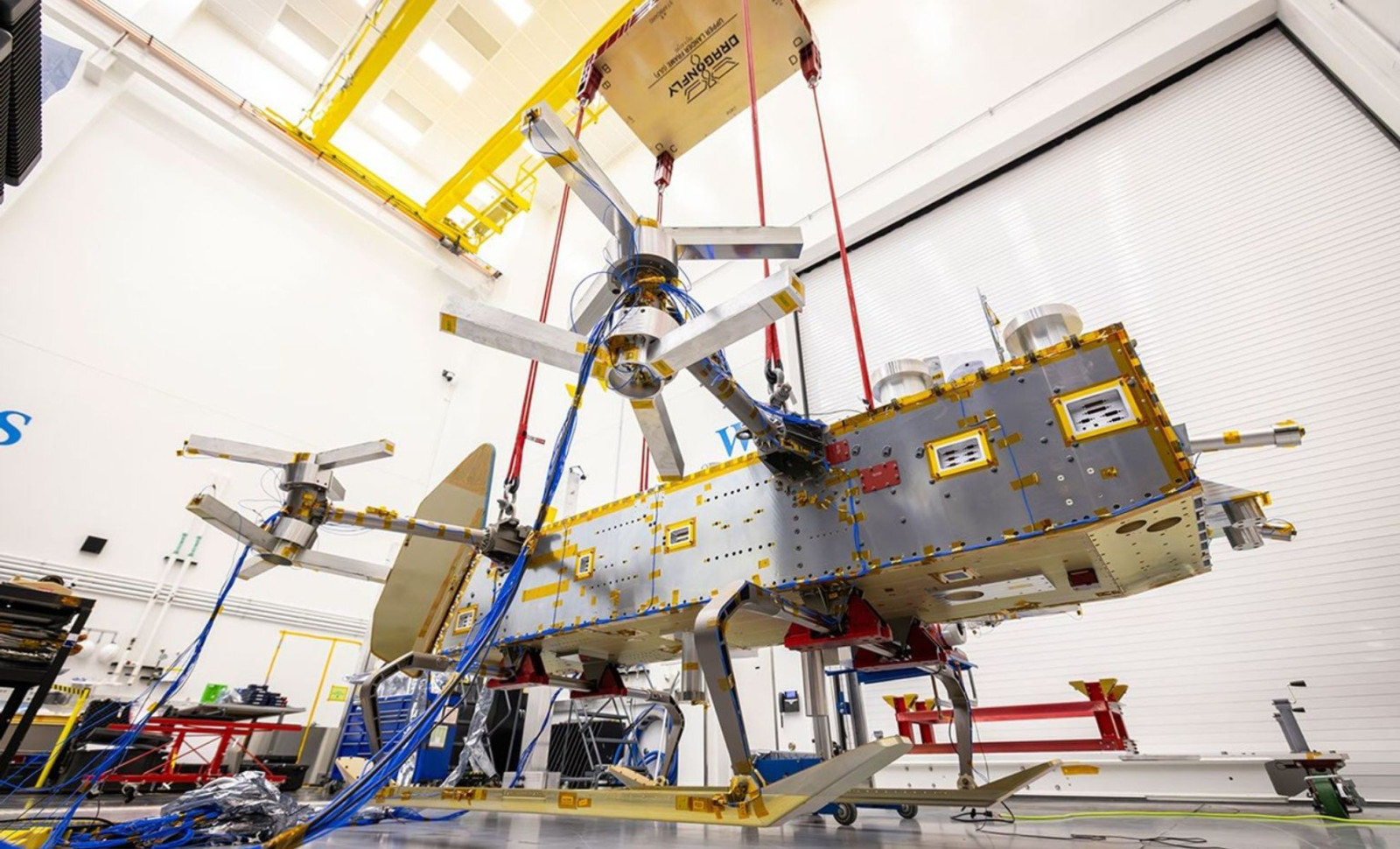
NASA’s Dragonfly project has cleared a pivotal phase by successfully passing a series of rigorous engineering challenges, affirming the spacecraft’s preparedness for the upcoming phases of assembly and integration. This milestone signifies one of the most crucial advances since the rotorcraft entered its build stage, showing that extensive design efforts are evolving into a functional spacecraft. NASA reports that these achievements validate Dragonfly's structural components are performing reliably as the engineering team moves forward with full system integration ahead of launch.
Dragonfly Evolves From Concept to Physical Spacecraft
This recent testing phase was much more than a standard engineering check. For those at the Johns Hopkins Applied Physics Laboratory (APL) managing Dragonfly’s development, it marked the crucial transformation from a computer model into a tangible spacecraft poised for one of NASA’s most daring planetary missions yet.
The assembled lander successfully endured a demanding array of tests aimed at confirming its durability, stability, and suitability for additional outfitting. Engineers thoroughly assessed the spacecraft’s ability to withstand the harsh vibrations of launch, space travel, and the challenging flying conditions it will face on Titan, Saturn’s largest moon. Completing these structural validations paves the way for the inclusion of avionics, scientific payloads, power and communication systems, insulation, and complex wiring, gradually converting Dragonfly into a fully operational space explorer.

Reflecting on the milestone, Hunter Reeling, the Dragonfly thermal-mechanical integration and testing lead at APL, shared,
“It was pretty awesome to see the lander, as we designed it, become real. From here, it’s about populating that structure with electronics boxes, instruments, wiring, insulation — everything that will enable its mission. It’s all about getting Dragonfly ready to launch.”
This shift from an engineering prototype to a flight-ready vehicle represents years of collaborative effort, involving hundreds of engineers, scientists, and technicians dedicated to a mission unlike any before attempted by NASA.
Systems Tested to Endure Extreme Conditions
NASA details how the engineering teams executed a thorough series of structural tests simulating the harsh environment Dragonfly will experience en route to and on Titan. Every part needed to demonstrate resilience to the intense launch vibrations and reliability for the long journey in space.
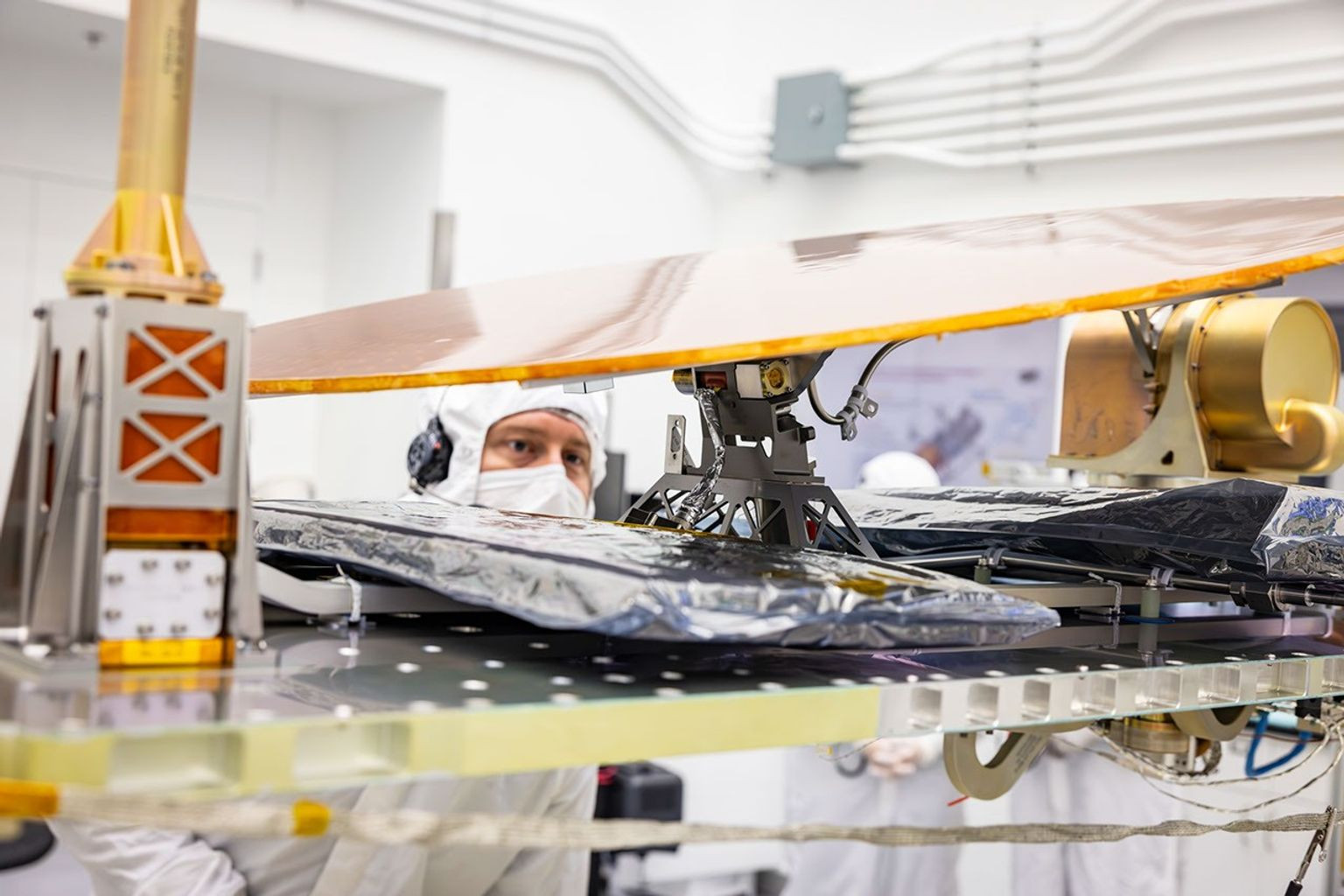
A vital focus was Dragonfly’s high-gain antenna, essential for transmitting scientific data back to Earth from over a billion kilometers away. The antenna incorporates a specialized deployment system enabling it to fold securely during flights between sites and extend again for communications.
Jackson Banbury, Dragonfly’s telecommunications mechanical and thermal lead at APL, emphasized the importance of this design.
“Every time the lander prepares to fly to another location, we store the antenna so it survives the vibrations created during flight and prevents resonance that could interfere with the rest of the lander,” Banbury said.
These successful assessments confirm that the communications system will function reliably and safeguard the spacecraft during repeated flights across Titan’s terrain.
Testing Dragonfly’s First Flight on Earth
A standout moment in the campaign was a unique suspension test, which allowed engineers to observe how the spacecraft’s structure behaves when suspended freely. Although Dragonfly remained just above the floor, this setup closely imitated the forces expected during powered flight on Titan.
This test provided the team with valuable insight into how the vehicle manages mechanical loads while supported only by its rotor system, enhancing predictive models for flight in Titan’s unique low-gravity, dense atmosphere.
Gordon Maahs, Dragonfly’s mechanical systems engineer at APL, reflected on the experience,
“Suspended for a few hours during that test – even barely above the floor – was structurally akin to Dragonfly’s first flight. It gets the imagination going about what actual flight will look like.”
Maahs also noted the exceptional nature of this testing method.
“I’ve never seen a test like it on any other spacecraft,” he said.
This suspension experiment highlights how Dragonfly merges traditional spacecraft engineering with advanced aviation systems, establishing innovative testing procedures for a vehicle with no precedent.
Ensuring Survival in Titan’s Extreme Conditions
Beyond structural strength, engineers performed thorough sealing assessments to confirm that Dragonfly can safeguard its sensitive electronics from contamination while maintaining the necessary thermal conditions for prolonged operation.
These tests supply crucial data for refining thermal models and assessing how effectively Dragonfly can conserve heat on Titan’s frigid surface where temperatures can fall to -290°F (-179°C).
Gordon Maahs emphasized the impact of these results, saying,
“We get a total flow rate based off of the sealing test, and that feeds our thermal analysis to determine if we’re sealed enough.”
Such evaluations reduce uncertainties before final assembly, increasing confidence that the spacecraft’s internals will remain secure throughout the years-long journey, atmospheric entry, and eventual exploration of Titan’s diverse environments.
- Categories:
- News








0 comments
Sign in to Comment