
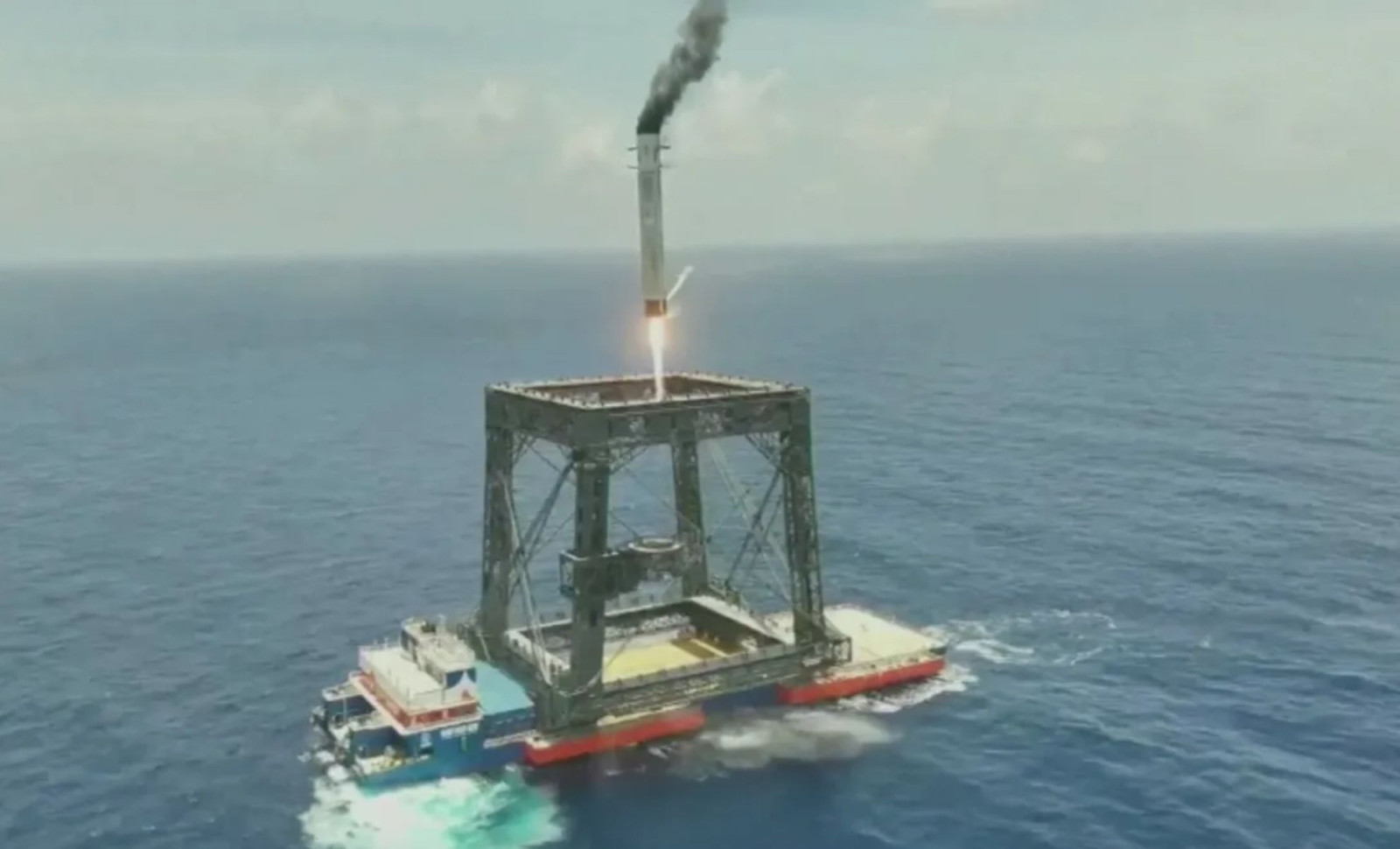
China has set a remarkable new benchmark in reusable spaceflight by successfully retrieving the first stage of an orbital rocket through a sea-based net capture method, a technique the China Aerospace Science and Technology Corporation (CASC) claims no other country has achieved before. This milestone was reached during a launch from the Hainan Commercial Space Launch Site, marking a pivotal development in China's ambition to produce reusable rockets aimed at lowering launch expenses and boosting mission cadence. While reusable rocket technologies have become integral to contemporary space missions, China’s latest approach introduces a novel recovery system that could diversify future orbital retrieval strategies.
Launching and Capturing with an Innovative Technique
The mission served as a critical test of China’s progress in reusable launch technology. As reported by CASC, the rocket ascended from the Hainan Commercial Space Launch Site on Friday at 12:15 a.m. EDT (0415 GMT; 12:15 p.m. Beijing time), initiating a precise sequence to retrieve the booster stage.
Approximately six minutes post-liftoff and following stage separation, the rocket's first stage began a controlled descent toward a sea-based recovery platform equipped with a large net system. Instead of performing a conventional water splashdown, the booster was guided vertically to land within this net, illustrating the combined effectiveness of advanced guidance, navigation, propulsion, and precision landing technologies during an operational launch.

In a statement shortly after the event, CASC highlighted the success: “Approximately 6 minutes after the first and second stages separated, the first stage returned vertically and was successfully recovered at a sea-based recovery platform using a net system,” underscoring that the launch and recovery operation was fully successful.
This milestone enriches the swiftly advancing domain of reusable launch vehicles, where efficient hardware recovery is increasingly vital for space programs worldwide.
The Significance of This Breakthrough for China’s Space Ambitions
Recovering a rocket stage is a fundamental step toward establishing reusable launch systems, but proving the durability of the retrieved hardware through multiple flights is equally important. By accomplishing a controlled, vertical capture of a booster on a maritime platform, China has demonstrated growing expertise and confidence in the precision and dependability of its reusable rocket technologies.
The China Aerospace Science and Technology Corporation (CASC) hailed the success as a major national achievement that underlines the broader impact this technology may have on the future of space launch operations.
As CASC stated: “This mission marks my country’s first successful controlled recovery of a launch vehicle and the world’s first network-based recovery of a launch vehicle,” the China Aerospace Science and Technology Corporation (CASC) announced via social media shortly after the launch. (Translation by Google.) “It signifies a historic breakthrough for my country in the field of reusable rocket technology and will lay a solid foundation for accelerating the improvement of my country’s space access capabilities.”
These remarks reflect China’s strategic focus on creating launch systems that can support a wider range of scientific, commercial, and governmental space efforts. The advancement of reusability is critical in modern rocketry, offering potential cost reductions and enabling more frequent launches by reusing first stages instead of manufacturing new ones each time.
Distinctive Aspects of China’s Recovery Approach
Most reusable rocket systems globally rely on vertical landings, either on terrestrial pads or drone ships at sea. China's latest success employs a unique net-based capture method installed on a recovery platform, allowing the booster to be caught without the need for a traditional legged touchdown.
This alternative recovery technique might bring operational benefits if further developed. Using a net to catch the booster could reduce impact stresses, simplify landing protocols, and provide an additional option for booster retrieval under different launch circumstances. However, further trials will be essential to validate the system's reliability across multiple missions.
The operation also demonstrates China's increasingly advanced guidance and control capabilities. The descending booster stage executed multiple engine burns with extreme precision and adjusted its flight path in real time to navigate atmospheric variations and vehicle dynamics, successfully aiming for a narrow recovery target at sea which demands highly accurate navigation.
- Categories:
- Space








0 comments
Sign in to Comment