
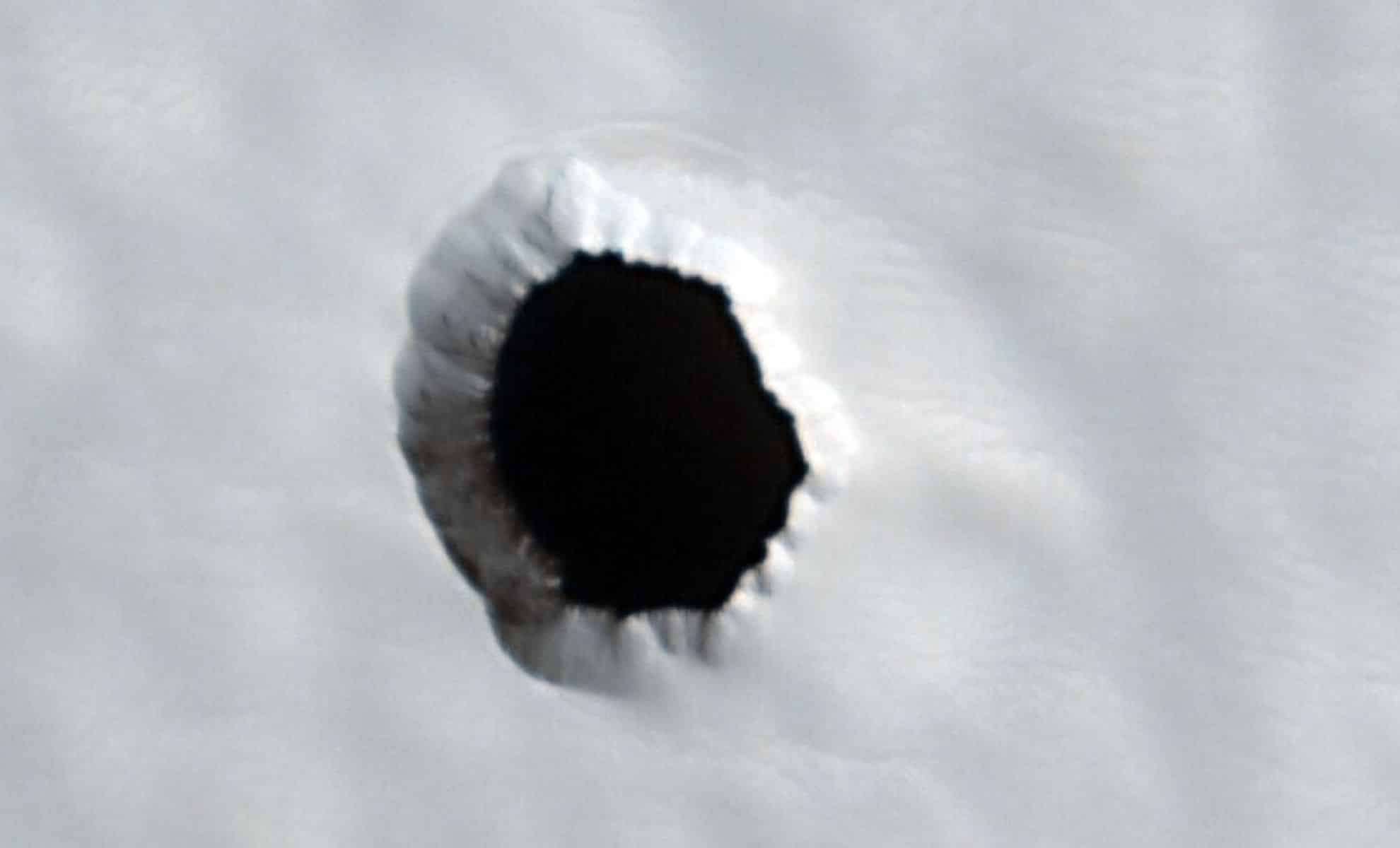
NASA’s Mars Reconnaissance Orbiter has recently identified an intriguing pit on Mars that has piqued the interest of planetary scientists.
Located within the Arsia Mons volcanic region, this enigmatic depression prompts questions regarding its formation and what lies beneath the Martian surface. Arsia Mons is one of three giant dormant volcanoes, reflecting a powerful volcanic past.
Exploring Hypotheses Behind the Formation
Could This Be a Lava Tube Skylight?
A prominent hypothesis suggests that this pit might be an entrance to an underground lava tube. Analogous structures occur on Earth, notably in volcanic areas such as Hawaii.

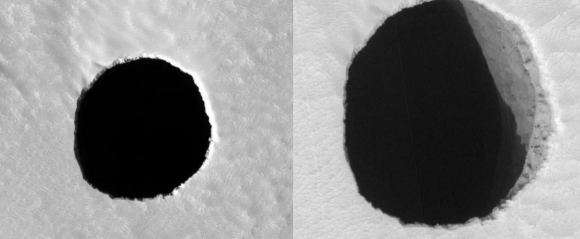
Such skylights emerge when the roof of a lava tube collapses, creating an opening to the subterranean chamber. If this feature on Mars indeed leads into lava tubes, these could provide natural shelters that shield explorers from the planet’s harsh radiation, extreme temperatures, and dust storms.
Due to Mars’ reduced gravity, lava tubes could potentially develop larger chambers compared to those on Earth, offering expansive, robust refuges conducive to long-term habitation.
Volcanic or Tectonic Origins
Another plausible explanation is that this pit formed through volcanic or tectonic mechanisms, similar to sinkholes found on Earth. These features typically arise when the ground surface collapses over an underground void created by previous volcanic activity.
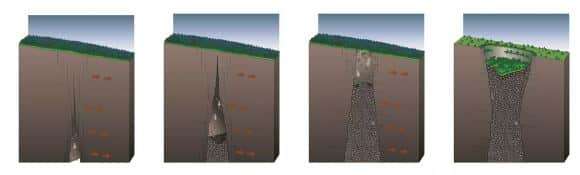
Distinguishing whether the pit is a simple ground collapse or an entryway to sizable subterranean cavities is essential. Studying such formations gives scientists a window into Mars’ underground composition and geologic timeline, deepening our grasp of the planet’s development.
The Role of This Feature in Mars Missions
Potential Habitats for Astronauts
Pinpointing the nature of these pits is vital for advancing manned Mars exploration efforts. If these holes open into lava tubes, they could become advantageous locations for human habitats. These subterranean spaces offer protection against the severe Martian environment.
Utilizing these natural shelters could lessen the pressure to build heavily reinforced surface bases, streamlining colonization plans. Such cavities could be converted into living quarters, science labs, and storage areas with relatively minimal construction.
Importance of Robotic Investigations
Despite the exciting prospects, much remains unknown about the pit. Future robotic missions equipped with advanced tools are necessary to thoroughly examine its structure and potential habitability.
Autonomous explorers outfitted with high-resolution sensors could create detailed maps of the interior, analyze mineral compositions, and test the stability of these underground spaces. These investigations will be critical for ensuring the safety and feasibility of human missions on Mars.
Drawing Insights from Earth Analogues
Lessons from Terrestrial Features
Volcanic sites on Earth offer valuable models for interpreting Martian pits and lava tubes. Areas like Hawaii feature well-researched skylights and lava tubes that vary greatly in size and form.
Comparing these terrestrial structures helps scientists hypothesize about Martian geological processes and the possible internal conditions of similar formations on Mars.
Mars’ Chance for More Massive Lava Tubes
Thanks to Mars’ weaker gravity, lava tubes there might grow far larger than those on Earth, enhancing their potential as habitats. If structurally sound and accessible, these large caverns could support permanent settlements, agriculture, and life support systems, making them prime targets for future exploration and colonization.
- Categories:
- Astronomy ,
- News ,
- Science ,
- Space ,
- Nasa







0 comments
Sign in to Comment