
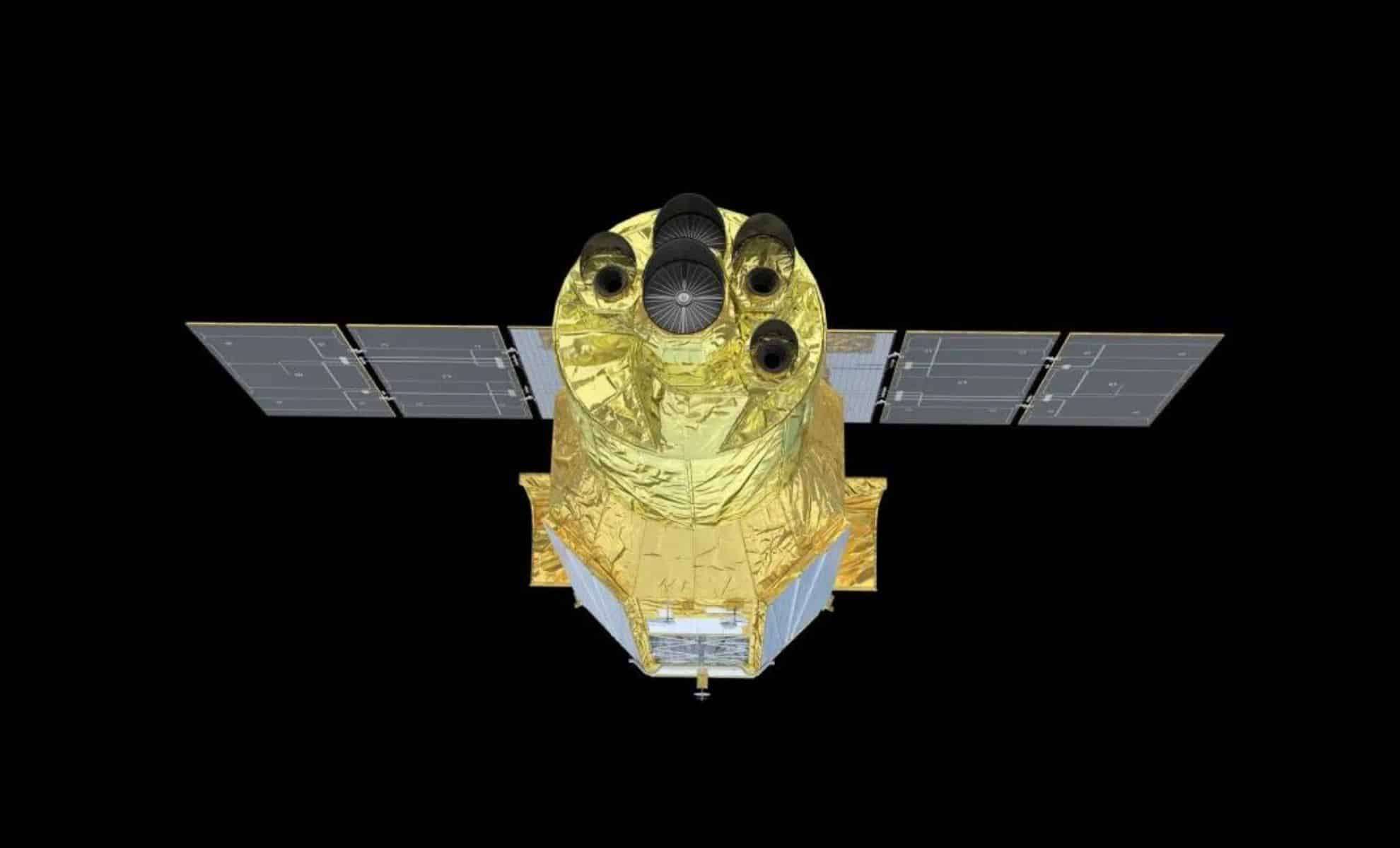
NASA and Japan’s JAXA remain committed to operating the X-ray Imaging and Spectroscopy Mission (XRISM) satellite for at least the next 18 months, despite an issue affecting one of its key instruments.
XRISM Mission Advances Despite Technical Hurdle
Launched by JAXA in September 2023, the XRISM spacecraft, with instruments co-developed by NASA, has initiated its core scientific observations. The satellite carries two primary X-ray observatory instruments.
In January, scientists revealed that XRISM was fully operational except for the gate valve—a beryllium aperture door—on the Resolve imaging sensor’s Dewar, which was unable to open. Although the instrument can still function with the valve closed, this configuration reduces sensitivity to certain low-energy X-rays.

Following attempts to open the valve, Mark Clampin, head of NASA’s astrophysics division, announced at a National Academies’ Physics and Astronomy Board meeting on May 7 that these interventions will be paused for the next year and a half.
He stated, “Our current plan is to focus entirely on scientific observations over the upcoming 18 months.” Clampin emphasized that Resolve continues to produce valuable data, saying, “Despite the gate valve remaining closed, the science we’re gathering is exceptional. We intend to resume efforts to free the valve after this period.”
The valve’s movement depends on two non-explosive actuators, and reports from JAXA indicate a probable snag in the wiring harness attached to one actuator is preventing valve operation.
The complicated cryogenic environment adds difficulty to resolving the issue. Potential solutions include regulating the sensor’s temperature or applying mechanical vibration to dislodge the harness. Clampin concluded that gathering data now is the safest path forward, deferring troubleshooting until after 18 months.
Funding Challenges in NSF Astronomy Programs
Clampin also touched on budget constraints, mentioning active considerations on how to manage expenses related to ongoing missions like the Chandra X-Ray Observatory and Hubble Space Telescope, though no new updates were shared.
At the same meeting, R. Chris Smith, interim head of the National Science Foundation's Division of Astronomical Sciences, revealed that NSF has decided to halt progress on a major ground-based project known as CMB-S4.
Designed to build a cutting-edge observatory at the South Pole investigating the cosmic microwave background—the remnant radiation from the Big Bang—the project sought to shed light on early cosmic evolution, dark matter, and dark energy, and was highly ranked in major scientific decadal reviews.
Smith noted that NSF has opted not to advance CMB-S4 to its Major Facility Design Stage right now, emphasizing the urgent need to upgrade essential South Pole infrastructure.
“Recapitalizing infrastructure at the South Pole will support a broad range of research, not limited to astrophysics,” Smith explained. He added that CMB-S4 could be revived at a future date.
Budgetary pressures influenced this decision. For fiscal year 2024, NSF requested $11.3 billion but received under $9.1 billion. Smith indicated that detailed operational plans for 2024 are still being developed, with uncertain impacts on astronomy and other programs.
These funding issues also affect the agency’s approach to supporting the United States Extremely Large Telescope (US-ELT) initiative — which includes the Thirty-Meter Telescope (TMT) and Giant Magellan Telescope (GMT).
The US-ELT effort envisions NSF jointly funding these two large telescopes in construction, with the foundation gaining partial observing rights for the broader astronomical community.
In March, the National Science Board recommended backing only one telescope with a budget of $1.6 billion, even as congressional language encouraged support for both facilities.
Smith shared that on May 2, NSF formally launched an external review process to evaluate the progress, risk mitigation, and resource impacts of the GMT and TMT designs, advising foundation leadership on which project to endorse.
The review is expected to conclude by September, though a final NSF decision timeline has not been announced.








0 comments
Sign in to Comment