
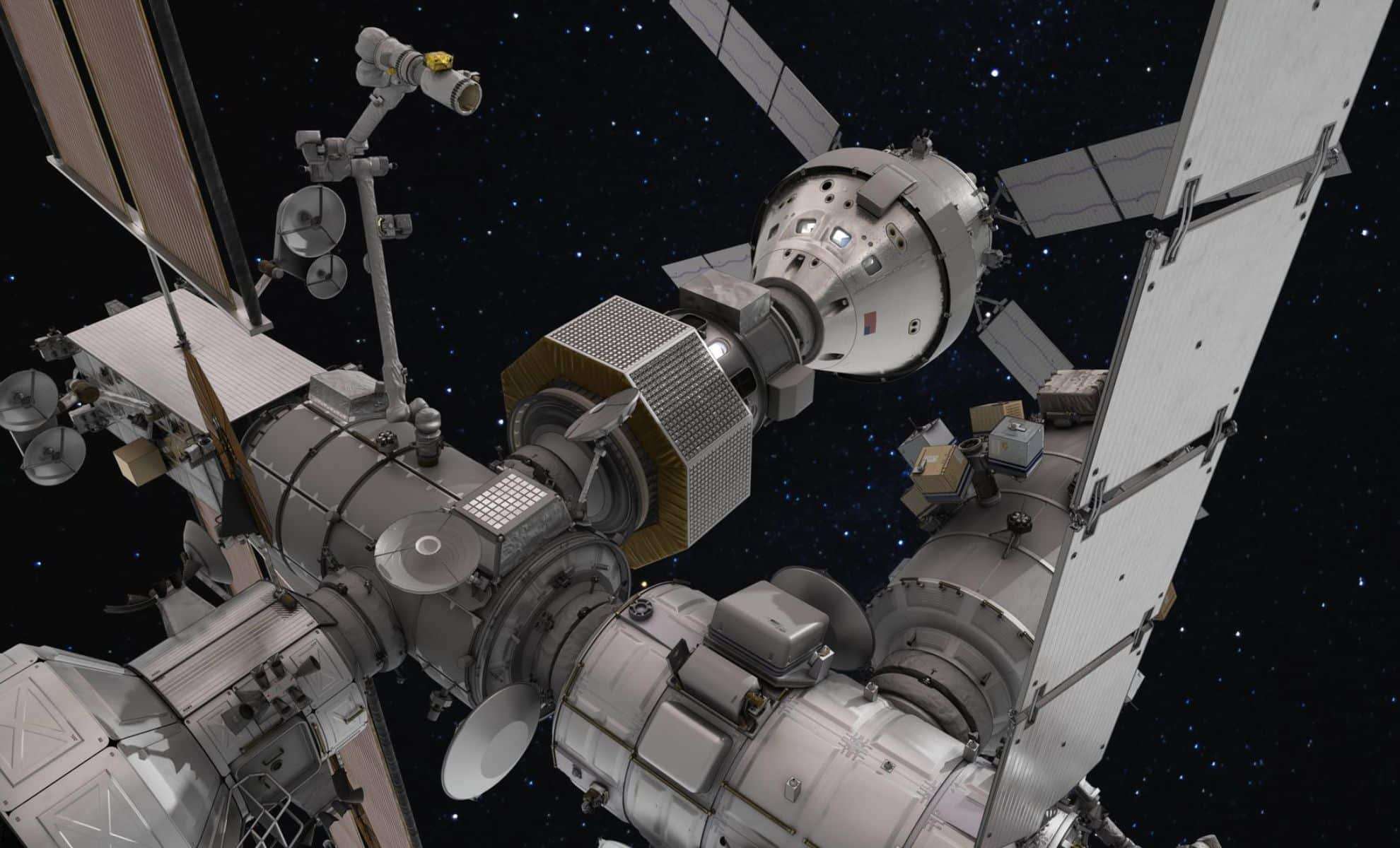
NASA along with its global partners is making remarkable progress in building Gateway, the inaugural space station orbiting the Moon.
Gateway is set to become a vital hub for astronauts conducting research and readying for expeditions to the lunar South Pole and deeper space.
Gateway’s Core Components and Global Teamwork
The Habitation and Logistics Outpost (HALO), developed by NASA’s commercial collaborator Northrop Grumman, represents one of the four main modules of Gateway.

Currently in testing phases in Turin, Italy, HALO will offer living quarters and operational space for international astronaut crews. It includes several docking hubs, accommodating cargo ships and the European Space Agency’s (ESA) Lunar View module.
Additional docking bays are planned for the SpaceX Starship and Blue Origin’s Blue Moon landers as part of Artemis IV and V missions.

Alongside HALO, Gateway’s initial launch into lunar orbit will feature the Power and Propulsion Element, supplied by Maxar Space Systems. This component is essential for providing energy and maneuvering the station. Future expansions include ESA’s Lunar I-Hab and Lunar View modules, the Crew and Science Airlock from the Mohammed Bin Rashid Space Centre, sophisticated robotic systems from the Canadian Space Agency (CSA), and key equipment from the Japan Aerospace Exploration Agency (JAXA). NASA noted, “Gateway will launch to lunar orbit with the Power and Propulsion Element, provided by Maxar Space Systems, and later expand with ESA’s Lunar I-Hab and Lunar View modules.”
The Scientific Significance and Mission Support of Gateway
Gateway plays a central role in NASA’s Artemis initiative, which plans to return humans to the Moon for exploration and prepare for missions to Mars. The station will enable astronauts to investigate deep space phenomena and conduct unique experiments.
Equipped with state-of-the-art laboratories, Gateway will facilitate pioneering studies in lunar geology, biology, and space medicine. Such research is critical to comprehending the impacts of extended space missions on human health and to developing technologies for long-term habitation on the Moon and Mars.
Furthermore, Gateway will function as an operational base for ventures to the lunar South Pole, an area rich in scientific interest because of accessible water ice deposits. This ice holds potential for producing oxygen and rocket fuel, representing a vital asset for future lunar missions.
Global Cooperation and Innovative Technologies Behind Gateway
The planning and execution of Gateway is a joint global endeavor involving multiple space agencies and commercial enterprises. This collaboration highlights the worldwide dedication to expanding humanity’s reach into space. Partnering organizations like ESA, CSA, JAXA, and the Mohammed Bin Rashid Space Centre contribute vital technology and expertise.
The international cooperation extends to integrating advanced systems, such as the external robotic arms from CSA, which will enhance maintenance and scientific capabilities. The Crew and Science Airlock developed by the Mohammed Bin Rashid Space Centre will enable spacewalks and facilitate the handling of scientific payloads. These combined efforts underscore the importance of teamwork in reaching ambitious extraterrestrial milestones.
Gateway’s Legacy for Expanding Human Space Ventures
Gateway marks a groundbreaking achievement in human space exploration. As the first lunar orbital station, it will serve as a platform for science, technological progress, and international partnership. This station is a critical step toward maintaining a continuous human presence on the Moon, supporting extended missions, and testing systems for Mars exploration. Continuous research and development in lunar orbit will deepen our understanding of the space environment and tackle challenges associated with deep-space travel.
Ultimately, Gateway stands to revolutionize the approach to space exploration. As a pivotal support node for lunar and Martian missions, it will drive scientific breakthroughs and innovation. With NASA and its collaborators advancing the Artemis missions, Gateway is key to ushering a new era of sustainable human space endeavors.








0 comments
Sign in to Comment