
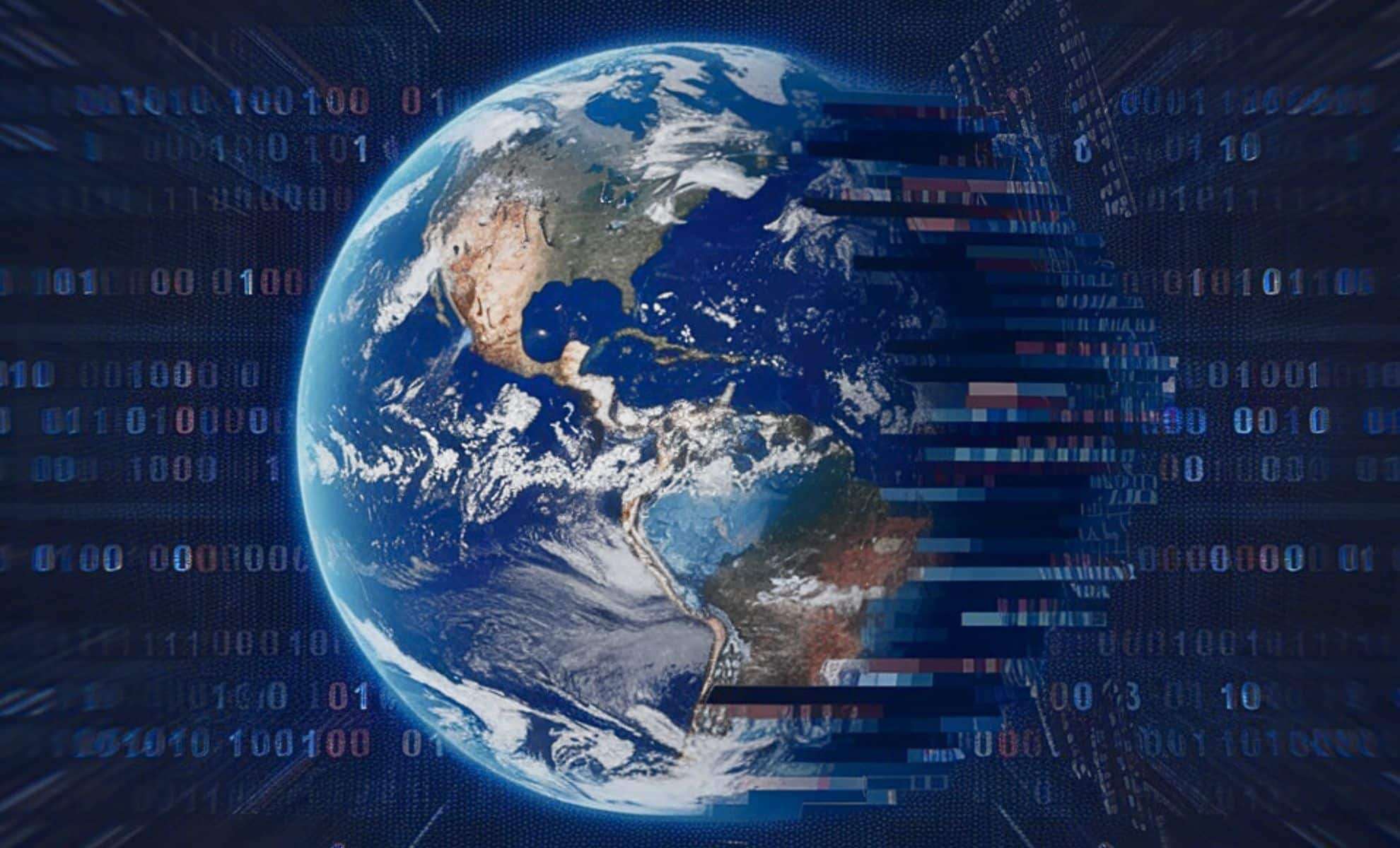
The Covid-19 outbreak has profoundly impacted global populations, resulting in millions of fatalities and altering societal dynamics across the world. Beyond these effects, a new theory by Dr. Melvin Vopson, a researcher focused on SARS-CoV-2, suggests the pandemic might reveal hidden truths about the essence of our existence. His controversial hypothesis proposes that our universe is a simulation, and that viral mutations—alongside changes in other life forms—may not be accidental, challenging established views on evolutionary processes.
While the simulation hypothesis has typically been relegated to philosophical speculation and science fiction narratives, Vopson applies scientific methodology to this concept. By studying the transmission dynamics and mutation patterns of SARS-CoV-2 through the lens of information physics, he suggests our cosmos displays characteristics akin to a simulated framework. Could the pandemic unintentionally offer insights into one of humanity’s deepest mysteries?
A Scientific Take on the Simulation Idea
The simulation hypothesis argues that what we perceive as reality is actually a highly sophisticated simulation engineered by an advanced intelligent entity. Historically, this concept faced skepticism, but recent progress in information physics has renewed scientific interest. Vopson’s investigation draws on the mass-energy-information equivalence concept, which asserts that information holds an elemental role in the makeup of the universe alongside matter and energy.

Vopson’s study introduces the second law of infodynamics, a principle formulated in 2022. This law suggests that contrary to the traditional second law of thermodynamics—which holds that entropy increases over time—the entropy of information, or information entropy, tends to decrease. He posits that this pattern resembles optimization routines typical in computer science, where data is compressed to maximize efficiency.
“The second law of infodynamics appears to be manifesting universally and is, in fact, a cosmological necessity,” Vopson writes. “This points to the fact that the entire universe appears to be a simulated construct.”
By extending this idea to fields such as genomics, atomic phenomena, and cosmological models, Vopson proposes that the universe functions like an optimized computational machine, consistently reducing the volume of information to lessen processing demands—a signature characteristic of a digital simulation.
Do SARS-CoV-2 Mutations Reveal Directed Evolution?
A particularly intriguing element of Vopson’s findings involves his detailed examination of SARS-CoV-2 mutation patterns. Since its first appearance in late 2019, the virus has experienced thousands of genetic changes, offering a live glimpse into mutation mechanisms. His analysis challenges the traditional assumption that mutations are purely random, a fundamental tenant of evolutionary biology.
Reviewing numerous virus variants, Vopson reports that an overwhelming 98.92% of mutations involve nucleotide deletions, with only 1.08% involving additions. He interprets this as supportive of the second law of infodynamics, implying the virus streamlines its genetic code over time. In essence, SARS-CoV-2 appears to refine its information similarly to how programmers optimize software code.
“This behavior is fully reminiscent of the rules deployed in programming languages and computer coding,” Vopson notes. “If the universe is a simulation, such optimization would be necessary to reduce computational power and data storage requirements.”
If mutations follow systematic information optimization rather than chance, this could revolutionize our perception of evolutionary theory. It provokes critical inquiries: to what extent does natural selection incorporate randomness, or is it governed by deeper informational laws? And what implications might this have regarding the fundamental nature of life?
Consequences of Living in a Simulation
Should Vopson’s theory hold true, the fallout would be profound. The notion that our universe is a simulation suggests all aspects of existence—from our own anatomy to cosmic structures and even the flow of time—are facets of an intricate computational model. This challenges conventional frameworks about reality and humanity’s role within it.
According to Vopson, the observed drive toward minimizing information complexity hints at a built-in optimization akin to algorithms in computer-generated environments. This might explain observed phenomena such as mathematical consistencies, biological system efficiencies, and the precise calibration of physical constants.
“A super complex universe like ours, if it were a simulation, would require a built-in data optimization and compression mechanism,” Vopson explains. “This is exactly what we are observing via empirical evidence all around us.”
Nonetheless, Vopson cautions that these intriguing correlations do not yet amount to conclusive proof verifying simulation theory. The idea remains speculative, yet ongoing advancements in information physics and technology may eventually permit more definitive evaluations.
- Categories:
- News







0 comments
Sign in to Comment