
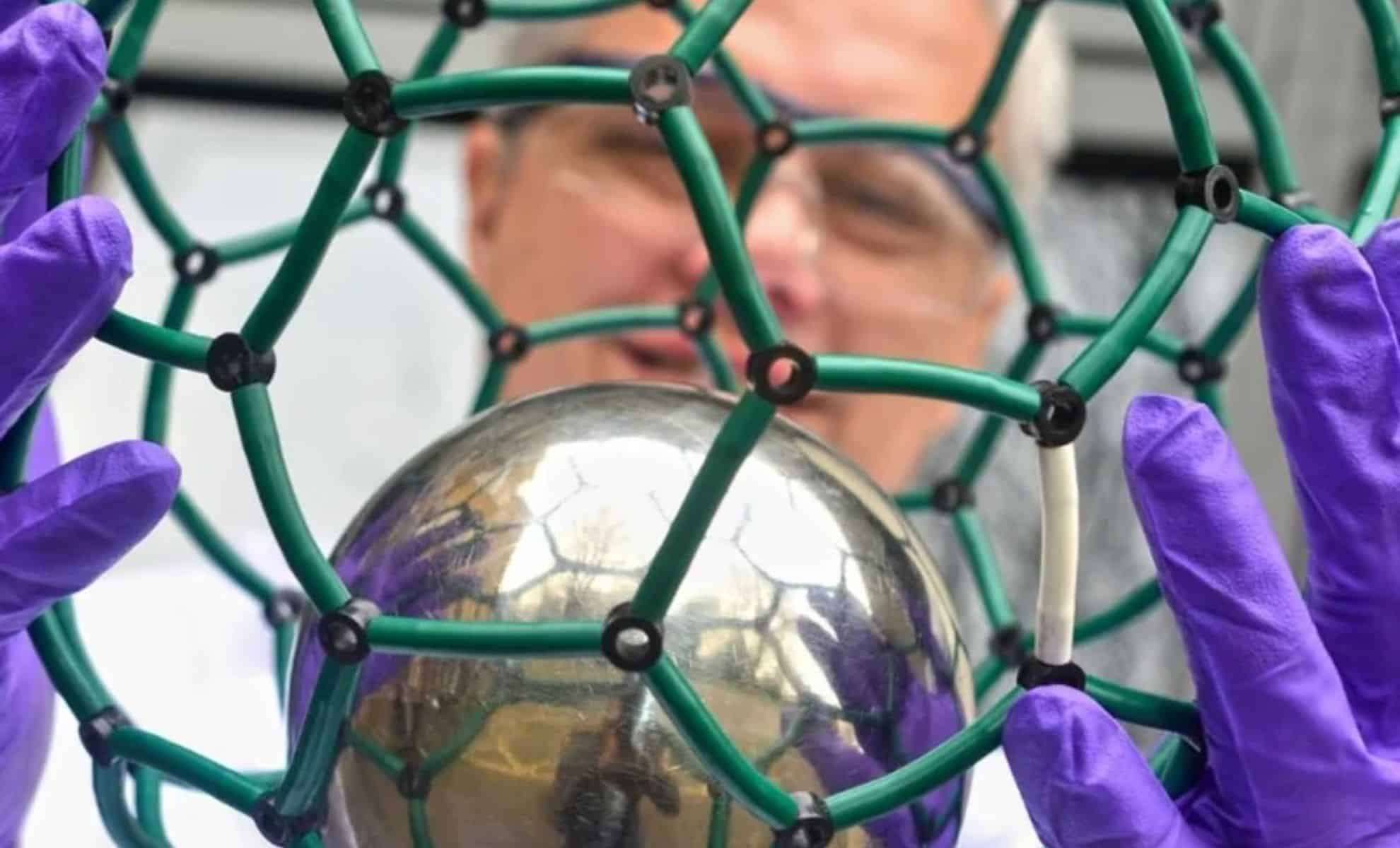
When we consider the costliest materials globally, precious gems, metals, or exclusive properties often come to mind. Surprisingly, the most valuable substance isn’t a jewel but a molecule called Nitrogen Atom-Based Endohedral Fullerenes.
Valued at an astonishing £110 million ($140 million) per gram, this rare powder commands its hefty price due to the intricate and expensive synthesis process behind its creation.
Unveiling the Molecular Wonder Behind Its Enormous Value
At the heart of Nitrogen Atom-Based Endohedral Fullerenes is a spherical cage made from 60 carbon atoms, famously known as a “bucky-ball.” Enclosed within this carbon sphere is a nitrogen atom, forming a molecule with exceptional electronic and physical characteristics. Its notably prolonged electron spin lifetime renders it invaluable for advanced scientific endeavors, including revolutionary atomic clock technologies.

The remarkable expense stems from the laborious and complex production required to produce even minuscule quantities. Originally synthesized by the startup Designer Carbon Materials, their first 200 mg batch sold for an immense £110 million ($167 million back in 2015). Owing to the painstaking craftsmanship involved, Oxford University dubbed it "the most expensive thing on Earth."
Advancing Atomic Clock Miniaturization
Nitrogen Atom-Based Endohedral Fullerenes hold tremendous promise in crafting compact atomic clocks. Historically, atomic clocks—renowned for their precise timekeeping—were bulky, room-sized devices. This novel material is enabling the development of smaller, ultra-precise clocks potentially small enough for smartphones.
Such clocks could measure time with astonishing accuracy, influencing how we rely on GPS technologies and enhancing their precision significantly.
Dr. Kyriakos Porfyrakis, a nanomaterials expert involved with these fullerenes since 2001, shared with The Telegraph in 2015, “Imagine a miniaturised atomic clock that you could carry around in your smartphone. This is the next revolution for mobile.”

Impact on Autonomous Vehicles and GPS Precision
The scope of this technology extends well beyond personal gadgets. One of the most exciting prospects lies in the autonomous vehicle sector, where current navigation systems—even those using GPS—face limitations.
Atomic clocks capable of millimeter-level measurement could redefine the way self-driving cars navigate. Lucius Cary, director of the Oxford Technology SEIS fund, highlights, “This endohedral fullerene would make it work on a chip that could go into your mobile phone. There will be lots of applications for this technology, but the most obvious is in controlling autonomous vehicles.”
Integrating this material into consumer electronics or vehicles could lead to unprecedented advances in safety, navigation, and the driverless car ecosystem. Precise location tracking on this scale could transform everyday interactions with technology.
Clearly, Nitrogen Atom-Based Endohedral Fullerenes represent not just an extraordinarily valuable compound but a gateway to transformative technological innovations.
- Categories:
- News











0 comments
Sign in to Comment