

NASA’s Global-scale Observations of the Limb and Disk (GOLD) mission has identified fascinating C- and X-shaped plasma patterns within the ionosphere, a vital layer of Earth’s upper atmosphere stretching from roughly 48 to 965 kilometers (30 to 600 miles) above the planet’s surface.
These unexpected observations could deepen our understanding of space weather and its effects on communication and navigation technologies.
Understanding the Ionosphere and Its Changing Features
The ionosphere is an essential atmospheric layer, critical for the transmission of radio signals and global connectivity. Ionization occurs when solar radiation hits atmospheric particles during the day, creating a plasma—a mix of ions and free electrons.

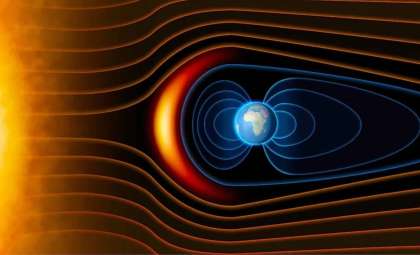
Within this layer, Earth’s magnetic field guides these charged particles into bands and dynamic plasma structures. At night, the plasma density drops, forming low-density regions known as plasma bubbles. These plasma features considerably influence radio wave propagation, making the ionosphere a focal point for studying and forecasting space weather effects.
New Insights from NASA’s GOLD Observations
The GOLD mission, designed to observe ionospheric changes, has delivered unprecedented images showing C- and X-shaped plasma formations. Historically, such shapes were mostly linked to major geomagnetic disturbances like solar storms or volcanic eruptions which disrupt magnetic conditions.

Contrary to earlier beliefs, GOLD's data show these structures can emerge even during periods of geomagnetic tranquility. Fazlul Laskar, a physicist specializing in the ionosphere at the University of Colorado, noted, “Earlier reports of merging were only during geomagnetically disturbed conditions. It is an unexpected feature during geomagnetic quiet conditions.” This points to more intricate processes behind plasma dynamics than previously assumed.
Among the captivating findings are C-shaped and reversed C-shaped plasma bubbles believed to be influenced by atmospheric winds, akin to how wind shapes tree growth. GOLD’s detailed imagery reveals these patterns forming close to each other, sometimes separated by just 634 kilometers (400 miles).
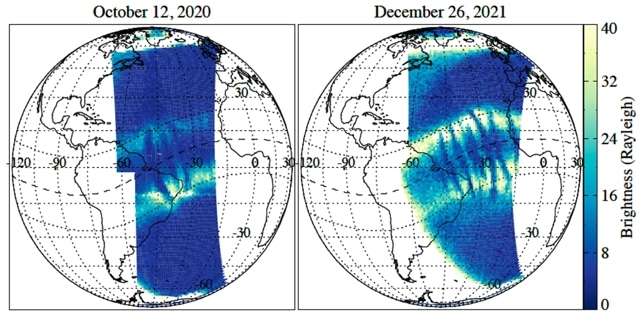
Their proximity suggests localized atmospheric phenomena—such as wind shears, minor atmospheric disturbances, or even tornado-like effects—might contribute to their emergence.
“Within that close proximity, these two opposite-shaped plasma bubbles had never been thought of, never been imaged,” explained Deepak Karan, an ionosphere expert at the University of Colorado. These tightly clustered C-shaped bubbles are uncommon, with GOLD having observed only two so far, highlighting complex atmospheric interactions.
Impact on Communication and Navigation Systems
The plasma structures within the ionosphere are critical for the reflection and bending of radio waves, facilitating long-distance communication. Interruptions caused by the newly detected C- and X-shaped formations can disrupt signals, resulting in communication outages and GPS inaccuracies.
Understanding and forecasting these ionospheric disturbances is vital for maintaining robust communication and navigation networks. Deepak Karan emphasized the importance of these findings: “Within that close proximity, these two opposite-shaped plasma bubbles had never been thought of, never been imaged.” Such data help refine ionospheric models, enhancing space weather predictions and reducing technological disruptions.
Pathways for Future Exploration and Innovation
The unveiling of these unique plasma shapes highlights the need for ongoing observation and advanced imaging methods in atmospheric science. GOLD’s high-resolution data are key to unraveling the complex dynamics at play in the ionosphere.
Upcoming studies will seek to pinpoint the exact atmospheric conditions responsible for these formations, whether involving wind shear effects, localized turbulence, or other factors. Jeffrey Klenzing from NASA’s Goddard Space Flight Center remarked, “The fact that we have very different shapes of bubbles this close together tells us that the dynamics of the atmosphere are more complex than we expected.”
This research advances both fundamental understanding of Earth’s upper atmosphere and the reliability of communication and navigation systems susceptible to space weather variations.
The findings, published in The Journal of Geophysical Research: Space Physics, demonstrate how cutting-edge observational tech like GOLD broadens our grasp of ionospheric phenomena. NASA's continual monitoring of these events promises improved space weather forecasting, bolstering critical infrastructures on Earth.
The GOLD mission showcases the vital role of space exploration in decoding the interplay between Earth’s atmosphere and space, lighting the path for future atmospheric research breakthroughs.
- Categories:
- Astronomy ,
- News ,
- Space ,
- Nasa




0 comments
Sign in to Comment