

A once-overlooked biochemist’s innovative concept explaining how life emerged is gaining renewed interest decades after being disregarded. As experts work to refine the definition of life, especially within astrobiology and synthetic biology, a groundbreaking theory from Cold War-era Hungary is quietly influencing scientific discourse worldwide.
A Visionary Concept Ahead of Its Era
In 1971, Tibor Gánti, a scientist in Soviet Hungary, introduced a challenging hypothesis addressing a fundamental question in biology: what constitutes the most basic form of life? His model, termed the chemoton, presented in the Journal of Theoretical Biology, proposed that life depends on three interconnected systems: a self-maintaining metabolic process, a hereditary information mechanism (akin to genes), and a distinct boundary separating the system from its surroundings.
Gánti emphasized these ingredients as indispensable; "chemistry becomes biology only with all three," he stated. Unfortunately, his insights remained largely unnoticed outside Hungary, as his influential book Az Élet Princípiuma (The Principles of Life) was published solely in Hungarian and translated many years later.

Today’s research into protocells, minimal genomes, and the origins of life beyond Earth is bringing Gánti’s work back into the spotlight.
The West Focused Elsewhere
Throughout the 1970s and 1980s, Western science prioritized studying genetics, particularly DNA and RNA. The influential RNA world hypothesis suggested life began through self-replicating RNA molecules, eclipsing more holistic models like that of Gánti.
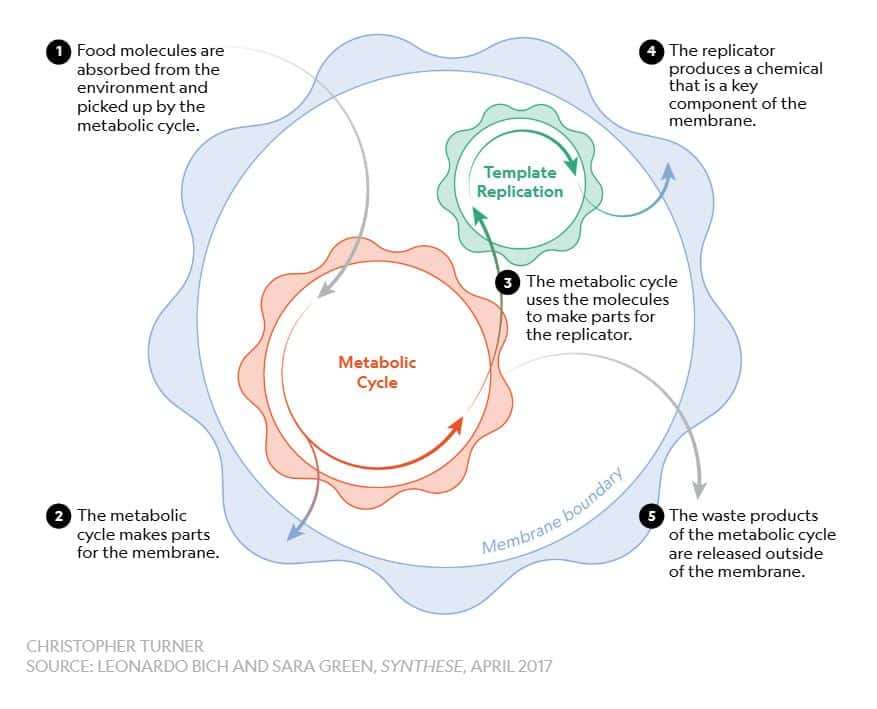
Contemporaries of Gánti included American theoretical biologist Stuart Kauffman, who proposed autocatalytic sets—chemical networks capable of self-sustaining replication—and German chemist Manfred Eigen, who introduced hypercycles, involving cooperative loops between genes and proteins. While Gánti's chemoton anticipated parts of these frameworks, it uniquely incorporated a membrane boundary that the others omitted.
According to Hungarian evolutionary biologist Eörs Szathmáry, co-author of The Major Transitions in Evolution, Gánti's strong attachment to his model and reluctance to collaborate hindered its wider acceptance.
New Experimental Results Support a Classic Idea
Recently, lab findings have increasingly confirmed Gánti’s theory. A 2023 study led by Sara Szymkuć at the Polish Academy of Sciences demonstrated that only six simple molecules, including water and methane, can produce over 30,000 biologically significant compounds, such as precursors to RNA and proteins. This evidence suggests that life’s emergence may not rely on rare molecular events.
Simultaneously, synthetic biologists like Jack Szostak at Harvard Medical School and Taro Toyota at the University of Tokyo have designed protocells, basic membrane-enclosed systems capable of growth and division. These systems emulate living cells’ traits without relying on DNA, reflecting the chemoton’s core ideas.
Petra Schwille, head of a research group at the Max Planck Institute for Biochemistry, highlights that current protocell research draws heavily from Gánti’s integrated approach. Her team is among those creating cell-like systems from basic biochemical building blocks.
Understanding Life on Earth and Beyond
In 1994, a NASA panel crafted a widely cited definition of life as “a self-sustaining chemical system capable of Darwinian evolution.” Gánti's chemoton, however, provides a more detailed and experimentally approachable outline. Its combination of metabolism, information storage, and compartmentalization portrays life as an integrated entity—not just self-replicating molecules.
This comprehensive framework is precisely what astrobiology needs to search for life forms that might never use DNA or RNA. On worlds such as Europa, Enceladus, or within Venus’s atmosphere, the chemoton model offers a versatile perspective to identify fundamentally different life.
- Categories:
- Science






0 comments
Sign in to Comment