
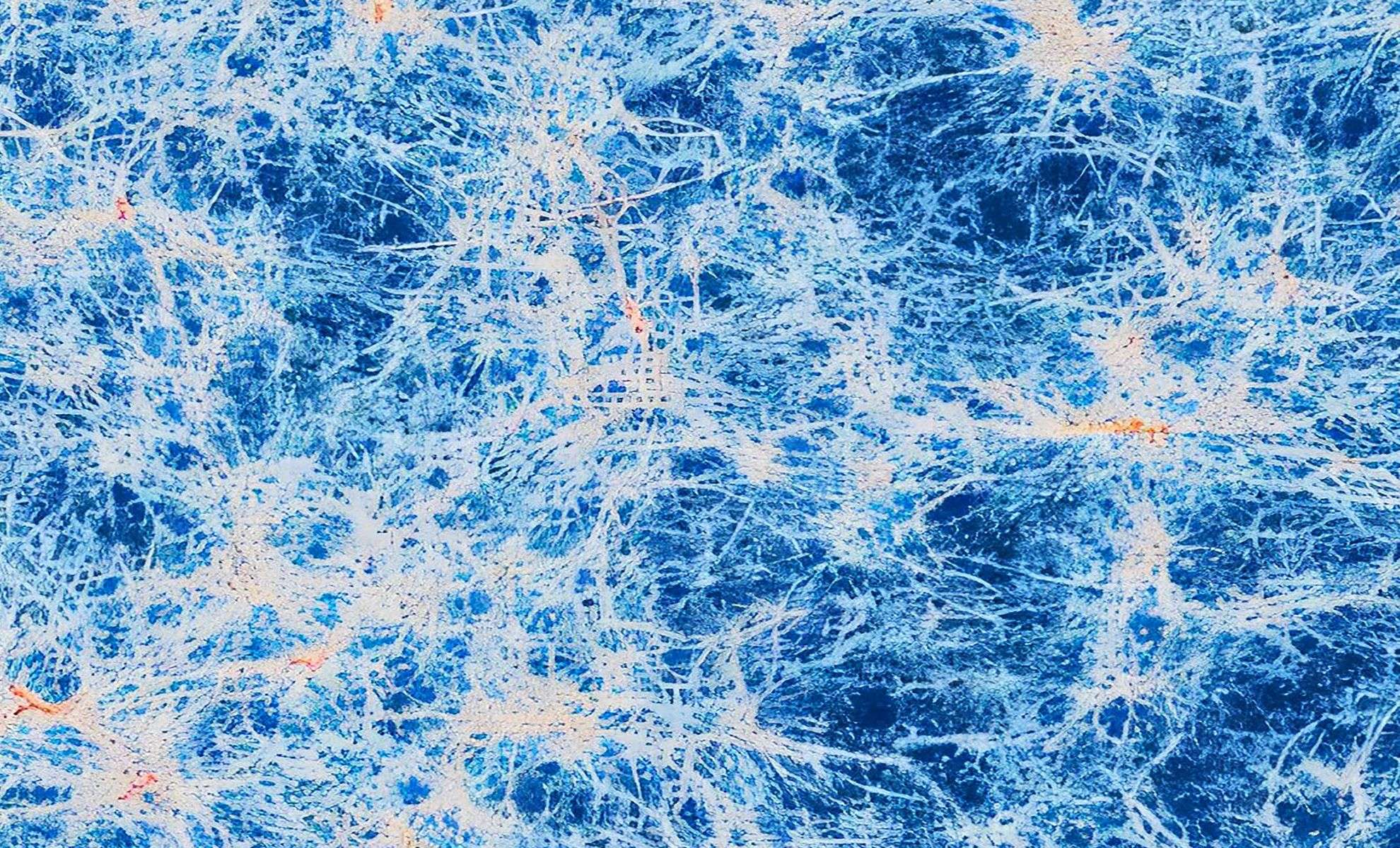
Astrophysicists have made a groundbreaking advancement by capturing the inaugural direct image of the cosmic web, an extensive and mostly unseen framework integral to galaxy formation and cosmic expansion. This cosmic web, often referred to as the universe’s “skeleton,” links galaxies via slender filaments of gas and dark matter that, until now, existed only in theoretical concepts and computer models. Utilizing state-of-the-art observational instruments, researchers have now photographed one such filament, confirming long-held scientific predictions.
Detailed in the esteemed Nature Astronomy, the breakthrough enhances our grasp of cosmic architecture and sheds light on the mechanisms driving galaxy evolution. By focusing on two quasars that lie over 11 billion light-years away, a team led by the University of Milano-Bicocca and the Max Planck Institute for Astrophysics unveiled the faint filament linking these distant galaxies. Spanning an incredible 3 million light-years, this filament constitutes a key feature of the cosmic web previously unobserved directly. This revelation opens new avenues for deeper exploration of the universe’s hidden design.
Unveiling the Subtle Cosmic Filament
Thanks to the Multi-Unit Spectroscopic Explorer (MUSE) attached to the European Southern Observatory’s Very Large Telescope (VLT) in Chile, astronomers achieved a level of detail in observing cosmic filaments never before attained. The filament's faint, gas-filled nature made it extraordinarily challenging to isolate against background noise. The advanced capabilities of MUSE allowed the team to extract detailed spectral information pixel by pixel, successfully detecting the subdued emission of hydrogen gas from the filament.

This filament stretches delicately between the two quasars, revealing a clear stream of hydrogen flowing along these cosmic web “gravitational highways.” Such channels are critical for star formation and the overall enlargement of galaxies. Davide Tornotti, a Ph.D. candidate at the University of Milano-Bicocca directing the study, explains, “By observing the faint light emitted from this filament, which traveled nearly 12 billion years to reach us, we could accurately detail its structure.”
This observation extends beyond capturing a distant sight; it strongly supports the theory that galaxies expand by drawing in gas through interconnected filaments. Galaxies don’t just collect isolated gas clouds; they pull material along these cosmic links, reinforcing the cold dark matter framework, which claims that most matter—about 85%—is invisible and constructs the cosmic web’s backbone.
Cosmic Filaments’ Crucial Role in Galaxies’ Evolution
These filaments are more than awe-inspiring formations—they hold the key to understanding how galaxies form and continue to develop. As gas travels along these threads, it nourishes the outskirts of galaxies, fueling new star birth. In the absence of this steady gas supply, galaxies would rapidly exhaust their star-forming fuel within a few hundred million years.
The captured filament also brings attention to the circumgalactic medium, the zone encasing galaxies where gas gathers. This area is critical for star formation as it replenishes the galaxy’s material reserves. Tornotti elaborates, “For the first time, we traced the boundary between gas bound to galaxies and the material flowing through the cosmic web using direct measurements.” Understanding this border is essential to uncovering how galaxies sustain star formation over cosmic timescales.
Moreover, the filament’s discovery highlights how the cosmic web influences galaxies’ shapes and properties. The gas flows not only promote star formation but also impact the galaxies’ structure, shedding light on why certain galaxies remain active in star production while others halt activity and transition to dormant states.
Advancing Dark Matter and Cosmological Knowledge
This image also serves as a valuable probe into dark matter, the elusive substance comprising much of the universe’s mass. The filament’s brightness is affected by the density of ambient dark matter, providing a novel method to examine the distribution of this enigmatic material. Observing this filament offers a fresh lens through which to study dark matter’s influence on the universe’s vast-scale structure.
As Fabrizio Arrigoni Battaia, an MPA scientist involved in the research, remarks, “We are excited about this crisp, direct observation of a cosmic filament. In Bavaria, they say ‘Eine ist keine’ – one doesn’t count.” This reflects the team’s recognition that this initial discovery is just the starting point. Their goal is to gather more observations of cosmic filaments, ultimately constructing a comprehensive map of gas flows in the cosmic web to further unravel the mysteries of dark matter and galaxy growth.
Future advancements with next-generation telescopes like the Extremely Large Telescope (ELT) will enhance resolution and allow even more detailed studies of these filaments. The team looks forward to using such instruments to deepen insights into galaxy formation mechanisms and the fundamental nature of dark matter.
Exploring the Future of Cosmic Web Discoveries
This discovery is just the beginning. As astronomers continue identifying additional filaments, they will refine cosmic web models and better understand galaxy development and the universe’s overall architecture.
Highlighting the power of modern observational technology and the promise of upcoming innovations, this research sets the stage for many more direct images of cosmic filaments. Gradually, scientists aim to reveal the vast, hidden framework that integrates the universe.
Summarizing the work, Tornotti states, “We are actively collecting more data to detect further structures, aspiring to achieve a full picture of gas distribution and movement within the cosmic web.” This ongoing exploration is poised to transform our cosmic perspective, illuminating the processes shaping galaxies, dark matter, and the evolving universe.
- Categories:
- News









0 comments
Sign in to Comment