
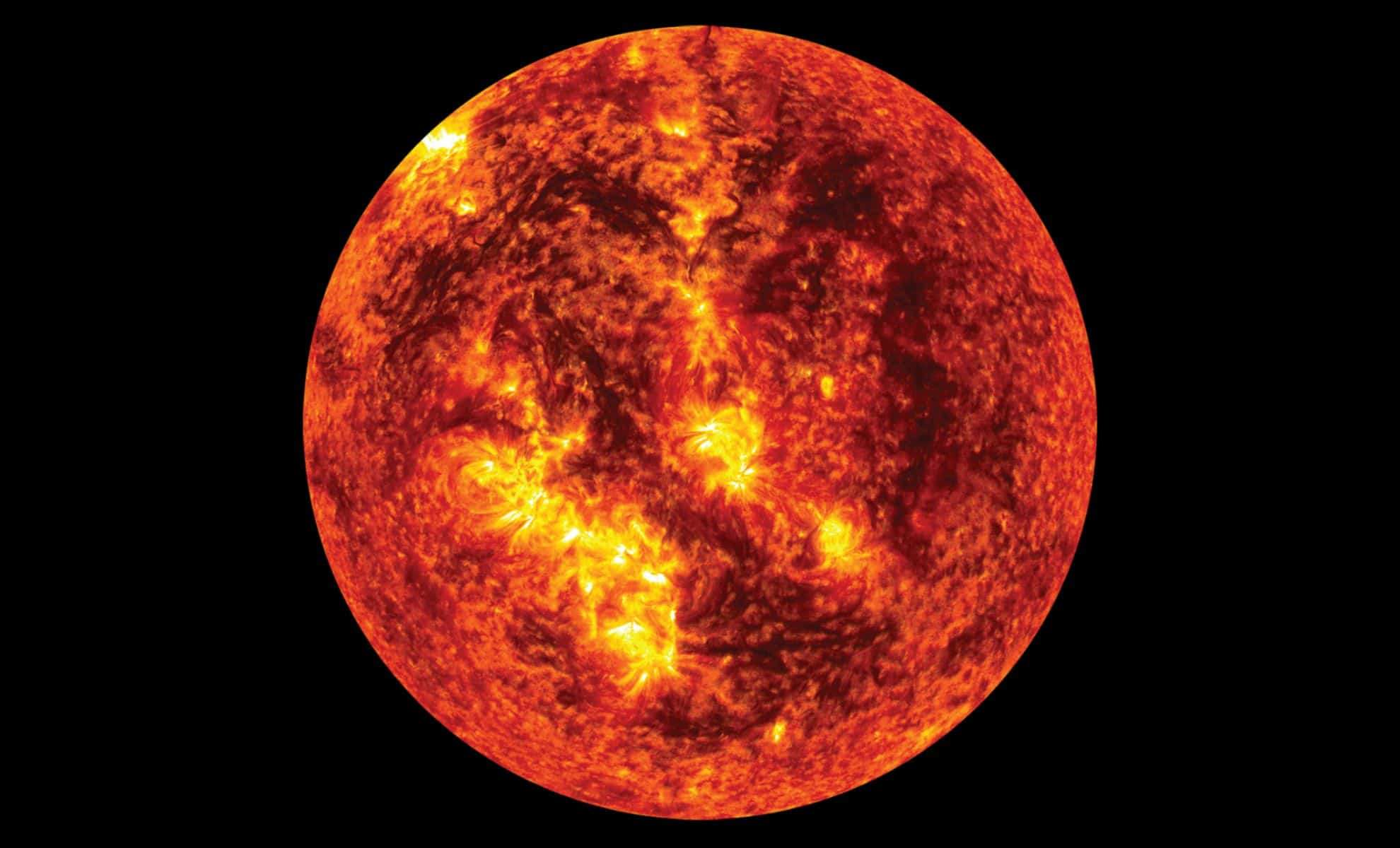
An extraordinary new photograph of the Sun, taken by the National Solar Observatory (NSO) with the advanced Inouye Solar Telescope perched in Hawaii, has unveiled previously unseen magnetic patterns on the solar surface. These formations, thin sheet-like magnetic fields only about 20 kilometers across—comparable to the width of Manhattan—represent an unprecedented discovery. This remarkable capture is being celebrated as one of the most detailed and sharpest solar images to date.
Unveiling the Sun’s Surface with Unmatched Precision
Employing a specialized Visible Broadband Imager camera and a G-band filter, which enhances magnetic features on the Sun, the Inouye Solar Telescope produced this ultra-high-resolution image. Scientists can now study magnetic structures on the solar surface in extraordinary detail. These magnetic ribbons resemble “curtains fluttering in the wind,” influencing how sunlight interacts with them, and provide critical evidence of the Sun’s dynamic magnetism.
These magnetic formations, often described as the Sun’s “signatures,” are vital to researchers aiming to decode the behavior of solar magnetism. Dr. David Kuridze, lead author of the study and researcher at NSO, emphasized that understanding these stripes could enhance forecasts of solar flares, eruptions, and space weather. Such advancements are crucial since solar disturbances can significantly affect Earth-based technologies like satellites, electrical grids, and navigation systems.

New Magnetic Features Shed Light on Space Weather
Beyond its striking appearance, the new image offers critical insight into solar magnetism, which drives space weather phenomena. For example, geomagnetic storms—caused by coronal mass ejections—can disrupt Earth's infrastructure by affecting electrical networks. Studying these magnetic patterns is thus not only fascinating scientifically but essential for protecting modern technologies in our interconnected world.
The Inouye Solar Telescope situated in Maui County, Hawaii, continues to be pivotal in advancing solar science. Its capability to capture intricate solar details showcases the forefront of observational technology. Dr. David Boboltz, NSO's associate director for the telescope, commented, “This achievement marks just one of many pioneering milestones for the Inouye, illustrating its vital role in expanding solar research.”

Public Enthusiasm and Diverse Opinions
The image rapidly gained popularity online, sparking admiration for its extraordinary clarity of the solar surface. On Reddit, users shared their excitement, with one stating, “SHARPEST-EVER view of the Sun’s surface at a 20 km scale,” while others commented on the vast scale displayed. “Seeing the 5,000 km scale at the bottom blew my mind,” noted another commenter.
However, reactions were mixed, as some viewers found the image unsettling. One user remarked, “It feels almost alien, like something unreal despite knowing it’s authentic.” Despite varied responses, the overall consensus celebrates the photograph as a revolutionary contribution to solar observation.
As ongoing studies proceed, the Inouye Solar Telescope is expected to uncover even deeper insights into the Sun’s magnetic behavior and their impacts on Earth’s environment.
- Categories:
- News











0 comments
Sign in to Comment