
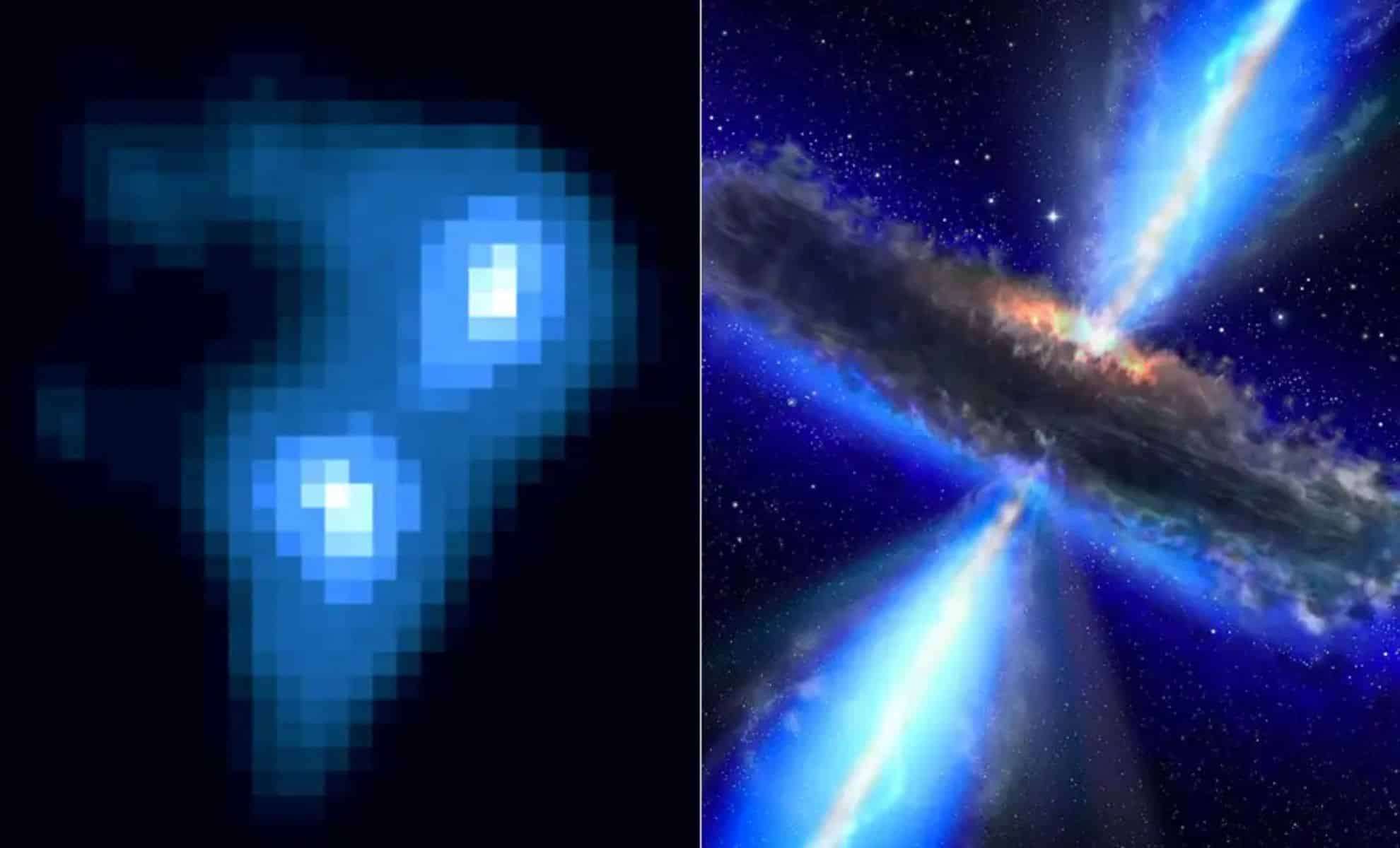
Researchers have uncovered the most massive and farthest water reservoir observed cosmic-wide. This enormous accumulation of water, equivalent to 140 trillion times the volume of Earth's oceans, envelops a quasar situated over 12 billion light-years away. This revelation questions earlier views on the early cosmos, highlighting water's critical presence in galaxy formation.
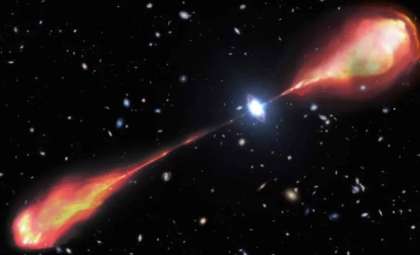
The quasar, named APM 08279+5255, hosts a supermassive black hole with a mass 20 billion times that of the Sun. Its incredible energy emission — comparable to a thousand trillion Suns — creates extreme environments that sustain abundant water vapor. Detailed in The Astrophysical Journal Letters, this discovery illuminates water’s influence on quasar surroundings and the early universe’s makeup.
An Unprecedented Cosmic Water Accumulation
Our Milky Way contains water vapor but at a mere fraction—about 4,000 times less—than the concentration encircling APM 08279+5255. Most galactic water remains frozen in ice, making this immense vapor cloud extraordinary.

Scientists employed infrared and millimeter-wave observatories to detect this vast water vapor expanse, which spans hundreds of light-years around the quasar. The gaseous environment here is denser—10 to 100 times—than typical space regions and maintains a relatively warm temperature of -63°F (-53°C) due to intense radiation from the quasar.
“The circumstances enveloping this quasar are exceptional, giving rise to a colossal volume of water,” explained Matt Bradford from NASA’s Jet Propulsion Laboratory, who led one of the research groups. “This discovery further confirms that water is widespread across the cosmos, even in its earliest stages.”
How the Largest Cosmic Water Body Was Discovered
This breakthrough was achieved by combining observations from several advanced telescopes:
- Caltech’s Submillimeter Observatory in Hawaii
- The Combined Array for Research in Millimeter-Wave Astronomy (CARMA) in California
- The Plateau de Bure Interferometer located in the French Alps
In 2010, Dariusz Lis and his Caltech team unexpectedly detected water signals from APM 08279+5255. This prompted follow-up studies by Matt Bradford’s group, who confirmed the massive volume of water vapor through multiple spectral detections.
Water’s Significance in the Early Universe
Water vapor plays a vital role in unraveling the evolution of galaxies and black holes. Around APM 08279+5255, the presence of carbon monoxide alongside water hints that this gas reservoir could fuel the black hole's growth, potentially increasing its size sixfold. Yet its fate is unpredictable — whether collapsing into new stars or being expelled by the quasar’s powerful energy.
This finding indicates that water was already prevalent just 1.6 billion years after the Big Bang, suggesting life’s key components existed far earlier than previously assumed.
- Categories:
- News







0 comments
Sign in to Comment