

A recent investigation has unveiled that a substantial portion of Earth's crust beneath the Midwestern United States is gradually being drawn downward into the Earth’s mantle. This gradual movement, termed “dripping,” is linked to the remnants of an ancient tectonic structure called the Farallon plate.
The Role of the Farallon Slab Under North America
The research, featured in Nature Geoscience and led by geologist Junlin Hua, focuses on the Farallon slab, a fragment of oceanic crust that separated from the principal tectonic plate millions of years ago. Once part of a subduction zone along the western edge of the continent, this ancient slab still exerts influence beneath North America.
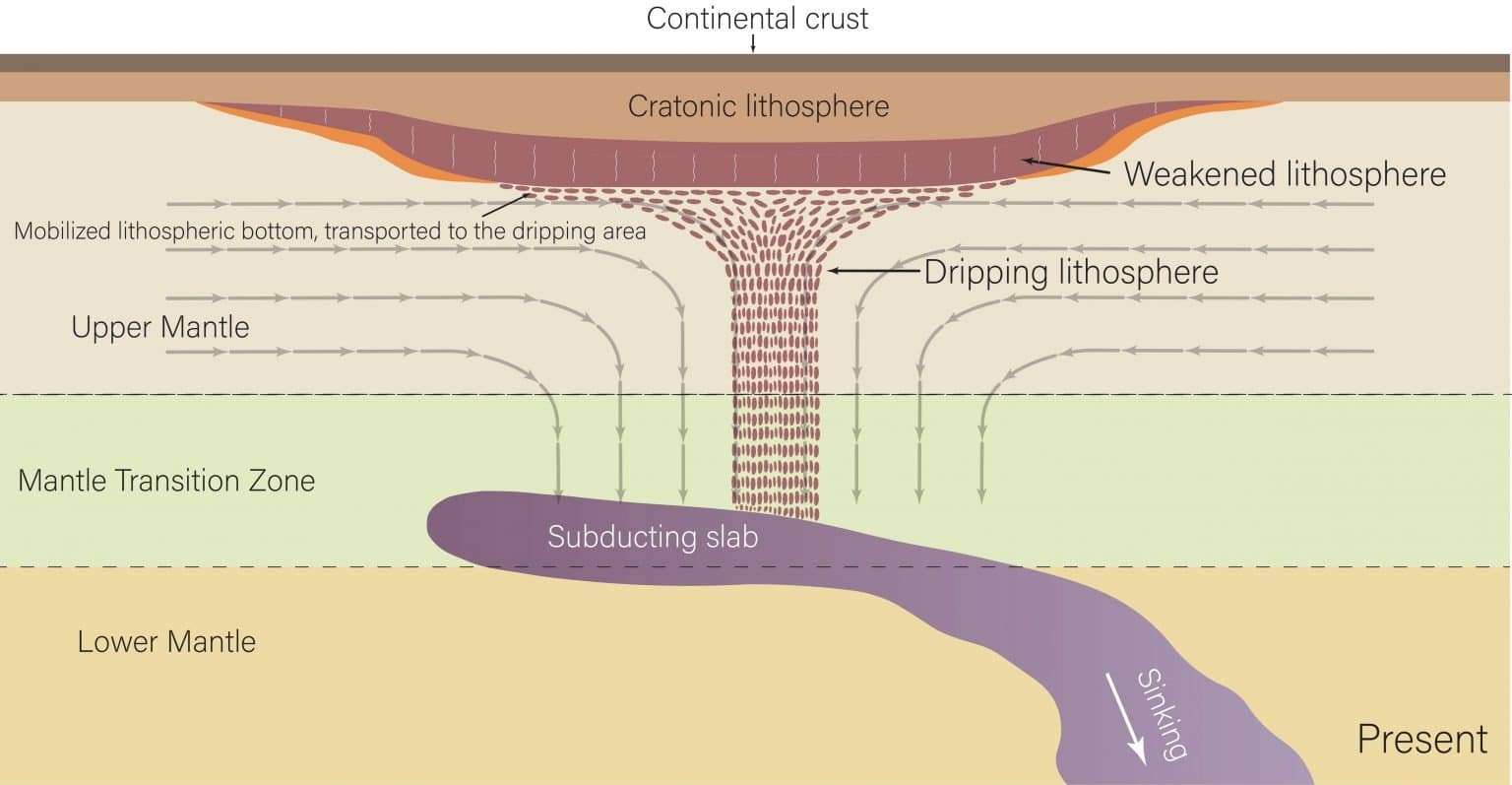
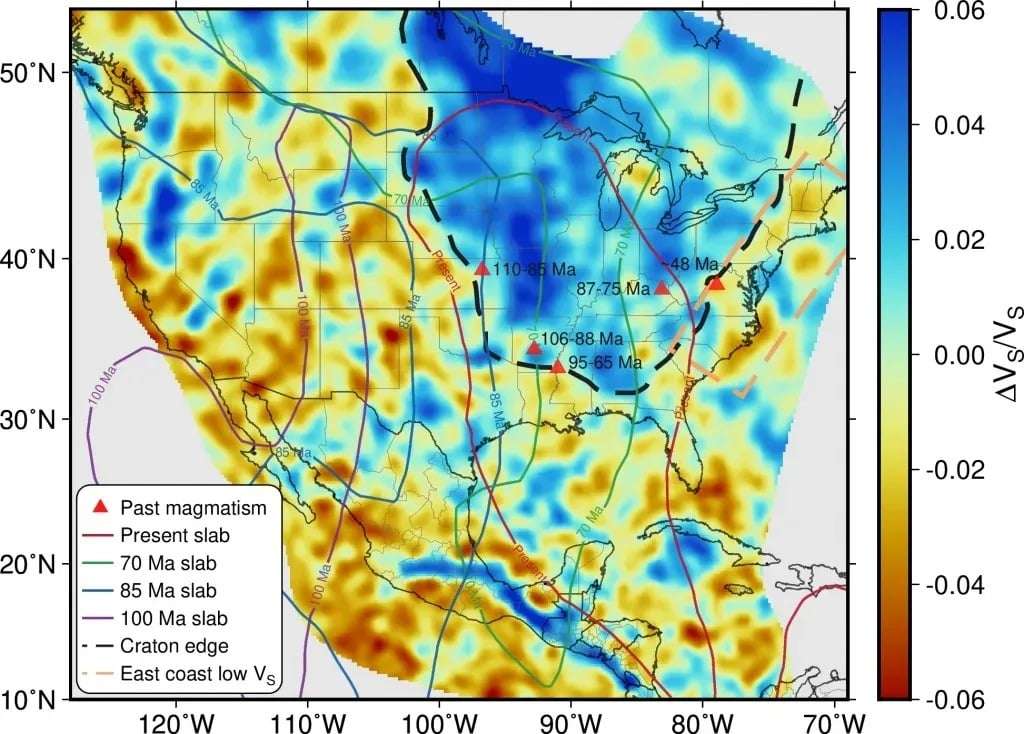
Hua explains that the Farallon slab causes “cratonic thinning” beneath the Midwest, pulling sections of the crust downward into the mantle. Its effect spans a wide area from Michigan through Nebraska to Alabama.

Seismic imagery has identified extensive “drips” hanging from the continent’s underside, extending approximately 400 miles (640 kilometers) deep into the mantle. These structures form a funnel-like shape that channels material beneath the continent’s surface towards the slab before it is drawn deeper into the Earth.
Innovative Seismic Techniques Reveal Subsurface Dynamics
The scientists employed an advanced seismic imaging approach, known as full-waveform inversion, to detect these hidden features. This cutting-edge method enabled detailed visualization of the Earth’s interior, focusing on the mantle and crust beneath the North American landmass.
This technique analyzes seismic waves generated by earthquakes to gain insights into the physical characteristics of subterranean layers, offering a clearer picture of deep Earth processes.
The findings mark the first observation of cratonic thinning occurring in real-time, shedding light on how the Earth’s crust evolves over geological timescales.
Insights Into Ancient Tectonic Activity
The impact of the Farallon plate on North American geology dates back around 20 million years when it fractured due to the advancing Pacific plate. Subsequently, fragments of this plate descended into the Earth's mantle, giving rise to the structures observed today.
This slab, situated between the mantle’s transition zone and lower mantle, was initially detected in the 1990s, but its full influence on the North American plate has only recently become evident.
Experts suggest this “dripping” beneath the Midwest should not produce immediate surface disruptions. As the Farallon slab gradually sinks further, its effects on the overlying crust will taper off, eventually causing the dripping to cease.
Nevertheless, this discovery enhances our understanding of the processes involved in continent formation, fragmentation, and renewal deep within the Earth’s geology.
These findings bring scientists closer to unraveling the long-term dynamics shaping Earth’s surface over millions of years.
- Categories:
- Science








0 comments
Sign in to Comment