

Researchers have uncovered an extraordinary collection of dinosaur footprints dating back to the Early Cretaceous era on two separate continents—South America and Africa. More than 260 tracks were found, providing compelling evidence of the final connections between these landmasses before the formation of the South Atlantic Ocean approximately 120 million years ago.
These footprints were discovered in the Sousa Basin of Brazil and the Koum Basin in Cameroon, marking a rare find that closely links the histories of these continents, once unified as part of the supercontinent Gondwana. The evidence indicates that dinosaurs, including theropods, sauropods, and ornithischians, roamed across the land bridge connecting the two regions before tectonic shifts led to their separation by ocean.
Insights into the Ancient World
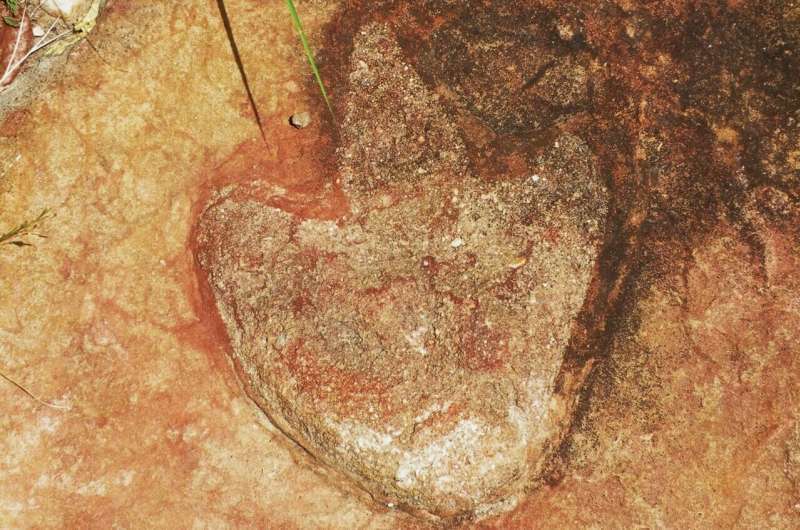
The parallel nature of these footprints offers a unique window into Earth’s geological transformations and the creatures inhabiting it millions of years ago. Paleontologist Louis L. Jacobs from Southern Methodist University (SMU), who spearheaded the study, notes, “The footprints not only match in age but also closely resemble each other in shape and geological context.”


The footprint similarities vividly illustrate a time when Africa and South America were joined, facilitating the movement of dinosaurs across what is now a vast ocean—more than 3,700 miles apart today. Impressions made in muddy riverbanks and lakebeds were fossilized, preserving detailed records of prehistoric dino activity along ancient waterways.
The locations where these footprints emerged correspond to a vanished land bridge connecting northeastern Brazil and Cameroon. This narrow terrestrial corridor allowed dinosaur migrations prior to the continents drifting apart, which occurred as tectonic forces drew the plates apart and submerged the land under the rising South Atlantic Ocean.
Geological Context Corroborates the Findings
Alongside the footprints, fossilized pollen discovered in the same sediment layers helped confirm their age at roughly 120 million years. These were found within half-graben basins, geological structures that formed as the Earth’s crust pulled apart during continental rifts. These basins preserve ancient river and lake sediment layers that reveal the ecosystem conditions of the time.
Jacobs explains, “These ancient river valleys served as natural corridors for species migration 120 million years ago.” The waterways supported diverse vegetation and ecosystems that sustained herbivores while preserving the tracks of carnivorous theropods and other dinosaurs in the mud. These footprints not only shed light on past life but also highlight the critical importance of river systems in linking the landmasses.
The geological record from these sites offers vital information about Gondwana’s breakup. As tectonic plates diverged, magma surfaced to create new oceanic crust, eventually flooding the gap with water to form today’s South Atlantic Ocean. These footprints remain some of the final tangible evidence of dinosaur travel across the land bridge before the ocean permanently separated the continents.
Implications for Continental Drift and Dinosaur Evolution
Finding matching dinosaur footprints on separate continents provides robust proof of the powerful geological forces reshaping Earth’s surface over time. Published by the New Mexico Museum of Natural History & Science, this study honors the late Martin Lockley, a trailblazer in fossil footprint research, whose work helped illuminate ancient dinosaur movement.
These footprints serve as more than mere impressions—they testify to how plate tectonics and continental drift influenced the distribution and evolution of prehistoric species. The striking similarity of footprints on both sides supports the idea that shared dinosaur species migrated across the land bridge before the Atlantic Ocean fragmented their habitats.
The research also highlights the broader effects of Gondwana's fragmentation, revealing how shifting continents led to species isolation and divergent evolutionary pathways. The rise of the South Atlantic Ocean spurred independent evolution on both continents, contributing to Earth's modern biodiversity. This remarkable discovery underscores the crucial role fossils play in uncovering Earth’s intricate geological and biological history.








0 comments
Sign in to Comment