
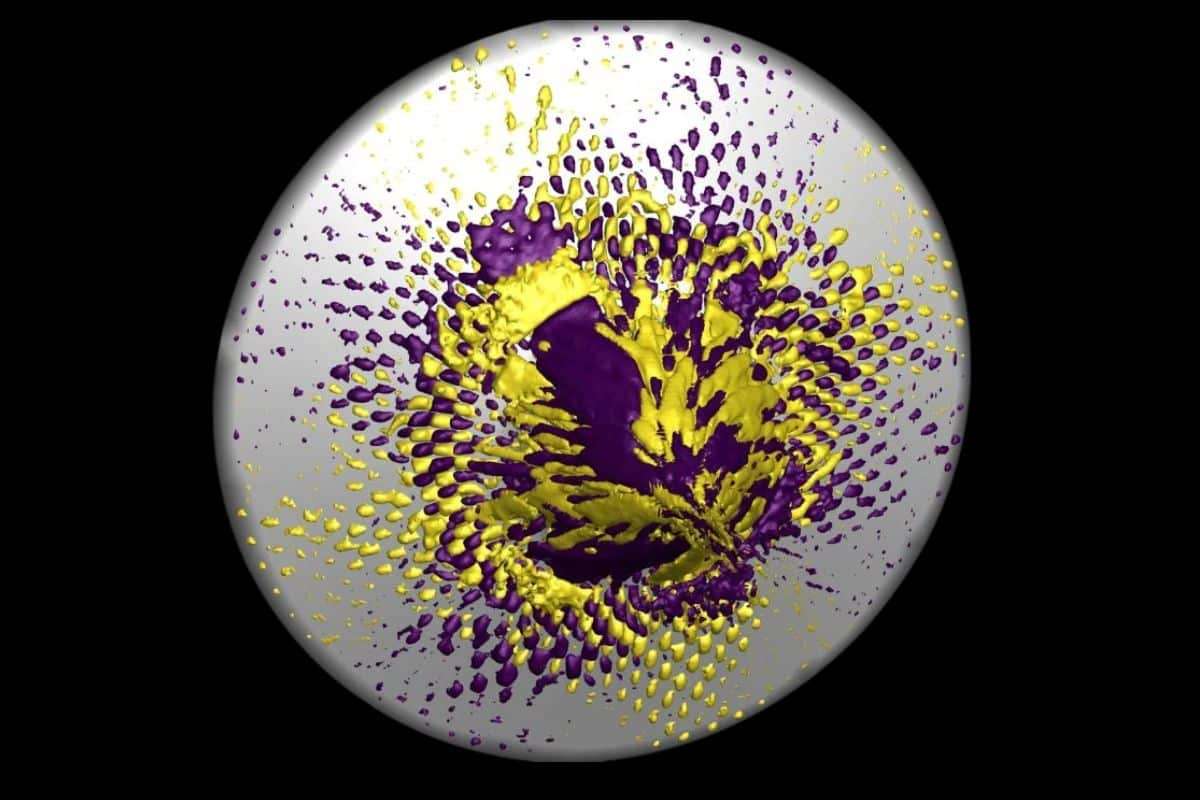
A team at the University of Illinois Urbana-Champaign has conducted a pioneering simulation study that reveals previously hidden flow instabilities affecting hypersonic vehicles cruising at Mach 16. This discovery calls into question established beliefs about fluid behavior at such extreme velocities. The study, published in Physical Review Fluids in March 2025, details complex turbulence phenomena that could significantly impact the future development of hypersonic technology.
Utilizing high-fidelity three-dimensional simulations powered by a cutting-edge supercomputer, researchers have fundamentally advanced our comprehension of aerothermal interactions at ultra-high speeds, setting the stage for a new era in aerospace engineering.
Revealing Hidden Turbulence Beyond Mach 5
Operating at hypersonic velocities, defined as speeds surpassing Mach 5, poses profound engineering hurdles due to intricate interactions between airflow and vehicle surfaces. At these speeds, air compresses to form intense shock waves, and boundary layers exhibit volatile behavior. Historically, three-dimensional aspects of these phenomena have eluded complete capture in both simulations and experimental wind tunnel work.

Lead investigator Professor Deborah Levin and doctoral candidate Irmak Taylan Karpuzcu applied specialized software running on Frontera—one of the fastest supercomputers dedicated to research—to model airflow around cone-shaped structures at Mach 16. Their observations defied expectations: instead of symmetric flow, they noted angular instabilities, oscillatory separation lines, and disrupted flow patterns.
Disruptions in Flow Patterns
Rather than smooth, concentric flow layers, the 3D models exposed chaotic features such as shock layer interruptions and abrupt density fluctuations, especially concentrated near the tip of the cones. At this speed, shock waves cling closely to surfaces, compressing air into viscous, unstable zones. These results imply that the traditional assumption of axial symmetry in hypersonic designs may not persist at extremely high speeds.
Comparisons with experiments at Mach 6 showed no similar anomalies, emphasizing that these instabilities emerge specifically at higher velocities. This warns against relying solely on low-speed tests for designing full-scale hypersonic vehicles.
Leveraging Direct Simulation Monte Carlo
A key advancement came with the implementation of the direct simulation Monte Carlo (DSMC) technique, which statistically follows individual air molecules through billions of random interactions. Unlike deterministic methods, DSMC incorporates probabilistic dynamics of molecular collisions.
This method unveiled the development of two distinct turbulent regions around a double-cone profile, repeating with a 180-degree rotational symmetry. To validate these insights, the team conducted linear stability analyses grounded in triple-deck theory, confirming the physical authenticity of their findings.
Consequences for Hypersonic Craft Engineering
The double-cone geometry, representative of many hypersonic vehicle noses and re-entry shapes, revealed a critical vulnerability: a form previously regarded as aerodynamically stable could instead experience unforeseen thermal and mechanical loading.
Reflecting on the importance of the 3D perspective, Karpuzcu explained, “Earlier 3D experiments from the early 2000s couldn't capture three-dimensional flow effects or unsteady behavior due to limited sensor coverage around cone models.”
Advancing Hypersonic Simulation Standards
This research establishes a new baseline for understanding fluid mechanics in the hypersonic regime. The demonstration that flow symmetry breaks down at Mach 16 challenges existing testing approaches, design methodologies, and safety assessments.
With the expanding global interest in hypersonic defense applications, spaceplane development, and orbital payload delivery, the necessity for precise simulation methods is more critical than ever. These results underscore that accurately accounting for three-dimensional instabilities is indispensable for reliable hypersonic vehicle design, something beyond the scope of two-dimensional models.
- Categories:
- News









0 comments
Sign in to Comment