
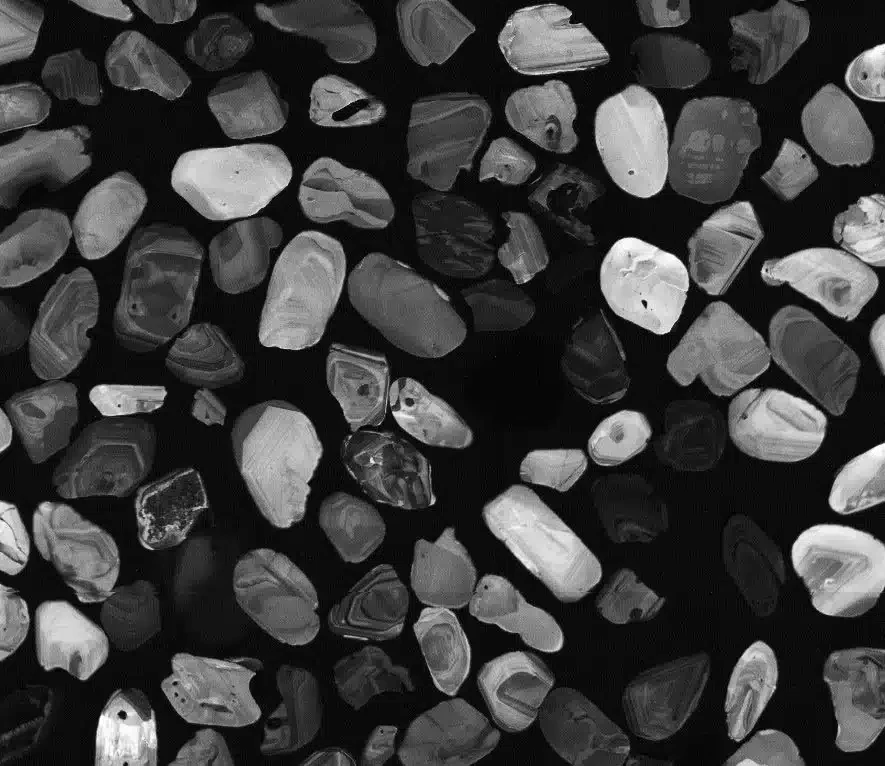
Microscopic crystals found in the sandy shores of Australia have recorded cosmic signals, offering scientists an unprecedented glimpse into erosion and geological transformations spanning millions of years. By examining a unique gas produced by cosmic radiation, researchers have pieced together timelines hidden not in fossil records or rock formations, but within grains barely thicker than a human hair.
Developed by a team at Curtin University alongside collaborators from the University of Göttingen and the University of Cologne, this innovative approach targets zircon, a durable mineral that has persisted through endless cycles of weathering and relocation. Each grain harbors a tiny record of its exposure to the sky, unlocking a novel method for interpreting Earth’s surface evolution.
Why is this discovery significant? It equips geologists with an unprecedented natural timer.

Revealing Earth’s History Through Cosmic Rays
The foundation of this technique centers around krypton, a noble gas formed when cosmic rays — high-energy particles from outer space — interact with minerals like zircon near Earth’s surface (source). This process, known as cosmogenic nuclide generation, gradually accumulates measurable quantities of krypton inside the crystals. By extracting and analyzing this trapped gas, scientists can determine how long the mineral remained at or near the surface prior to burial.
Think of it as geological timing with extraordinary accuracy. The research, published in Proceedings of the National Academy of Sciences, features lead author Dr. Maximilian Dröllner, who explains that this method reveals ancient landforms far beyond the reach of conventional dating techniques.
“Our planet’s history shows climate and tectonic forces can control how landscapes behave over very long timescales,” he said. And now, scientists can finally measure that behavior with surprising precision.
Although individual zircon grains are smaller than 0.1 millimeters, their resilience ranks them among the hardiest minerals known.
Still Landscapes and Sediment Preservation
One striking revelation is that in regions with minimal tectonic activity and steady high sea levels, sediments tend to remain largely undisturbed. These tranquil settings allow minerals to linger near the surface for millions of years without being displaced or deeply buried.
Professor Chris Kirkland, co-author and leader of Curtin’s Timescales of Mineral Systems Group, highlights that these circumstances shift prevailing views on how landscapes evolve. He notes:
“As we modify natural systems, we can expect changes in how sediment is stored in river basins and along coastlines.” That’s not just a note for geologists, but for planners, engineers, and environmental scientists looking at long-term coastal behavior.
Periods of reduced erosion and sediment movement, which usually remain hidden with older methods, become visible through the study of cosmogenic krypton. This breakthrough lets researchers identify quiet geological epochs and assess their role in maintaining landscape stability.
Impacts on Mineral Resource Discovery
This discovery also holds substantial promise for mineral exploration. Australia is rich in mineral sands, and understanding the formation processes over deep time may improve identification of valuable deposits.
SciTechDaily shares Associate Professor Milo Barham’s insights connecting climatic factors to mineral concentration:
“Extended periods of sediment storage allow durable minerals to gradually concentrate while less stable materials break down.”
In essence, the longer zircon remains exposed, the more enriched the sediment layer becomes in economically important minerals.
- Categories:
- Science





0 comments
Sign in to Comment