

In a landmark achievement once reserved for theory and simulation, astronomers have now directly observed a planet in the earliest stages of its development. This remarkable discovery, not merely artistic interpretation, was published in The Astrophysical Journal Letters.
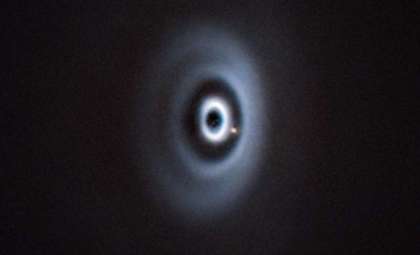
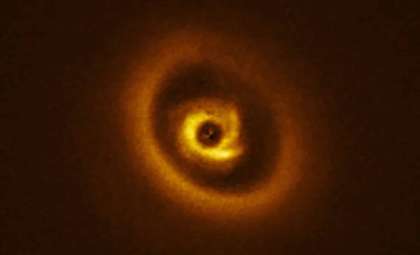
The infant world, designated WISPIT 2b, was spotted inside a darkened gap within a circumstellar disk of dust and gas around a star similar to our sun, named WISPIT 2. Previously, these dark spaces were only hypothesized as indicators of planet formation, but this marks the first time they’ve been observed in such vivid detail.
Peering Back in Time Using Advanced Optics
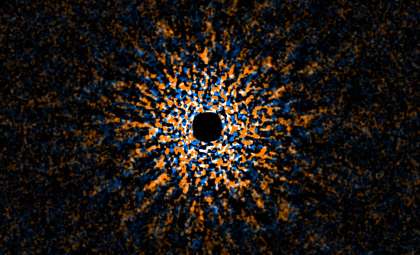
This extraordinary observation was made possible by a group led by Laird Close of the University of Arizona, alongside graduate student Richelle van Capelleveen from Leiden Observatory. Employing one of the world's most sophisticated optical instruments—MagAO-X—the team scrutinized the space between two rings of dusty material and detected a faint point emitting H-alpha emission.

Here’s the concept: as a forming planet accumulates hydrogen gas, the infall generates intense heat, causing a brief luminous burst that can be captured with specialized tools. Installed on the 6.5-meter Magellan Telescope in Chile, MagAO-X was specifically designed to observe this kind of emission—and it succeeded.
Innovative Technology Reveals Hidden Realms
MagAO-X, which stands for Magellan Adaptive Optics eXtreme, is an innovative system that corrects for atmospheric disturbances that typically blur telescope views. This technology enables researchers to isolate the faint glow of a planet from the blinding radiance of its host star.
When the team directed MagAO-X toward the WISPIT-2 star system, the results were outstanding. Close recounted that "the planet became immediately obvious once the adaptive optics were engaged." In just two hours of observation, the embryonic planet emerged clearly as a luminous spot nestled within the disk’s rings.
Along with WISPIT 2b, another contender planet named CC1 was discovered closer to the star, with an estimated mass around nine times that of Jupiter. These findings were corroborated through infrared observations using the Large Binocular Telescope in Arizona and reinforced by data from the SPHERE adaptive optics system installed on the Very Large Telescope (VLT) in Chile.
Using MagAO-X, astronomers have captured—for the first time—a baby planet growing inside a disk of dust and gas. The sharp U of A-developed adaptive optics revealed how young worlds plow dark paths through their star’s protoplanetary disks as they form: https://t.co/zE6jRVkBFT pic.twitter.com/7PIMlGtmkp
— Steward Observatory, University of Arizona (@StewardAstro) August 28, 2025
An Intricate Planetary Cradle Many Light-Years Away
WISPIT 2b orbits its star approximately 56 astronomical units (AU) away—equivalent to about 3.5 billion miles—which places it much farther from its sun than Neptune is from ours. The other planet candidate, CC1, travels at a closer distance of roughly 14 to 15 AU, similar to the space between Saturn and Uranus in our solar neighborhood.
Gabriel Weible, a graduate researcher involved in the project, likened the discovery to unearthing "infant snapshots" of Jupiter and Saturn, albeit at a significantly larger scale. “The planets in the WISPIT-2 system appear to possess masses roughly ten times greater than our gas giants and are spaced farther apart,” he shared.
A Rare Opportunity to Witness Planetary Infancy
This finding is particularly thrilling because these visible stages are ephemeral. Richelle van Capelleveen explained: “To observe planets during their brief formative phase, astronomers must locate young disk systems, which are exceedingly rare.” Had the researchers observed WISPIT 2 when it was as old as our sun, no such illuminating features would have appeared—no discernible light, gaps, or planetary hints.
Because this luminous phase is so fleeting, many planets in formation remain undetected. But through meticulous preparation, advanced instrumentation, and a stroke of cosmic fortune, this team succeeded in capturing one in its earliest glow.
- Categories:
- News







0 comments
Sign in to Comment