
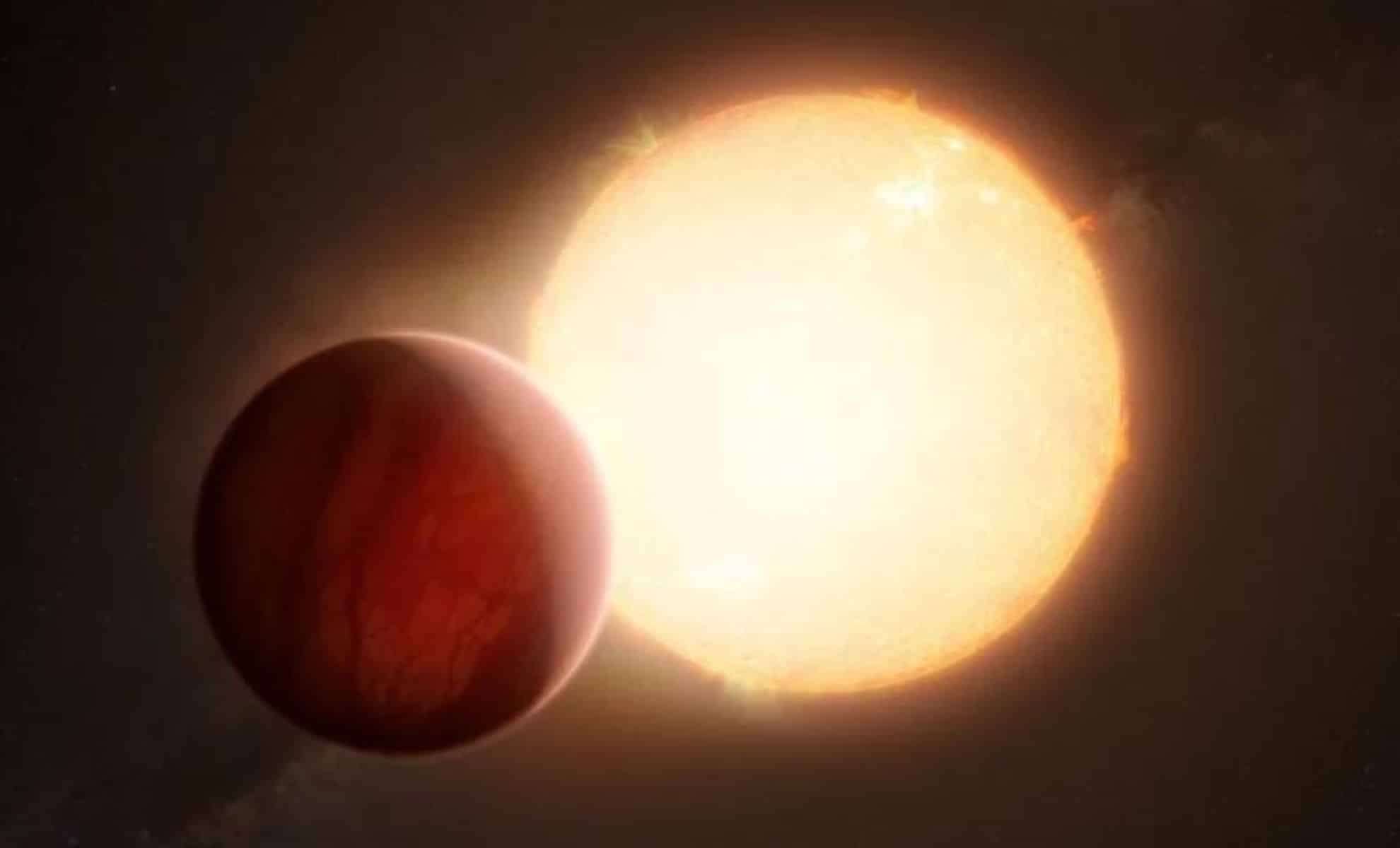
Scientists at Lund University in Sweden have identified an unusual exoplanet whose behavior could revolutionize our understanding of how planets form and maintain their orbits.
A newly observed planet, named TOI-1408c, located 455 light-years away, exhibits an unexpected orbital pattern that contradicts existing planetary science theories.
This finding sheds light on the complexities of planetary systems, especially in scenarios with closely interacting planets and their central star. Discovered with assistance from NASA’s Transiting Exoplanet Survey Satellite (TESS), TOI-1408c is a remarkable addition to the growing catalog of exoplanets.

TOI-1408c's Irregular Orbit Reveals Intricate Planet-Star Dynamics
TOI-1408c, about eight times the mass of Earth, orbits in close proximity to a significantly larger gas giant, TOI-1408b, within the TOI-1408 stellar system. The gravitational interplay between these two planets and their star generates a complex orbital pattern described as a “cosmic dance.” The smaller planet’s transit times vary noticeably, indicating highly complicated gravitational interactions within the system.
What makes this discovery particularly striking is the atypical orbital motion of TOI-1408c compared to other known exoplanets. Lead astrophysicist Judith Korth from Lund University explains, “The small planet exhibits very unusual orbital behavior and shows considerable variations regarding the time when it passes in front of its star, which is something that we don’t see as a rule.” These unexpected orbital shifts challenge the conventional ideas of planetary stability and formation.
New Planetary Formation Theories Needed to Explain TOI-1408c’s Anomalies
The presence of TOI-1408c questions established planetary formation models that typically assume planets exhibit stable orbital paths, especially within systems containing gas giants. The irregularities in TOI-1408c’s orbit imply that some planetary systems may evolve through more chaotic and complex stages than science previously acknowledged. The interactions between the smaller TOI-1408c and its neighboring gas giant push the boundaries of current stability theories.
Judith Korth emphasizes the broader scientific significance, stating, “The small planet’s existence challenges existing theories on the formation and stability of planetary systems.” The peculiar conditions within the TOI-1408 system could serve as a new framework for investigating other planetary arrangements. TOI-1408c’s erratic orbit presents an exceptional chance to explore the dynamics of planets in tight, interactive environments.
Impacts on Understanding the Diversity of Planetary Systems
The anomalous behavior of TOI-1408c may broaden astronomers’ perspectives on how planetary systems develop and operate. Traditional formation theories often rely on data from stable, orderly systems. In contrast, TOI-1408c’s irregular orbit indicates that planetary environments can be far more dynamic, particularly when involving massive gas giants. This discovery provides a valuable reference for studying the formation and evolution of planets in diverse star systems.
The intricate dynamics of the TOI-1408 system offer more than theoretical insight; they also enhance understanding of planetary evolution on a practical level. As Korth notes, “Our results will help researchers to learn more about how planets are formed and how they behave when they are very close to each other, particularly in systems with giant planets.” This study may reshape astronomers’ concepts of planetary variety across the galaxy by highlighting the importance of examining these less predictable environments.
The Future of Exoplanet Exploration with TESS and Beyond
The identification of TOI-1408c was made possible by data from NASA’s Transiting Exoplanet Survey Satellite (TESS), which has played a pivotal role in discovering over 7,000 candidate exoplanets since its launch in 2018. Among these, TOI-1408c is notable for its distinctive orbital behavior that challenges existing planetary models in multi-planet systems.
Results published in The Astrophysical Journal Letters are anticipated to influence planetary science significantly. By unraveling the complex associations within systems like TOI-1408, researchers aim to fine-tune models of planet formation and identify patterns applicable to other, undiscovered systems. Korth remains hopeful: “I hope that our results can be used in future studies to discover even more planets in other systems, but also to better understand the large range of planetary systems that exist in our galaxy.”
- Categories:
- Astronomy ,
- News ,
- Space ,
- Nasa









0 comments
Sign in to Comment