
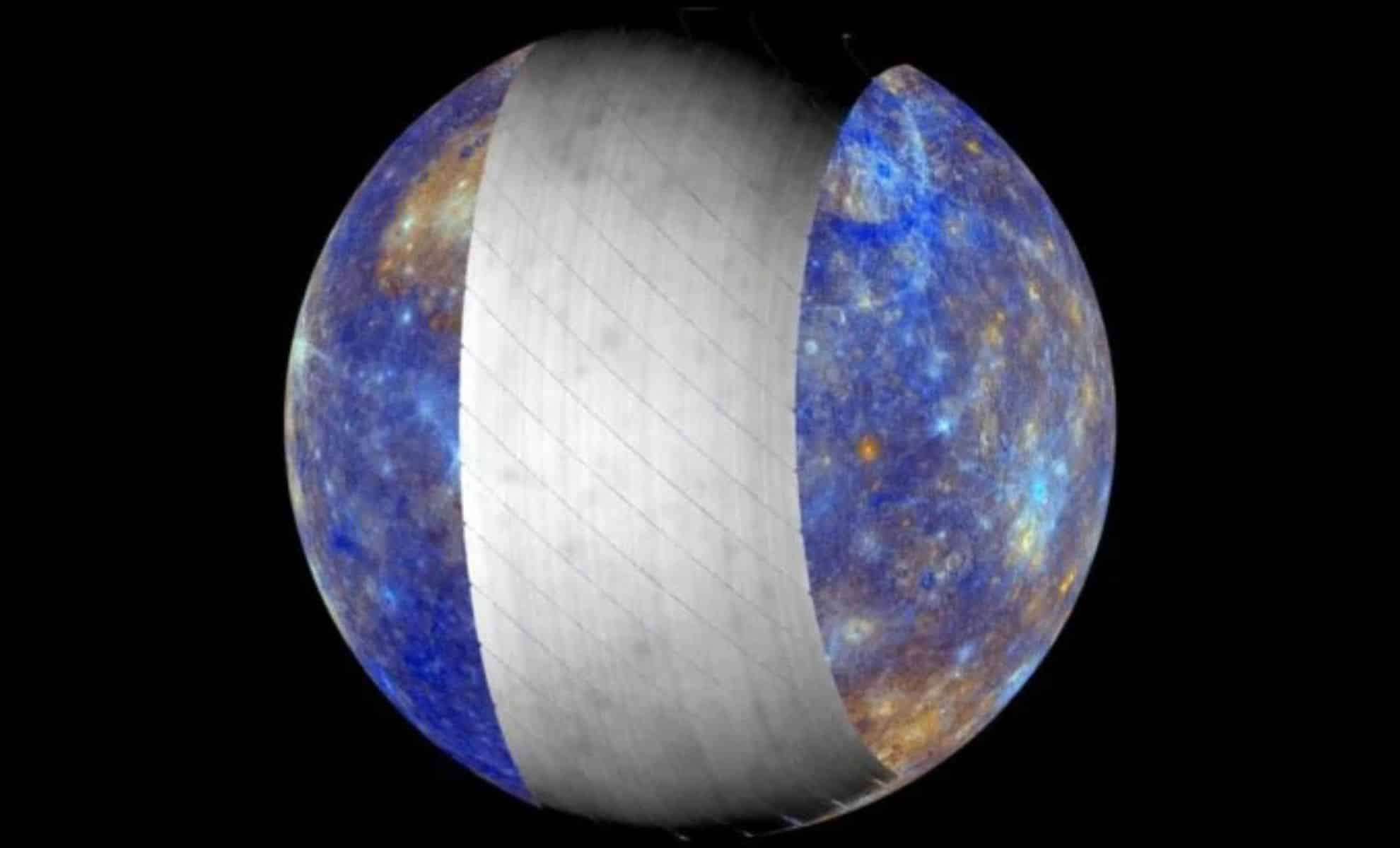
The BepiColombo spacecraft, a collaborative project between the European Space Agency (ESA) and Japan Aerospace Exploration Agency (JAXA), continues to deepen our understanding of Mercury, the solar system’s least explored terrestrial planet. On December 1, 2024, during its fifth close encounter with Mercury, the probe captured remarkable mid-infrared images of the planet’s terrain. These observations represent a pioneering achievement in planetary research, as this wavelength range had never before been used to study Mercury’s surface. The data reveal intriguing differences in surface composition, temperature fluctuations, and texture, providing new clues about the planet’s geology.
This latest flyby marks another important phase in BepiColombo’s eight-year pursuit of Mercury, which launched in 2018. Although the spacecraft is slated to enter orbit around Mercury in late 2026, this encounter has already demonstrated the immense capabilities of its advanced instruments, particularly the Mercury Radiometer and Thermal Infrared Spectrometer (MERTIS).
Delving into Mercury’s Surface Properties and Thermal Landscape
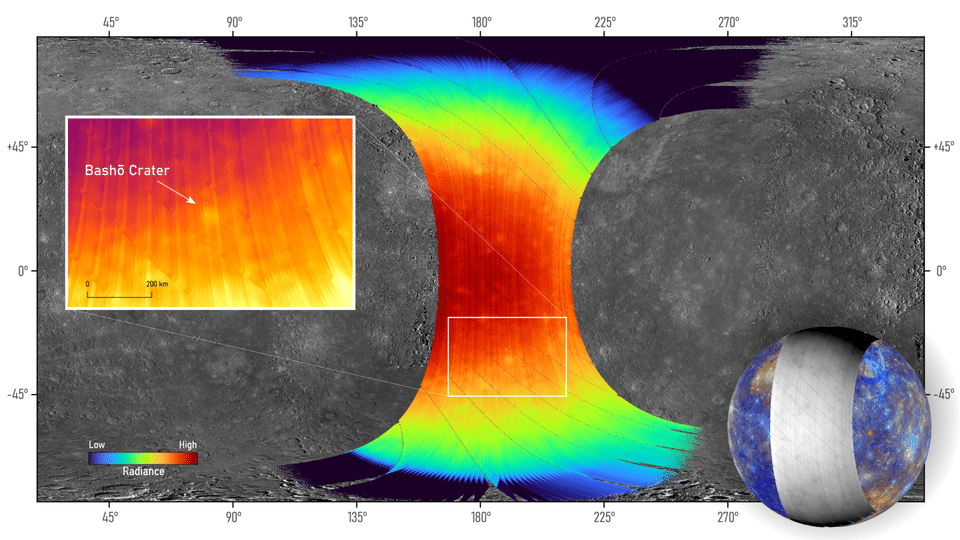
The new flyby yielded fresh perspectives on Mercury’s geological makeup, thanks largely to the capabilities of the MERTIS instrument. Unlike past missions such as NASA’s Messenger, which analyzed visible light, MERTIS probes the planet in the mid-infrared spectrum. This technique is especially effective in detecting minerals and characterizing temperature variations across Mercury’s surface. The data identify areas that emit stronger mid-infrared signals, offering vital information on their mineral content and surface roughness.

“MERTIS is opening novel avenues for us to understand Mercury’s materials, mineralogy, and temperature dynamics with far greater precision,” explained Harald Hiesinger, the instrument’s principal investigator from the University of Münster, Germany. The dataset encompasses diverse features like the vast Caloris Basin, one of the largest known impact craters, along with volcanic plains located in Mercury’s northern latitudes.
Using mid-infrared imaging, MERTIS also provided new insights into the Bashō Crater, a prominent impact structure studied previously by missions like Mariner 10 and Messenger. The crater’s distinctive light and dark markings seen in visible light appeared with unique signatures in the mid-infrared range, uncovering further aspects of its composition.
Two Decades of Innovation Culminate in Breakthrough Results
The creation of MERTIS was the result of over twenty years of focused development and rigorous testing. Designed to endure Mercury’s extreme daytime temperatures that can climb to 420°C (788°F), MERTIS’s ability to discriminate minerals under such harsh conditions stands as a tribute to the dedication of its creators.
“Following nearly twenty years of development, extensive lab tests using heated rock analogs representing Mercury’s surface, and thorough mission simulations, it’s thrilling to finally receive actual data from MERTIS at Mercury,” said Jörn Helbert, co-principal investigator of the instrument from the German Aerospace Center (DLR) in Berlin.
Those analyzing the new data found the results exhilarating. “Our first glance at the MERTIS flyby measurements, instantly revealing impact craters, left us astounded. This dataset promises to uncover countless previously unseen surface details,” shared Solmaz Adeli, planetary scientist and flyby project lead at the DLR. “We’re closer than ever to comprehending Mercury's global surface mineralogy as we gear up for BepiColombo’s orbital phase here.”
Investigating Mercury’s Distinct Surface Chemistry
Mercury holds a chemical enigma: its surface is unexpectedly low in iron despite hosting a massive iron-nickel core beneath. This puzzling characteristic has inspired extensive laboratory research to mimic the planet’s surface environment.
“Given Mercury’s surface scarcity of iron, we have been experimenting with both natural and synthetic iron-free minerals,” Adeli noted. “We test rock-forming minerals to better simulate the nature of Mercury’s crust.” Comparing these laboratory findings with MERTIS observations is crucial for interpreting the planet’s mineralogy and understanding the chemical evolution of its surface through time.
The Dawn of a New Chapter in Mercury Exploration
BepiColombo’s expedition is ongoing. While flybys offer valuable snapshots, the full power of its scientific payload will be unleashed once the spacecraft settles into orbit in 2026. Thereafter, MERTIS will produce detailed maps of mineral distribution, unlocking deeper insights into Mercury's geological past and development.
Reflecting on the discoveries so far, Helbert expressed optimism: “The most exciting revelations are yet to come. When MERTIS operates in orbit, it will maximize its observational potential.” Until then, the recent flyby’s dataset offers a compelling preview of the transformative knowledge awaiting scientists.
- Categories:
- Astronomy ,
- News





0 comments
Sign in to Comment