
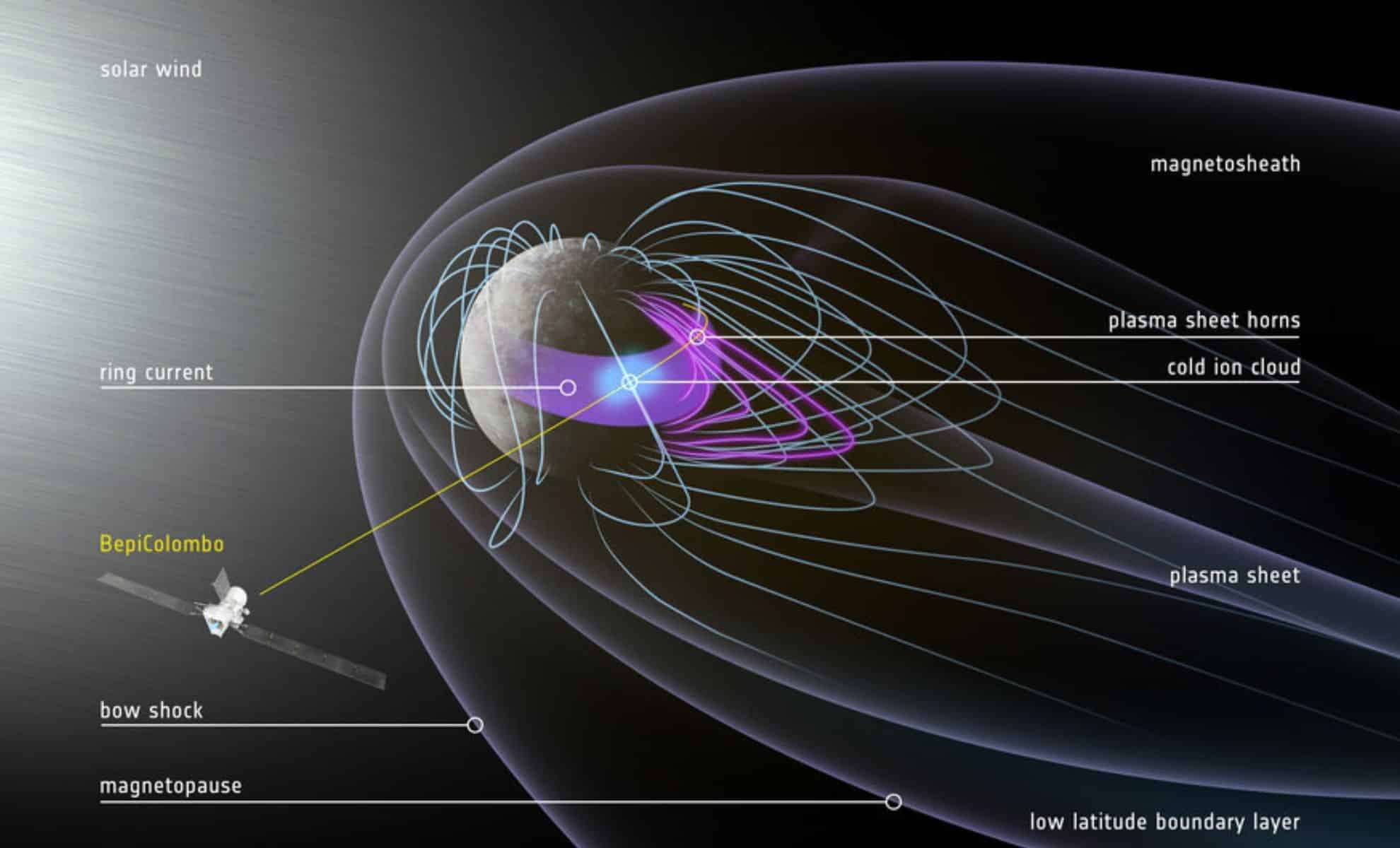
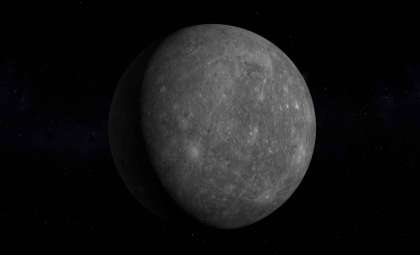
The BepiColombo spacecraft, a collaborative effort by the European Space Agency (ESA) and the Japan Aerospace Exploration Agency (JAXA), is offering groundbreaking data on Mercury’s magnetic field.
On its third close approach to Mercury in June 2023, BepiColombo collected valuable measurements that are helping researchers decode the planet’s magnetosphere—a magnetic shield far weaker than Earth’s own. Although the spacecraft has yet to reach its stable orbit around Mercury, these early flybys provide unprecedented insights into the interactions of magnetic forces on the solar system’s smallest, innermost planet.
Rapid Survey of Mercury’s Magnetic Environment
Like Earth, Mercury possesses a magnetic field, but it is roughly 100 times less intense at the surface. This tenuous field generates a protective magnetosphere that deflects the solar wind, a continuous flow of charged particles from the Sun. Being located merely 36 million miles from the Sun, Mercury encounters an especially powerful solar wind compared to Earth.

During the June 2023 encounter, BepiColombo zipped through Mercury’s magnetosphere in about 30 minutes, crossing from dusk to dawn at an altitude of just 235 kilometers (146 miles) above the planet’s surface. This brief but intense passage allowed the onboard instruments to analyze the population of particles, assess their temperatures, and track their movements, thereby enabling a detailed mapping of Mercury’s magnetic surroundings.
Lina Hadid from the Laboratoire de Physique des Plasmas at Paris Observatory, who contributed to interpreting the data, remarked, “The flybys are brief; it took us around 30 minutes to probe Mercury’s magnetosphere, giving us a clear snapshot of its magnetic structure during that short span.” The data offers crucial clues about how Mercury’s magnetic field copes with solar wind conditions, setting the stage for more comprehensive analysis when BepiColombo enters its final orbit in 2026.
Unexpected Phenomena inside Mercury’s Magnetic Domain
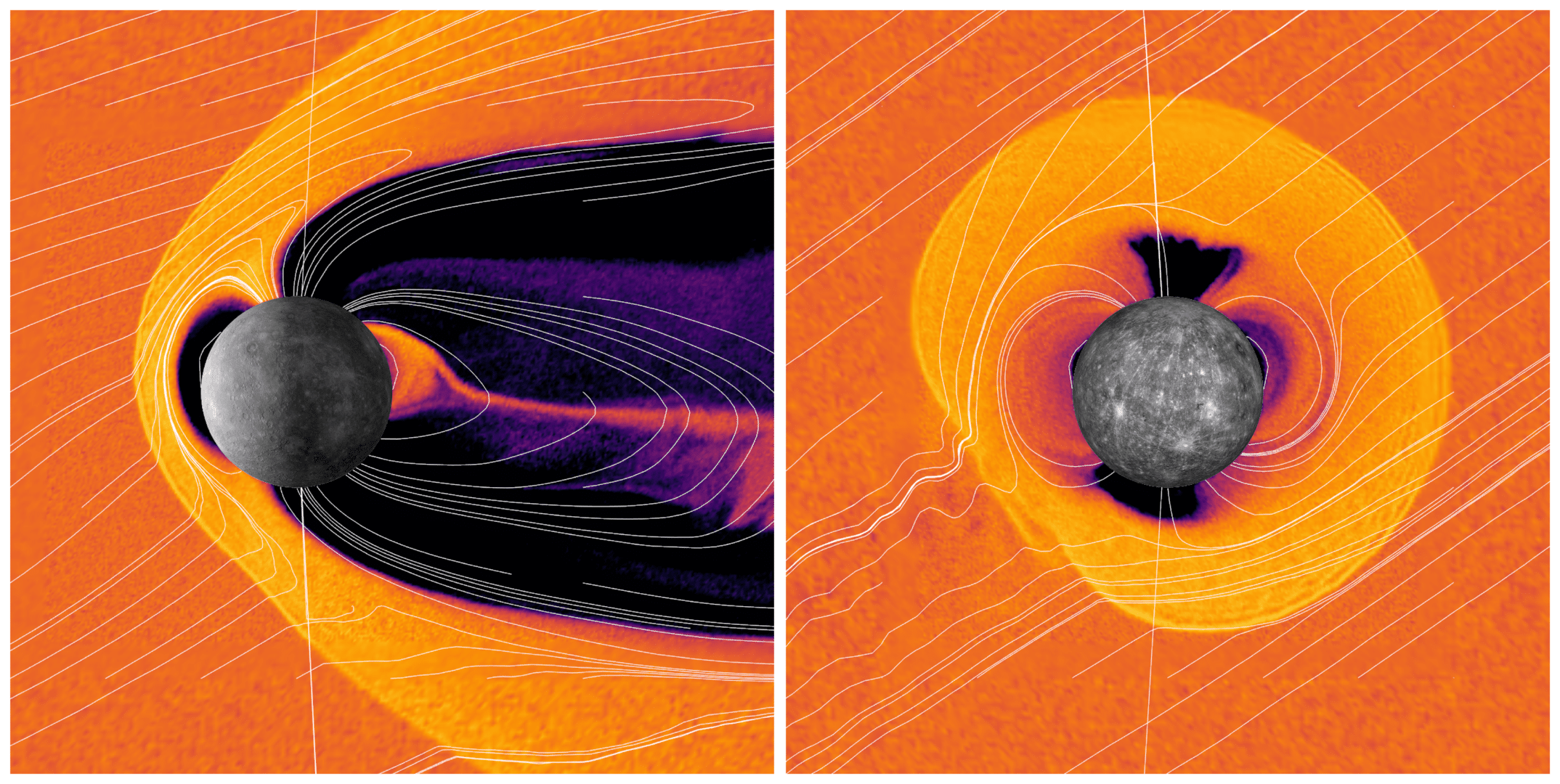
BepiColombo confirmed anticipated characteristics of Mercury’s magnetosphere, such as the shock boundary where solar wind meets the magnetic field and the plasma sheet, a wake of hot, charged gas trailing the planet. Yet, the mission also uncovered surprising new details.
Notably, the spacecraft detected energetic hot ions lingering near Mercury’s equatorial region, suggesting a possible ring current within its magnetic bubble. These ring currents, electric currents carried by particles caught in magnetic fields, are known around Earth hundreds of kilometers above us, but Mercury’s tightly compressed magnetosphere raises questions about particle trapping much closer, just a few hundred kilometers from the surface.
Hadid, a co-investigator for the Mercury Plasma Particle Experiment (MPPE), emphasized the importance of this finding: “We observed these hot ions near the equator at low latitudes, likely maintained by a ring current… though this remains a debated topic.” The identification of such a ring current on Mercury could challenge existing models of how magnetospheres behave in extreme settings.
Additionally, instruments aboard BepiColombo recorded turbulent plasma along Mercury’s low-latitude magnetospheric boundary—the interface where solar wind directly interacts with the planet’s magnetic shield. Dominique Delcourt, former lead scientist of the Mass Spectrum Analyzer instrument on BepiColombo, explained this region revealed a broad spectrum of particle energies unlike anything seen before at Mercury. “We detected what’s called a low-latitude boundary layer… here, particles exhibited an unprecedented range of energies,” said Delcourt.
Tying Mercury’s Surface to Its Surrounding Plasma
The flyby also uncovered oxygen, sodium, and potassium ions within Mercury’s thin exosphere. These elements are likely released from the planet’s surface by meteoroid impacts or solar wind interactions. The ions became detectable when BepiColombo entered Mercury’s shadow zone, where the spacecraft cooled, reducing electrical charge and enabling the observation of colder, heavier ions.
Delcourt likened this observation to a three-dimensional view of the planet’s surface composition. “It’s as though we’re witnessing the composition of Mercury’s surface material dispersed throughout its extremely thin atmosphere—or exosphere—in 3D,” he stated. This finding offers vital clues about how Mercury’s surface connects with and influences the surrounding plasma environment.
Looking Forward: Opportunities for Groundbreaking Discoveries
The June 2023 flyby was just one of six planned close encounters designed to adjust BepiColombo’s course and preview upcoming scientific gains. According to Go Murakami, JAXA’s project scientist for BepiColombo, this dusk-to-dawn journey through Mercury’s magnetosphere represents a mere “sample of what future flybys hold.” These brief passes allow exploration of magnetic zones that might become inaccessible once the spacecraft settles into its permanent orbit.
With two more flybys slated for December 2024 and January 2025, the mission will continue to unveil the complexities of Mercury’s magnetic field and surface-plasma interactions. Full mission capabilities will activate when BepiColombo’s two orbiters—the Mercury Planetary Orbiter (MPO) and Mercury Magnetospheric Orbiter (Mio)—operate together, creating a comprehensive view of the dynamic magnetic environment enveloping the solar system’s smallest world.
ESA’s BepiColombo project scientist, Geraint Jones, summed up the excitement: “These observations underscore why the two orbiters and their complementary instruments are essential to uncover the complete picture… we eagerly anticipate how BepiColombo will reshape our understanding of planetary magnetospheres.”
- Categories:
- Astronomy ,
- News ,
- Space





0 comments
Sign in to Comment