
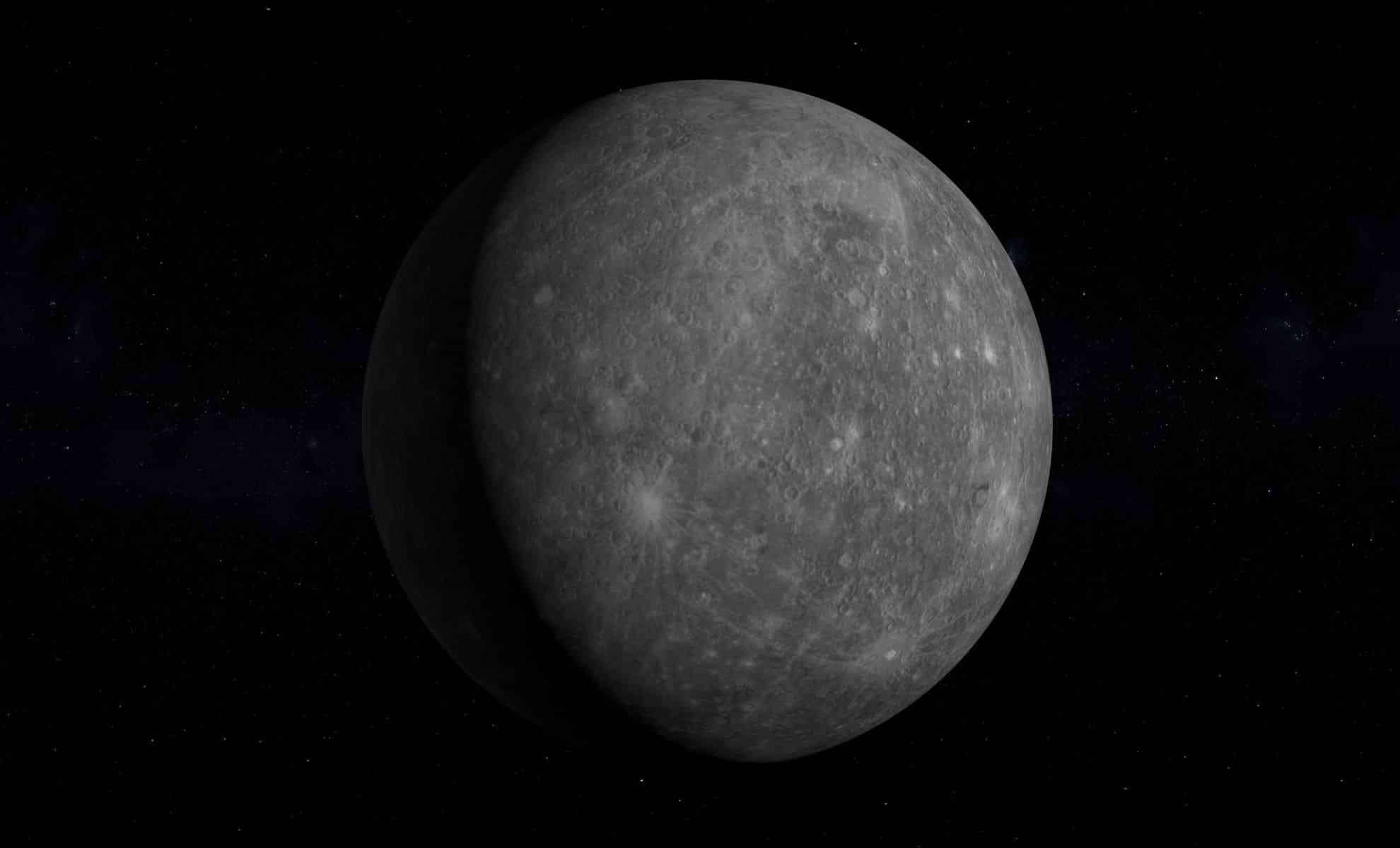
Emerging investigations imply that Mercury might possess a substantial diamond-rich layer nearing 18 kilometers in thickness along its core-mantle interface.
Through a synergy of advanced simulations and laboratory high-pressure testing, this pioneering research sheds light on Mercury’s inner makeup and its geological development.
Carbon’s Journey on Mercury: Transition from Graphite to Diamond
Mercury’s surface is known to harbor considerable amounts of carbon, mainly in the form of graphite. NASA’s MESSENGER findings attribute the planet’s dark surface hue to this graphite presence.

Nonetheless, recent research highlights that, under the crushing pressures and scorching temperatures deep inside Mercury, carbon could convert into diamond. Dr. Yanhao Lin from the Center for High Pressure Science and Technology Advanced Research in Beijing pointed out the significance: “Years ago, I recognized the high carbon levels on Mercury might have profound implications. This made me suspect unique phenomena inside its interior.”
The study replicated conditions near Mercury’s core-mantle boundary, where pressures reach about 7 GigaPascals (GPa)—approximately seven times deeper ocean pressure on Earth. At these extreme states, carbon material was found to solidify into diamond rather than remain graphite, implying the planet could contain vast diamond reserves beneath its crust.

Simulating Mercury’s Deep Interior: Laboratory Breakthroughs
To explore diamond formation processes inside Mercury, researchers employed high-pressure and high-temperature experiments with synthetic silicate mimicking Mercury’s mantle composition. Subjected to CMB-like conditions, samples demonstrated that under these intense parameters, carbon readily changes into diamond.
Dr. Lin described the methodology: “In our labs, we replicate planetary core environments, which demands extremely precise and often challenging setups. Equipment must endure harsh pressures and heat to accurately simulate such extreme conditions.” Additionally, sulfur found within Mercury’s iron core acts as a melting catalyst, facilitating diamond crystallization. This sulfur-induced separation significantly influences Mercury’s distinctive geophysical features.
Effects on Mercury’s Magnetic Field and Layered Structure
The discovery of a diamond stratum could considerably affect Mercury’s magnetic field. Due to diamond’s exceptional thermal conductivity, heat transport from the core to the mantle might be more efficient, affecting internal convection and temperature distribution.
Such dynamics likely contribute to sustaining Mercury’s surprisingly strong magnetic field. Dr. Lin explained, “As the molten core cools, carbon oversaturation results in diamond formation, which ascends to the core-mantle boundary. Diamond’s superior heat transfer alters temperature gradients and convection within the liquid outer core, impacting magnetic field generation.”
This insight extends to planetary differentiation—the way planets form distinct inner layers like cores and mantles. The mechanisms producing a diamond layer on Mercury may also operate in other similarly sized, compositionally akin planets, hinting at widespread geological processes that shape planetary interiors throughout the solar system.
Looking Ahead: Expanding Our Understanding of Planetary Interiors
This research marks an important step for studying Mercury and other celestial bodies rich in carbon. The experimental and modeling insights improve comprehension of how planets with elevated carbon contents develop and evolve. Detecting diamonds nestled inside Mercury’s interior broadens perspectives on the influence of pressure, temperature, and chemistry in planetary geology.
Dr. Lin stressed the broader relevance: “These findings might also help explain characteristics of other terrestrial planets with similar sizes and compositions. The processes behind Mercury’s diamond layer formation could be a common planetary phenomenon, leaving recognizable signs elsewhere.”
Unveiling a potential diamond layer at Mercury’s core-mantle boundary highlights the critical role of high-pressure experiments and computational models in planetary science. Continued exploration of such extreme planetary conditions promises to unlock further mysteries tied to the origin and transformation of worlds both inside and beyond our solar system.
- Categories:
- Astronomy ,
- News ,
- Space ,
- Nasa ,
- Physics










0 comments
Sign in to Comment