

Researchers from the United States have unveiled experimental proof indicating that electric power can be derived from the Earth’s rotational motion via a specially engineered apparatus interacting with the planet’s magnetic field. Published in Physical Review Research, this study revisits longstanding beliefs about the feasibility of exploiting geophysical energy sources.
Harnessing Energy from Earth's Rotation
For many years, scientists have pondered whether the immense spin of our planet might be tapped as a power source. Because the Earth rotates through its magnetic field, an electromotive force should theoretically arise. Yet earlier efforts to capture this energy failed, largely due to the fact that electrons tend to rearrange themselves and neutralize the effect, preventing usable current generation.
However, three experts — Christopher Chyba at Princeton University, Kevin Hand at the Jet Propulsion Laboratory, and Thomas Chyba from Spectral Sensor Solutions — argued that these failures stemmed from experimental oversight rather than theoretical error. Their objective was to design an experiment that isolates the specific mechanism and reduces confounding factors that might hide the subtle electric signals.

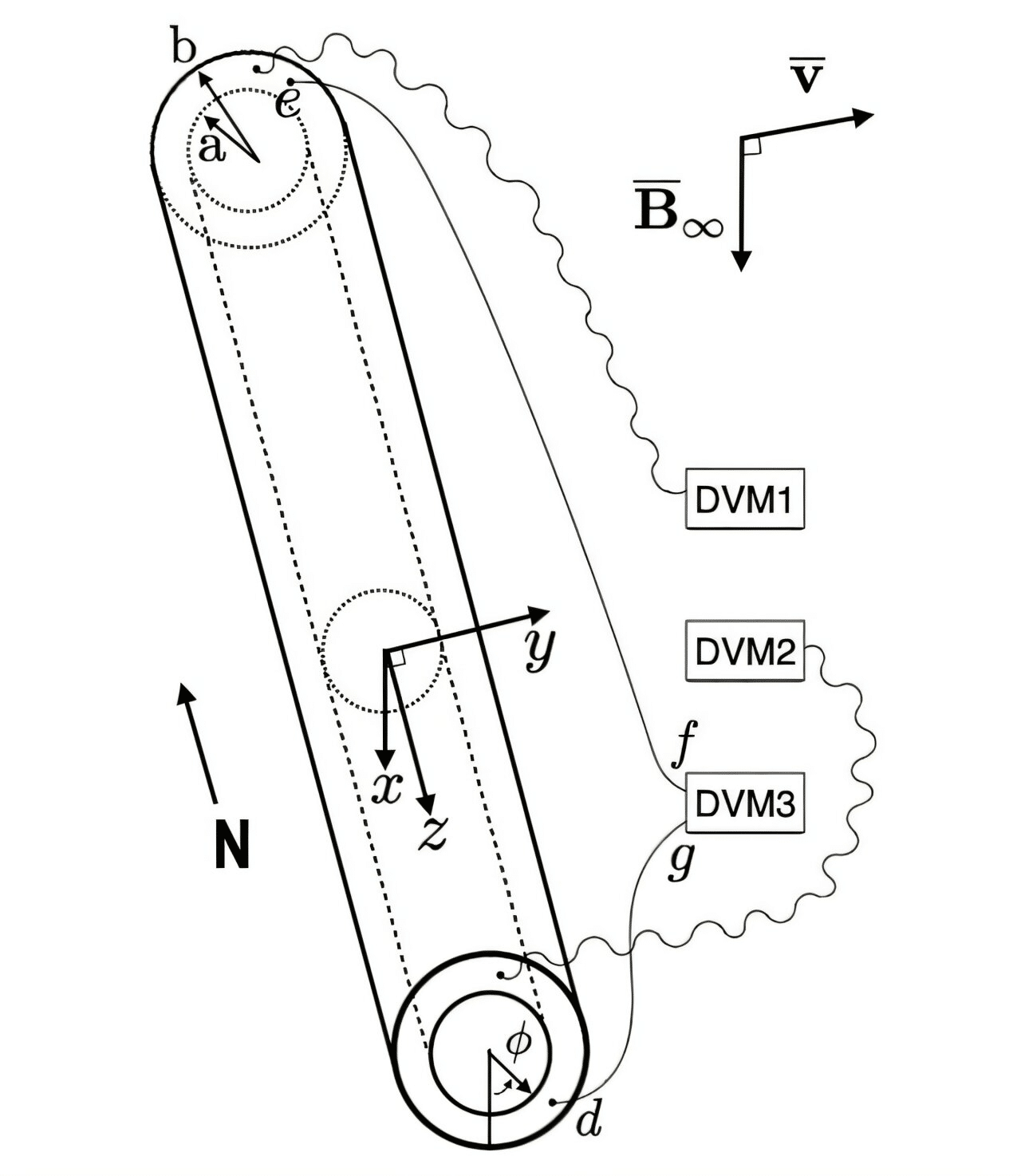
Credit: Physical Review Research
Magnetic Cylinder Produces Measurable Voltage
The team built a device composed of a manganese-zinc ferrite cylinder, a material that exhibits weak conductivity and magnetic shielding. Importantly, this cylinder was aligned along the north-south axis and tilted at a 57-degree angle, positioning it perpendicular to both the Earth’s rotation direction and magnetic field lines.
Electrodes attached at both ends of the cylinder captured a persistent voltage difference. Eliminating interference from external light sources to prevent photoelectric effects, the researchers detected a consistent voltage of approximately 18 microvolts, which they attribute to the interaction between Earth’s spin and magnetic field.
Eliminating Alternative Explanations
Recognizing the extraordinary nature of their claims, the investigators employed rigorous controls. They measured and excluded effects from thermal gradients, a usual cause of spurious voltages. Altering the cylinder’s orientation or substituting non-magnetic materials resulted in the disappearance of the voltage signal, reinforcing the conclusion that the effect is genuine.
Although the power measured — 18 microvolts — is extremely low, the key takeaway is the validation of the concept itself. The researchers emphasize the need for additional experiments to reproduce these findings under varied conditions and to explore scaling this phenomenon into a practical energy solution.
Potential for Powerful, Steady Energy Source
If verified, this discovery could introduce a groundbreaking form of renewable energy, distinct from weather-dependent solar or wind power. Earth’s continuous rotation is a persistent and planetary-scale source of energy, offering in principle an exceptionally stable supply.
Nonetheless, significant engineering hurdles remain before advancing from laboratory proof to widespread application. The currently generated voltage is far too small for industrial usage, but future innovations in materials and design may yield greater outputs.
This advancement may find valuable applications for space probes or remote scientific stations, where traditional power sources are impractical. Ultimately, harnessing the rotation of Earth or other celestial objects could become a vital technique in the exploration technology toolkit.













0 comments
Sign in to Comment