

A pioneering team at the University of Innsbruck has achieved a groundbreaking feat by generating a Schrödinger’s cat state at temperatures considerably higher than previous attempts allowed. This development could signal a major leap forward for quantum computing, making these advanced systems more practical and less dependent on extreme cooling technologies.
Exploring Quantum Phenomena Beyond Ultra-Cold Conditions
For many years, it was widely accepted that quantum effects could only reliably appear near absolute zero, where particles behave according to the unusual principles of quantum mechanics — such as existing simultaneously in multiple states or being entangled over distances.
This temperature limitation has directed the engineering of quantum devices, which traditionally operate within highly specialized cryogenic chambers that cool components to about -273.15°C, effectively halting molecular motion.

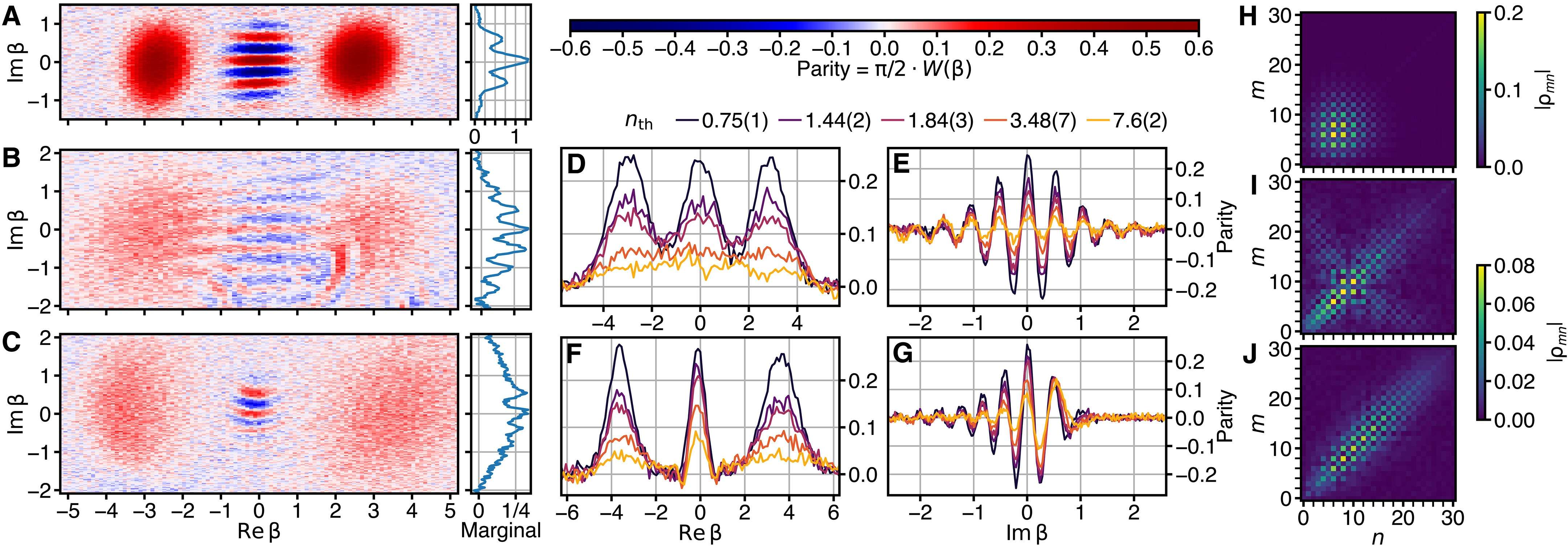
Now, a recent publication in Science Advances, reveals an experiment where researchers have preserved a Schrödinger’s cat-like quantum state at a comparatively elevated temperature of 1.8 kelvin (~-271.3°C).
Though still extremely cold by everyday standards, this marks a significant rise in the allowable temperature range, offering promising flexibility for future quantum technology applications.
From Hypothesis to Laboratory Reality
The concept of “Schrödinger’s cat” originated in 1935 through physicist Erwin Schrödinger as a thought experiment that illustrates quantum superposition's perplexing nature.
The scenario imagines a cat in a closed chamber whose fate — lifeless or alive — hinges on a quantum event. Until the box is opened, the cat is paradoxically in both states at once, embodying a fundamental quantum principle.
Decades later, scientists no longer rely solely on theory. By employing superconducting microwave resonators, the Innsbruck researchers replicated this superposition within a controlled experimental setup.
The team used a quantum bit, or qubit, called a transmon, embedded in the resonator. This configuration allows for precise encoding and manipulation of quantum data at temperatures surpassing traditional limits.
Advancing Quantum Stability Through Sophisticated Techniques
What sets this work apart is the innovative approach to maintaining delicate quantum coherence at elevated temperatures. The researchers applied two advanced strategies to safeguard and control the system.
The first, ECD (Echoed Conditional Displacement), works to correct errors during the quantum state transition, akin to a pilot correcting for turbulence. The second, qcMAP (quantum-controlled Mapping), facilitates entanglement between multiple qubits, enabling interaction control that sustains coherence under thermal disturbances.
Utilizing these combined methods, the team succeeded in reducing the disruptive impact of thermal noise, long considered a fundamental barrier to quantum coherence in warmer conditions.

Opening the Door to Scalable Quantum Devices
This advance carries major consequences for the future of quantum computing. Presently, quantum machines depend heavily on cumbersome, energy-demanding cooling systems that restrict their deployment and scalability.
Proving that Schrödinger’s cat states can endure at higher temperatures points towards quantum processors that may operate under less extreme conditions. This could significantly cut costs and simplify device design, enabling broader access to quantum innovations.
While completely ambient-temperature quantum computers remain a future goal, this research redefines expectations by demonstrating quantum superpositions resilient to heat. The Innsbruck team’s work challenges established notions in quantum physics and highlights exciting new directions for technology and science.
- Categories:
- Science












0 comments
Sign in to Comment