

China has introduced its latest spacesuit designed specifically for lunar missions, marking a crucial step towards the country’s goal of landing astronauts on the moon by 2030. This announcement highlights China’s growing capabilities in space exploration as it works to become the second nation to place humans on the lunar surface. The innovative suit is engineered to endure the moon’s harsh environment while offering the necessary agility for astronauts to perform detailed exploratory tasks.
Innovations in Spacesuit Technology
The China Manned Space Agency (CMSA) recently unveiled the striking red-and-white extravehicular activity (EVA) suit, emphasizing its robust features. Built to withstand the lunar environment—where temperatures can vary from a scorching 121°C (250°F) to a frigid -133°C (-208°F)—the suit also protects against damaging lunar dust, vacuum, and intense radiation exposure.
Beyond protection, the suit provides enhanced mobility, enabling astronauts to crouch, bend, and conduct complex movements essential for moonwalks, sample collection, and experiments. Esteemed astronauts Zhai Zhigang and Wang Yaping demonstrated the outfit’s adaptability by maneuvering easily while climbing and moving about.

Additional technological advances include a control console on the chest panel, along with integrated dual-range cameras mounted on the helmet, which features a glare-resistant visor to shield against solar rays. The suit’s aesthetic design incorporates red accents inspired by traditional Chinese art, reflecting both cultural heritage and national pride.
China’s Vision for Lunar Exploration
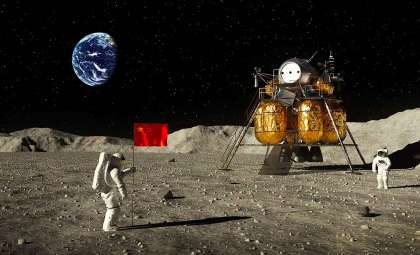
China’s rapid progress in space over recent years culminates with plans for a manned moon landing by 2030. The introduction of this advanced lunar suit is a key component of that mission, which aims to place China alongside the United States as nations with human footprints on the moon.
Preparatory robotic missions targeting the moon’s south pole are scheduled for 2026 and 2028, focusing on resource assessment and groundwork for human arrival. These efforts are designed to support the development of the ambitious International Lunar Research Station (ILRS) expected to be operational in the 2030s.
Specialized to endure the moon’s extreme surface conditions, the spacesuit addresses challenges posed by factors like lunar dust, soil (regolith), and elevated radiation. Wang Chunhui, deputy chief designer at the China Astronaut Research and Training Center, noted, “The spacesuit must be lightweight yet highly protective, ensuring astronauts maintain full range of movement while facing complex environmental hazards.”
Global Lunar Race Intensifies
China’s moon ambitions unfold alongside NASA’s efforts to return humans to the lunar surface under the Artemis program, which targets a landing by 2026. However, setbacks have delayed NASA’s Artemis III mission, initially planned for 2024.
Both nations are striving to claim a key presence on the moon, motivated by scientific objectives and the prospect of mining lunar materials crucial for future space ventures. Each country is also actively seeking international collaboration—China through the ILRS and NASA via a sustained lunar exploration agenda with Artemis.
In the context of this growing competition, China’s debut of its cutting-edge lunar suit represents a milestone that underscores the country’s commitment to advancing human lunar exploration.
- Categories:
- Astronomy ,
- News ,
- Space







0 comments
Sign in to Comment