
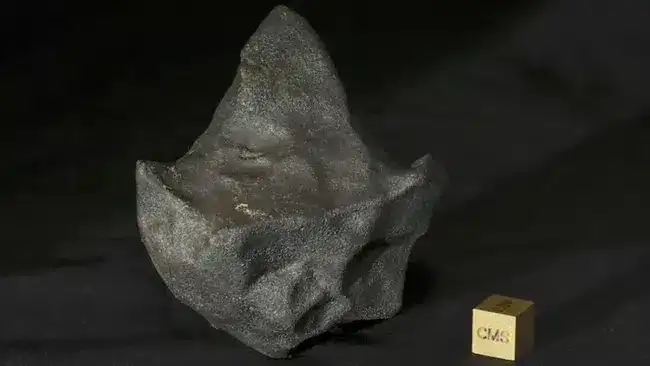
A remarkable find in 2019 brought to light a unique meteorite in Costa Rica, stirring great interest among researchers. Called Aguas Zarcas, this extraterrestrial rock stands out due to its water-laden minerals, diverging from the usual space rocks often scarred by cosmic collisions. This discovery is reshaping scientists' ideas about the durability of such meteorites and provides fresh evidence about how these space travelers endure their passage through the cosmos and fiery descent through our atmosphere.
The Aguas Zarcas meteorite belongs to the carbonaceous chondrite class, known for their abundant water and volatile compounds. Defying the common fate of most meteorites that incinerate upon atmospheric entry, this specimen preserved much of its original structure. Experts suggest it originated in the outer regions of the asteroid belt and journeyed through space for up to two million years with minimal damage.
Published on March 29, 2023, in Science Advances, this research was spearheaded by Peter Jenniskens, a meteor astronomer affiliated with the SETI Institute and NASA Ames Research Center. Their work advances our grasp of how space rocks survive the rigors of their voyage and challenges previous notions about meteorites rich in water.

Distinctive Features of Aguas Zarcas
The Aguas Zarcas meteorite is notable for its exceptional ability to withstand the intense heat and friction involved in atmospheric re-entry. Whereas most meteorites endure ablation, losing significant mass due to atmospheric friction, this one maintained a large portion of its original composition. Scientists attribute this to its steep angle of entry, which minimized atmospheric exposure and helped preserve its bulk.
Additionally, the meteorite's appearance is striking. Its fragments exhibit a smooth, fusion crust shimmering with a subtle blue sheen—a glassy layer formed by melting during descent. The rounded contours of these pieces contrast sharply with the typically flattened surfaces of more collision-worn meteorites. As highlighted by Laurence Garvie of the Buseck Center for Meteorite Studies at Arizona State University, “Some stones have a beautiful blue iridescence to the fusion crust.”
Tracing the Meteorite’s Origins
The story of the Aguas Zarcas meteorite begins deep in the outer asteroid belt, where it was once part of a larger parent body. Peter Jenniskens explained, “Its flight path indicates it originated from an asteroid located in the outer sector of the belt.” The meteor's dramatic passage through Costa Rica’s skies was recorded live by satellite instruments such as the GOES 16 and GOES 17 within the Geostationary Operational Environmental Satellite network managed by NASA and NOAA. These satellites captured the intense flash produced when the meteorite fragmented roughly 25 kilometers above the Earth’s surface.
Traveling at an incredible speed of 9 miles per second (14.6 km/s), the meteorite penetrated deeply before breaking apart at an altitude near 15.5 miles (25 kilometers). The luminous burst was visible to orbiting satellites, initiating a meticulous search through Costa Rica’s jungles and fields by dedicated meteorite collectors and volunteers eager to retrieve the fallen pieces.
Enduring Through Time and Space
A key intrigue surrounding the Aguas Zarcas meteorite is its extensive history in space prior to Earth impact. Led by cosmochemist Kees Welton at UC Berkeley, studies determined its last collision occurred about two million years ago—a blink in solar system time, which spans around 4.6 billion years. Welton commented, “After detaching, it took two million years to target Earth, all while avoiding damage that would cause fracturing.”
This finding provides valuable insight into the lifecycle of carbonaceous chondrites, meteorites altered by water on their parent asteroids. According to Peter Jenniskens, “Other Murchison-like meteorites appear to have broken away during the same event and similar time frame.” The analysis of Aguas Zarcas enhances understanding of the long-term transformations these meteorites undergo across millions of years.
A Landmark Discovery for Costa Rica
The meteorite’s arrival was a momentous event in Costa Rica. Gerado Soto from the University of Costa Rica stated, “The Aguas Zarcas fall captured exceptional national attention. No other fireball has been reported and then retrieved on Costa Rican soil with such widespread coverage over the past century and a half.” Recovering this meteorite is a landmark in the country’s scientific heritage, highlighting Aguas Zarcas as a major milestone in meteoritics research.
Soto further remarked, “Recovering Aguas Zarcas was a small step for humanity, but a giant leap for the study of meteorites.” This rare find opens new avenues for exploring extraterrestrial water and deepening our understanding of solar system history.
- Categories:
- News







0 comments
Sign in to Comment