
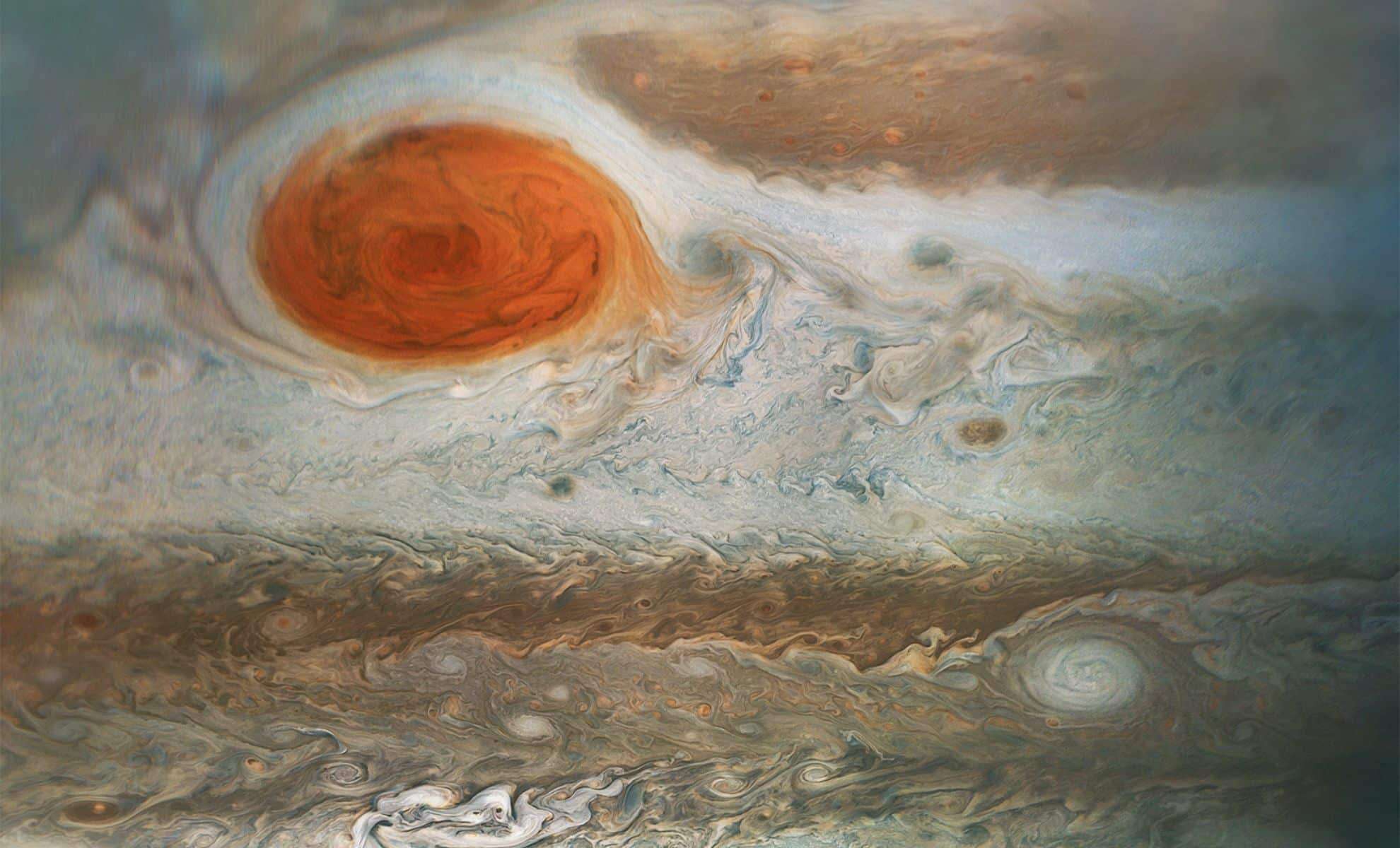
Groundbreaking research has shed new light on the origin and age of Jupiter’s Great Red Spot (GRS), a striking and enduring feature in our cosmic neighborhood.
This enormous storm, recognizable by its vivid red color and vast scale, has captivated astronomers for generations. By merging centuries-old observations with state-of-the-art numerical modeling, scientists have advanced our understanding of this planetary phenomenon.
Tracing Historical Records and Cutting-Edge Investigations
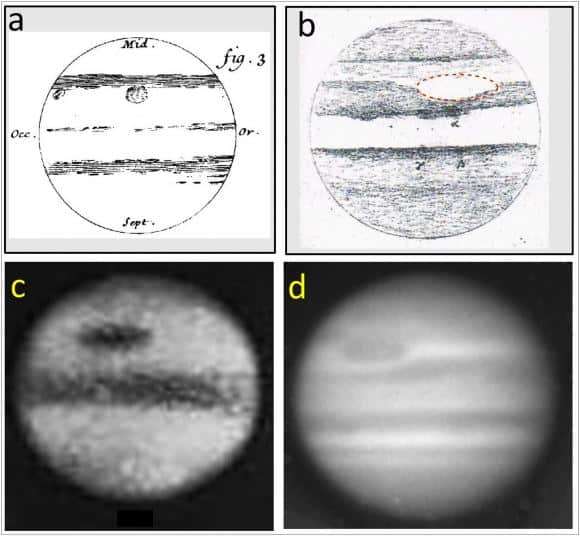
The Great Red Spot is an immense anticyclonic vortex exceeding Earth's diameter, with winds reaching speeds over 400 kilometers per hour (250 miles per hour). Chronicles dating back to the 17th century note its early sightings. Giovanni Cassini, the renowned Italian astronomer, reported a persistent storm at the same latitude as the modern GRS in 1665, which he named the “Permanent Spot” (PS). Sightings of this feature waned around 1713, only for a similar storm to be observed by S. Schwabe in 1831, frequently cited as the earliest record of Jupiter’s current Great Red Spot.

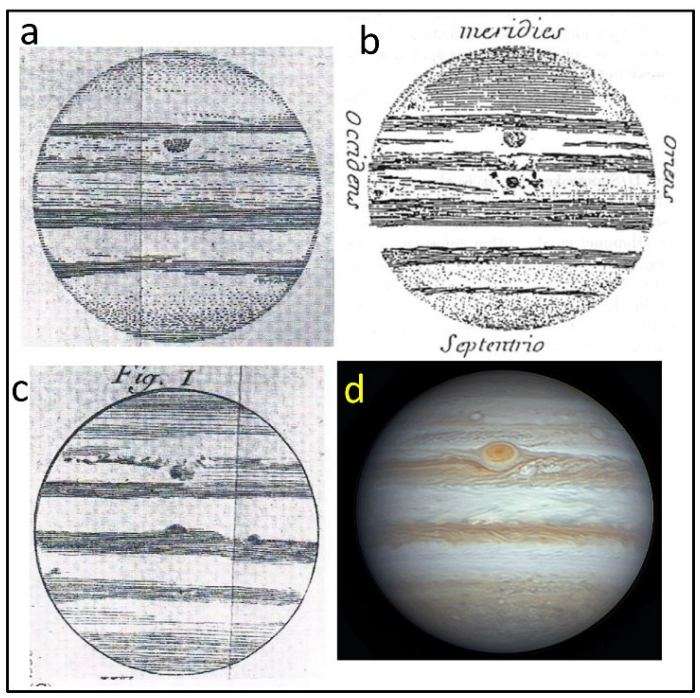
In a study published in Geophysical Research Letters, Agustín Sánchez-Lavega and his colleagues at the University of the Basque Country combined these archival observations with modern computational simulations to delve into the origins and durability of the GRS. Sánchez-Lavega remarked, “Based on the assessment of size and dynamics, it is improbable that today's GRS is the same as the Permanent Spot noted by Cassini. The PS likely vanished between the middle of the 18th and 19th centuries, indicating that the current Red Spot has persisted for at least 190 years.”
Jupiter’s Powerful Winds and Their Influence
The planet’s atmosphere is defined by strong, alternating jet streams. To the north of the GRS, winds move westward at roughly 180 km/h, while to the south, winds travel eastward at about 150 km/h. This contrast generates a significant wind shear, which supports the vortex’s persistence. Measurements from instruments aboard the Juno spacecraft reveal that the GRS is comparatively shallow, extending some 500 km vertically but spanning thousands of kilometers horizontally.
Researchers employed high-performance computing to simulate various potential origins of the Great Red Spot, testing ideas such as an enormous superstorm or the merging of smaller vortices influenced by wind shear. These models did not align with the observed features of the GRS. Instead, the simulations pointed to instabilities within Jupiter’s jet streams—especially the South Tropical Disturbance (STrD)—as the driving mechanism.
Modeling How the Great Red Spot Took Shape
Using two complementary computational approaches, the team simulated the behavior of thin vortices in Jupiter’s atmosphere. Their results indicated that the STrD generates an elongated atmospheric cell capable of organizing surrounding winds into a unified, coherent vortex. The authors concluded, “We propose that the GRS evolved from a persistent elongated cell linked to the STrD, which gained compactness and stability as it contracted.”
Enrique García-Melendo, affiliated with the Universitat Politècnica de Catalunya, noted, “Our supercomputer-driven models revealed that these elongated structures remain stable when rotating around the GRS’s perimeter at velocities matching Jupiter’s jet streams, consistent with their formation through this instability.”
Refining the Timeline for the Great Red Spot’s Emergence
The evolution of the Great Red Spot remains a compelling subject in planetary science. Cassini’s early 1665 documentation of the “Permanent Spot,” observed at the same latitude as the modern feature, disappeared from observations by the early 1700s. This observational hiatus between 1713 and 1831 has fueled speculation about whether the current GRS is a continuation or a newly formed storm.
Insights from Sánchez-Lavega’s team clarify this debate, suggesting that the Permanent Spot recorded by Cassini is likely distinct from the Great Red Spot visible today. Instead, the Great Red Spot probably reemerged in the early 19th century around Schwabe's noted observation. “It is improbable that the current GRS corresponds to Cassini’s PS,” Sánchez-Lavega commented, implying that today’s spot has endured for at least 190 years, consistent with the earliest 19th-century sightings.
- Categories:
- Astronomy ,
- News ,
- Science ,
- Space





0 comments
Sign in to Comment