

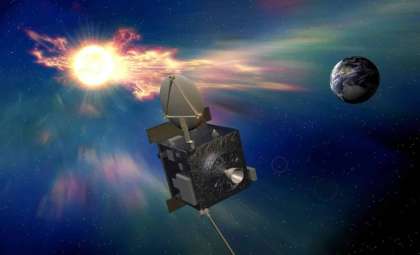
Space enthusiasts will soon have the chance to witness the European Space Agency’s (ESA) JUICE spacecraft as it performs a groundbreaking flyby of Earth and the Moon next week.
This critical maneuver will boost JUICE’s velocity, propelling it forward on its ambitious eight-year mission toward Jupiter, where it will study the planet’s frozen moons, particularly Ganymede, considered a candidate for having a hidden ocean beneath its icy surface.
Innovative Dual Flyby: A First in Space Exploration
The Jupiter Icy Moons Explorer (JUICE), launched in April 2023, is preparing to carry out the first-ever combined Earth-Moon flyby. This intricate operation leverages gravitational forces from both the Moon and Earth to slingshot the spacecraft onward into the outer solar system. The milestone represents a “double-world first” as JUICE will be the first probe to employ a twin gravity assist to refine its trajectory en route to Jupiter.

ESA emphasizes that this mission has been carefully crafted over the past two decades, showcasing extraordinary precision in spacecraft navigation and mission design.

JUICE will approach the Moon’s surface to within 700 kilometers on August 19th, before making a close pass at just 6,807 kilometers from Earth on August 20th.

This complex flyby has been described as navigating “a very narrow corridor at immense speed,” utilizing gravity to steadily steer JUICE through its course corrections.
“Our tolerance for error is extremely tight,” noted Ignacio Tanco, Spacecraft Operations Manager for JUICE. “Even a minor miscalculation could throw the spacecraft off its intended path.”
Harnessing Gravity to Propel Deep Space Missions
JUICE’s momentum boost comes courtesy of a gravity assist maneuver, which provides necessary acceleration without relying on excessive fuel. “Without employing gravity assists, JUICE would have needed an unmanageable 60,000 kilograms of propellant,” stated Nicolas Altobelli, the mission’s manager.
As the spacecraft swoops around the Earth and Moon, its path will curve, effectively reducing its speed and redirecting it toward Venus, where another gravity boost is scheduled for 2025.
Following the Venus encounter, JUICE will make two additional Earth flybys in 2026 and 2029, delivering the final velocity increments required for its arrival at Jupiter by 2031.
Viewing Opportunities for JUICE’s Flyby
People situated in optimal locations will have a rare opportunity to spot JUICE as it nears Earth and the Moon. Clear skies will favor observers in Australia and southeast Asia, where the spacecraft can be seen in the pre-dawn sky on August 20th.
Other areas, including Europe and North America, might catch glimpses of JUICE, although from greater distances. Astronomers suggest consulting tracking tools like Heavens-Above and precise ephemerides from JPL Horizons to locate the spacecraft’s position.
Spanning an impressive 27 meters tip-to-tip across its solar panels, JUICE may occasionally produce a specular glint as sunlight reflects off its surfaces, potentially making it visible to the unaided eye.
Instrument Testing During the Critical Flyby
Mission control will utilize this close passage to evaluate multiple onboard scientific tools. The Radar for Icy Moon Exploration (RIME), in particular, will undergo significant testing during the lunar encounter. Since RIME has faced interference from other instruments, this flyby presents an opportunity to diagnose and address these issues.
During its closest lunar approach, RIME will have an eight-minute timeframe to gather crucial data on the Moon’s surface. ESA hopes this brief interval will yield enough information to enhance noise reduction algorithms, ensuring RIME operates optimally when observing Jupiter’s moons.
Unlocking the Secrets of Jupiter’s Frozen Satellites
JUICE's main objective is to investigate Jupiter’s icy moons, including Europa, Callisto, and Ganymede. These celestial bodies intrigue scientists due to their potential subsurface oceans hidden beneath icy exteriors. Ganymede, the largest moon in the solar system, is especially notable for its intrinsic magnetic field and possible suitability for life.
Upon reaching Jupiter in 2031, JUICE will commence an extended exploration of these moons, targeting evidence of water, ice formations, and potential biosignatures. Its array of 10 scientific instruments, including RIME, will facilitate detailed surface mapping and interior studies of these enigmatic worlds.
- Categories:
- Astronomy ,
- News ,
- Space ,
- Evolution









0 comments
Sign in to Comment