
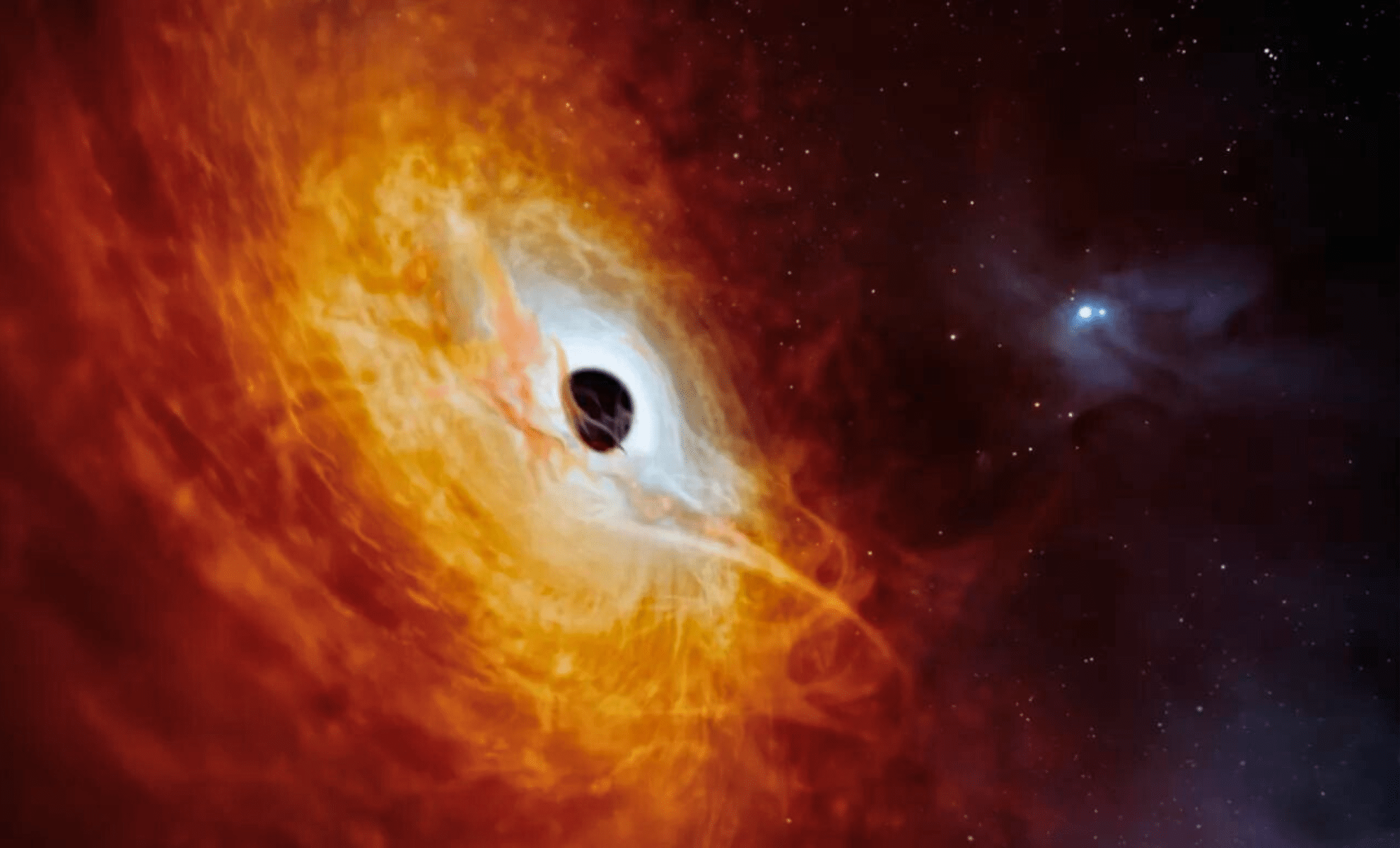
Researchers have identified a remote quasar that could be responsible for halting star production in adjacent galaxies. This quasar, called VIK J2348-3054, ranks among the most distant known quasars, and its powerful radiation appears to inhibit the birth of new stars within galaxies up to 16 million light-years away.
Quasars: Intense Cosmic Engines
Quasars are among the universe's most luminous and energetic entities, fueled by supermassive black holes at the centers of their host galaxies where extremely hot gas emits tremendous energy.
For VIK J2348-3054, its light has covered a span of 13 billion years, revealing conditions just 770 million years after the Big Bang.

At this epoch, the black hole powering the quasar had already amassed a mass roughly 2 billion times that of our sun, indicating rapid growth in a cosmologically brief time.
Scientists originally anticipated the quasar’s galaxy to lie within a cluster rich in star-forming galaxies, but surprisingly, observations showed the contrary.
An Expansive Region Lacking Star Formation
Trystan Lambert from Universidad Diego Portales in Santiago, Chile, along with his collaborators, identified a large void surrounding the quasar. The closest actively star-forming galaxy was measured at a distance of 16.8 million light-years—over six times farther than the separation between the Milky Way and its neighbor, the Andromeda Galaxy. This implies the quasar’s intense energy output has stifled star formation nearby.
Lambert commented, “The results were unexpected. It was intuitive to expect a clustering of star-forming galaxies close to the quasar, but instead, we found fewer.”
The team’s broader survey region compared to past studies enabled the detection of this effect, highlighting quasars as significant influencers rather than passive residents of their surroundings.
The widely accepted explanation is that the quasar’s energetic output heats the gas in proximate galaxies, thwarting its collapse into the dense clouds needed for star formation. By maintaining the gas at elevated temperatures, the quasar creates a star-formation barren zone around itself.
Nonetheless, some researchers, like Martin Rees of the University of Cambridge, raise the possibility that the scarcity of star-forming galaxies near the quasar could arise from statistical chance due to the expanding volume surveyed at greater distances.
Upcoming Studies Could Verify the Theory
Further observations employing more advanced instruments will be essential to verify these findings. Should new data show additional star-forming galaxies emerging only at farther distances from the quasar, it would bolster the argument that its radiation is responsible for impeding nearby star formation.
This discovery also prompts speculation about the role of quasars in shaping the star formation histories of other galaxies, such as M87, a large galaxy situated roughly 54 million light-years from the Milky Way.
M87 harbors a supermassive black hole known to have powered a quasar in the early universe. Given that galaxies were more tightly packed in the past, M87 might have influenced star production in our own galaxy.
Gaining a deeper understanding of how quasars affect their environments is crucial for unraveling the complex relationships between black holes, star formation, and the overall evolution of the cosmos.
- Categories:
- Astronomy







0 comments
Sign in to Comment