

The James Webb Space Telescope (JWST) has unveiled unprecedented insights into the fueling mechanisms of galaxies during the universe’s formative years.
This breakthrough enhances our understanding of how galaxies gradually assembled and expanded mere hundreds of millions of years following the Big Bang.
Investigative Approach and Breakthrough
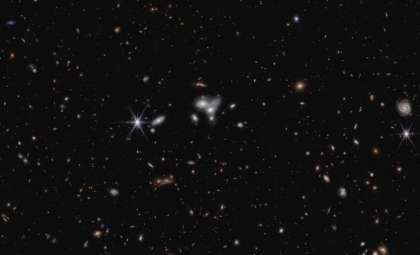
Scientists scrutinizing data from the James Webb Space Telescope pinpointed three star-forming galaxies that existed when the cosmos was between 400 and 600 million years old. Instruments aboard JWST detected significant amounts of dense, cold gas, chiefly hydrogen and helium—the universe’s earliest elements—surrounding these youthful galaxies. This cold gas acts as the vital fuel enabling star birth and galaxy expansion.

These galaxies appeared as faint red smudges in JWST imagery, requiring spectral analysis for further investigation. The spectral signatures indicated substantial absorption by neutral hydrogen, unveiling large reservoirs of cold gas primed for cooling and condensing into future stellar nurseries.
The Importance of These Discoveries
Identifying cold gas around infant galaxies holds pivotal importance:
- Galaxy Evolution Insight: Detecting dense gas highlights galaxies in active star formation stages, offering a direct window into early galactic growth processes.
- Unraveling Cosmic Origins: Studying nascent galaxies informs researchers about environmental conditions governing initial cosmic structures and the universe’s developmental timeline.
- Galaxy-Environment Interaction: Findings underscore the dynamic relationship between galaxies and the intergalactic medium, where galaxies draw in surrounding gas to fuel ongoing growth.
JWST’s In-Depth Observations
JWST’s data demonstrate that these primordial galaxies are rapidly accumulating cold hydrogen gas from their vicinities. Absorption patterns in their spectra allowed researchers to quantify these vast gas reserves, confirming that abundant fuel is available for sustained star formation.
The absorption features produced by neutral hydrogen helped map the quantity and spread of cold gas enveloping these galaxies, affirming their vigorous growth phases marked by high star-formation rates.
Understanding the Era of Reionization
This extraordinary period, the Era of Reionization, was characterized by the cosmos remaining largely opaque due to neutral hydrogen gas. It took nearly a billion years post-Big Bang for the universe to become fully transparent. JWST permits detailed exploration of this transformational era.
During the Era of Reionization, nascent stars and galaxies began emitting light that gradually ionized the surrounding gas. JWST’s ability to observe these earliest luminous objects enables scientists to dissect the events that led to the universe’s transition and the birth of large-scale structures.
Prospects for Further Study
These revelations pave the way for extensive future investigations. Researchers plan to compile comprehensive datasets of early galaxies to evaluate how common such cold gas reservoirs are and to decode their properties.
Upcoming JWST observations will aim to chart the spatial distribution of gas within and around these galaxies. By analyzing the chemical makeup, scientists hope to understand star formation histories and how heavier elements have enriched intergalactic space over time.
Impact on Galaxy Formation Models
Discovering cold gas streams nourishing early galaxies reinforces models where galaxies grow primarily through gradual gas accretion, known as “cold accretion,” supplementing the role of dramatic mergers.
Balancing the contributions of cold accretion and galaxy collisions is essential for refining galaxy evolution theories. JWST’s data offer strong direct support for cold accretion’s role, improving predictions about galaxy growth throughout cosmic history.
- Categories:
- Astronomy ,
- News ,
- Space ,
- Nasa




0 comments
Sign in to Comment