

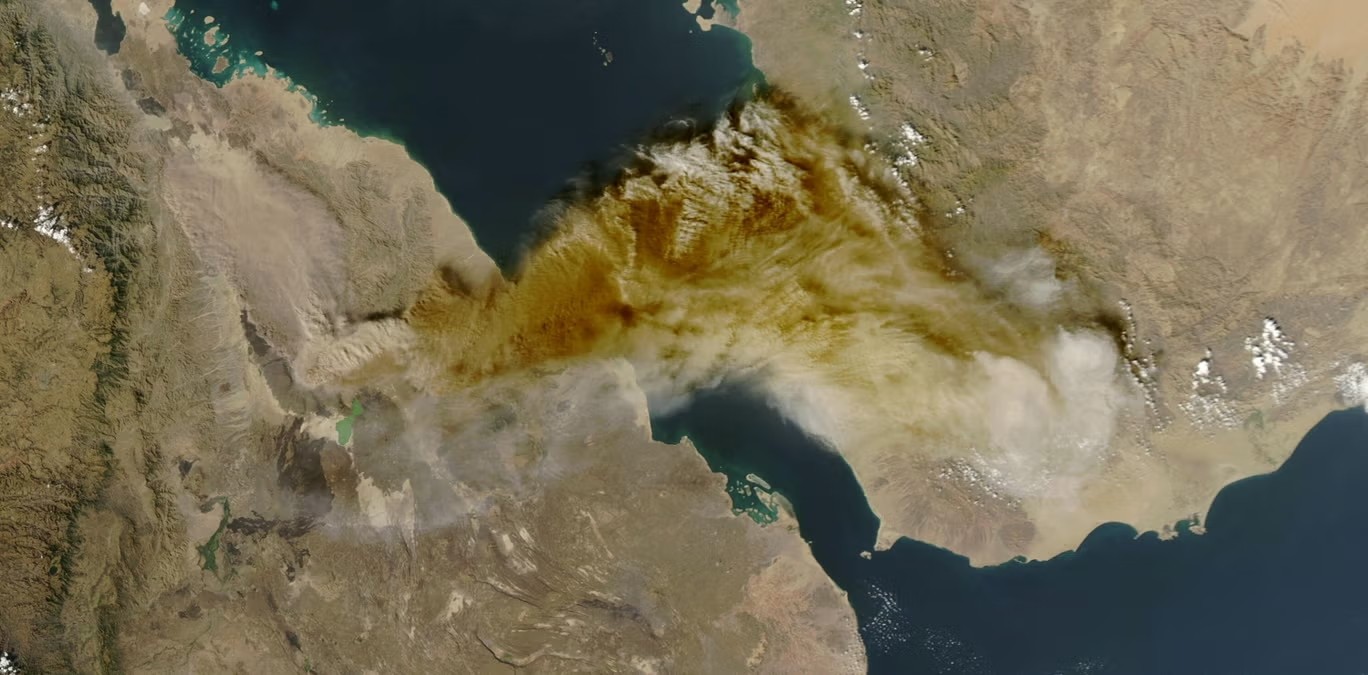
Hayli Gubbi volcano, located in northeastern Ethiopia, erupted on Sunday for the first time in approximately 12 millennia. The eruption propelled dense smoke plumes reaching nearly 9 miles (14 km) high, with volcanic ash drifting across the Red Sea into Yemen and Oman.
This eruption took scientists and locals by surprise, as Hayli Gubbi has been inactive for thousands of years. Situated within the Afar Rift, a geologically active zone, the sudden volcanic activity raises new concerns given the region’s fragile social and environmental stability.
A Rare Geologic Event Shakes the Earth
Volcanologists recognize this eruption as an extraordinary occurrence. Simon Carn from Michigan Technological University emphasized that Hayli Gubbi has not erupted during the Holocene epoch, making this a notably unexpected event. The extensive ash plumes were visible from space and have spread far beyond Ethiopia’s borders. As reported by The Guardian, ash has reached Yemen, Oman, and even parts of Pakistan and India.

“It felt like a sudden bomb had been thrown with smoke and ash,” said Ahmed Abdela, a resident of the Afar region.
Impact on Local Communities and Livelihoods
The volcanic activity poses significant challenges for communities, particularly pastoralists dependent on livestock. The Afar region supports many herders whose livelihoods revolve around their animals. According to local representative Mohammed Seid:
“While no human lives and livestock have been lost so far, many villages have been covered in ash and as a result their animals have little to eat.”
The ashfall’s continuation threatens the stability of the local economy dependent on animal husbandry, raising concerns over future resource availability and food security.
Widespread Environmental Implications
The volcanic ash cloud is extending its influence beyond Ethiopia, affecting air quality in countries such as Yemen and Oman. The ash may also interfere with sunlight reaching the ground, potentially endangering crops in the surrounding regions.
Based on information from the Volcanic Ash Advisory Center (VAAC), ash particles have been tracked as far north as Pakistan and India, illustrating the eruption’s vast atmospheric impact. Predicting the longer-term consequences remains challenging, given the rarity of such events.
“Measuring contamination caused by volcanic eruptions take a lot of preparation. Sensors have to be deployed in advance. This particular volcanic eruption did not provide any room for preparation. So the level of contamination is not known,” GP Sharma, president at Skymet Weather said.
Current (black) and forecasted (green +6hr , yellow +12, red +18) ash cloud observations from today’s eruption of Hayli Gubbi volcano in northern Ethiopia. pic.twitter.com/96vtwvLD20
— Flightradar24 (@flightradar24) November 23, 2025
- Categories:
- News



0 comments
Sign in to Comment