
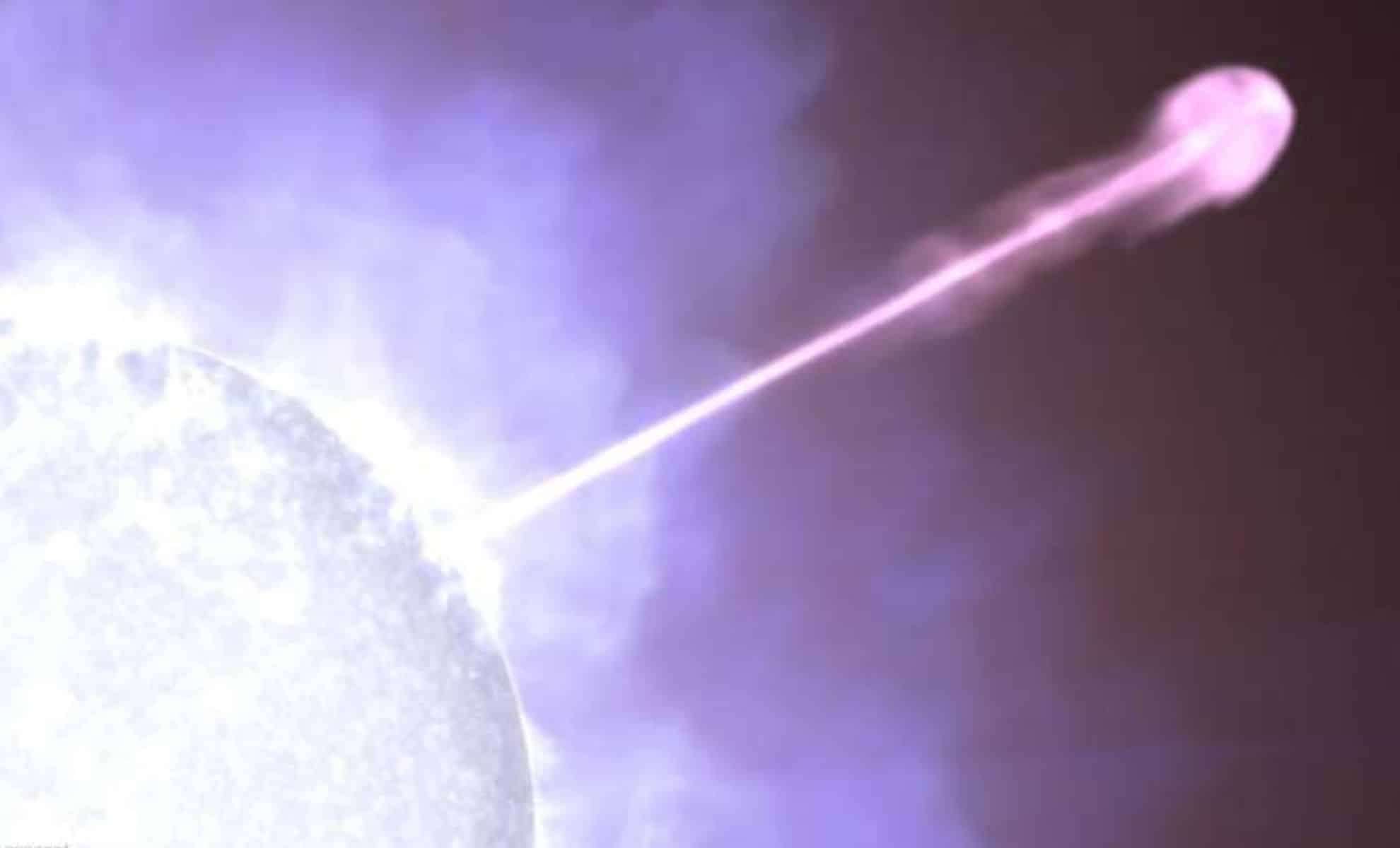
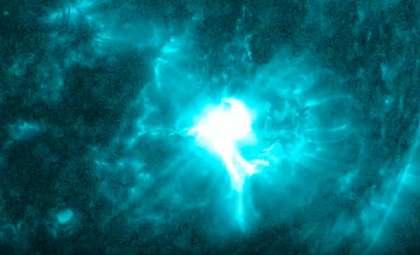
The Fermi Gamma-ray Space Telescope, operated by NASA, has made a landmark discovery in gamma-ray burst (GRB) research by detecting a novel emission signature in the brightest GRB ever observed.
Known as GRB 221009A and nicknamed the "brightest-of-all-time" (BOAT), this event erupted on October 9, 2022. Its exceptional brightness overwhelmed many gamma-ray sensors, including those onboard Fermi, initially complicating full intensity measurements.
Despite initial sensor overload, further detailed analyses uncovered a striking energy spike—a high-confidence emission line unprecedented in over five decades of GRB observations.

In-Depth Examination of the Emission Feature
Detected nearly five minutes post-burst, the unique emission line lasted roughly 40 seconds and exhibited a peak energy near 12 million electron volts (MeV), a value vastly exceeding the few electron volts typical of visible light. This is a landmark observation, marking the first reliable emission line found within a GRB’s spectrum.
Maria Edvige Ravasio, the principal investigator from Radboud University, expressed her excitement: “Seeing that signal for the first time was truly electrifying. Our analyses confirm this as the first solid emission line recorded in the 50 years of GRB studies.”
The emission is believed to originate from the annihilation of electrons with their antimatter counterparts, positrons, emitting gamma rays. The particles involved were traveling at roughly 99.9% the speed of light, which caused the gamma rays to be blueshifted significantly into higher energy ranges.
New Insights into Gamma-Ray Burst Physics
This emission line discovery offers a fresh perspective on the energetic processes driving GRBs, which rank among the universe’s most violent explosions, often emerging from a massive star’s core collapse into a black hole.
The collapse creates high-velocity jets that discharge powerful gamma rays. The extraordinary brightness of the BOAT event has provided an unparalleled chance to examine these relativistic jets in fine detail. Om Sharan Salafia from the INAF-Brera Observatory in Milan highlighted the observation’s importance: “The probability that this signal is a random noise fluctuation is less than one in 500 million.”
This remarkable statistical significance emphasizes the results’ robustness, paving the way for deeper understanding of GRB jet mechanisms and their astrophysical environments.
Advancing High-Energy Astrophysics Research
Beyond enhancing GRB comprehension, this finding has far-reaching implications for high-energy astrophysics. Uncovering such an emission line provides vital clues about black hole surroundings and the dynamics of relativistic particle jets.
Elizabeth Hays, the Fermi project scientist at NASA’s Goddard Space Flight Center, underscored the discovery’s potential: “Despite decades of observation, details about jet formation remain elusive. Observing an extraordinary emission line like this opens new paths for exploring these extreme phenomena.”
These insights are expected to refine theoretical models for particle acceleration and magnetic field interplay in the intense environments surrounding GRBs. Ongoing analyses of data from GRB 221009A and other events demonstrate the invaluable role of the Fermi Telescope in unraveling the mysteries of the universe’s most energetic bursts.
- Categories:
- Astronomy ,
- News ,
- Nasa ,
- Aircraft






0 comments
Sign in to Comment