
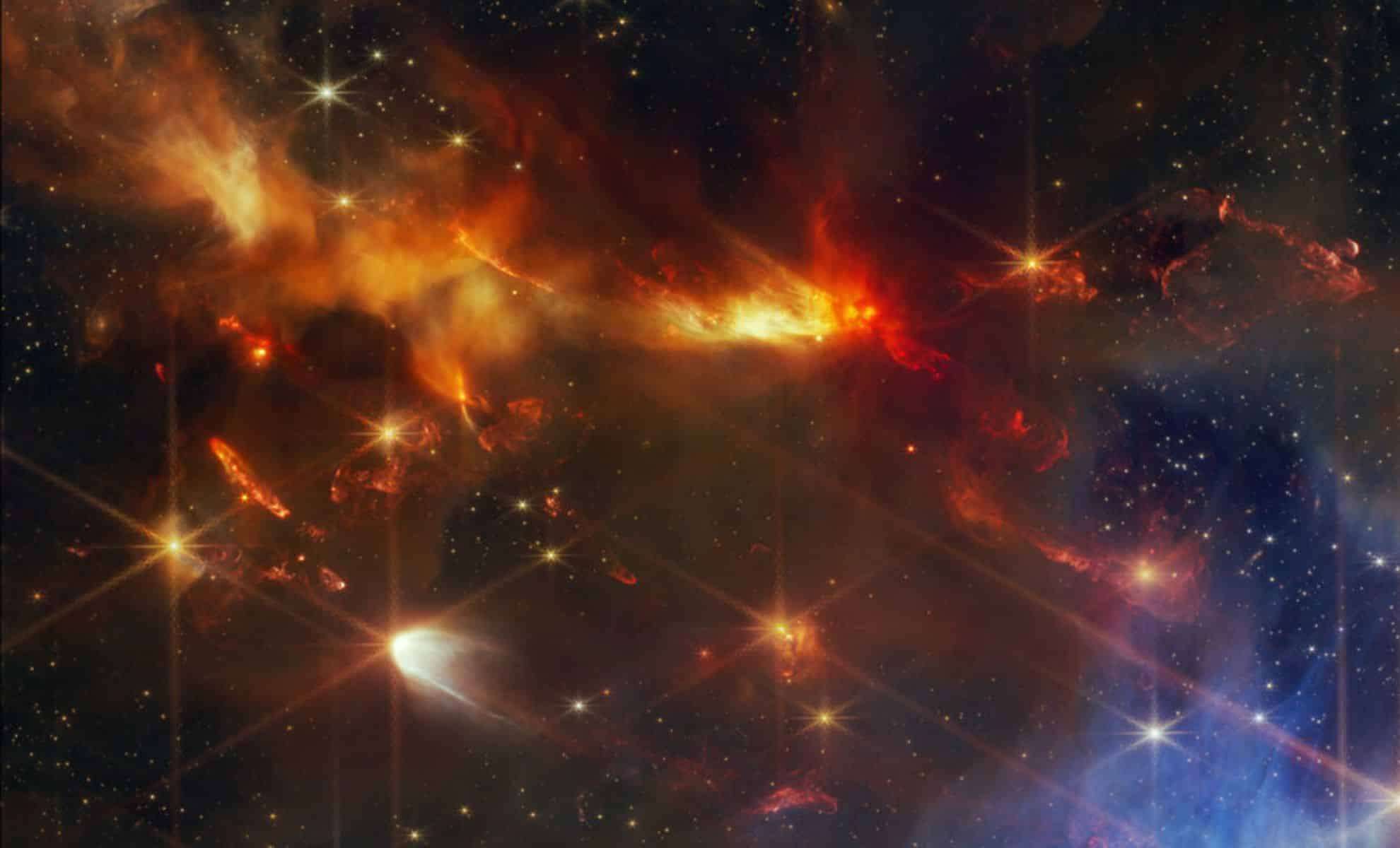
NASA’s James Webb Space Telescope has unveiled a stunning new image capturing jets aligned from recently formed stars within the Serpens Nebula, shedding light on stellar birth mechanisms.
This breakthrough marks a pivotal moment in astrophysics, offering tangible proof that bolsters theoretical models of star formation.
Breakthrough Observations in the Serpens Nebula
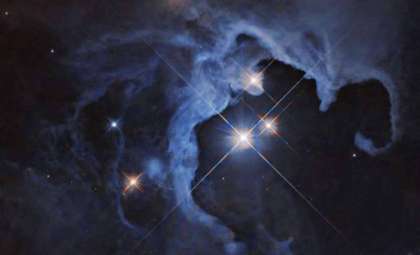
Astronomers have, for the first time, obtained direct imagery of synchronized protostellar outflows utilizing Webb’s Near-Infrared Camera (NIRCam). The captivating photograph displays a cluster of protostellar jets in the northern segment of the Serpens Nebula, a nascent stellar nursery roughly 1,300 light-years away from Earth.

These outflows form when high-speed jets of gas erupt from infant stars, striking nearby clouds of gas and dust. Typically, such jets are oriented in various directions, but intriguingly, in this region, they all align uniformly, resembling sleet falling steadily during a storm.
"This observation is enriching our understanding of the fundamental processes involved in star birth," said Klaus Pontoppidan, lead investigator at NASA’s Jet Propulsion Laboratory. The consistent direction of these jets, revealed by Webb’s remarkable sharpness and near-infrared precision, indicates we’re witnessing the region during a rare developmental phase.
Why Aligned Jets Matter
The parallelism of these stellar jets connects to the rotational dynamics of the emerging stars. As the interstellar cloud contracts into a star, its rotation accelerates. To continue the inward flow of gas, some rotational energy or angular momentum must be disposed of.
This is achieved through the creation of a circumstellar disk that channels matter inwards, much like water spiraling down a drain. Magnetic fields within this disk propel some material outward in dual jets moving opposite each other and perpendicular to the disk’s plane.
In the Webb image, these jets appear as luminous red, patchy streaks, highlighting areas where the jets slam into surrounding matter, causing shockwaves.
The red hues indicate the presence of molecular hydrogen and carbon monoxide. "This capability lets us observe these extremely young stars and their outflows, which previously only appeared as blurry blobs or were hidden in visible light by dense dust," explained Joel Green, lead author from the Space Telescope Science Institute.
Next Steps in Exploration
This extraordinary imagery and the serendipitous finding of aligned jets represent only the start of an extensive study. Researchers will employ Webb’s Near-Infrared Spectrograph (NIRSpec) to explore the cloud’s chemical composition. Their goal is to learn how key volatile compounds, such as water and carbon monoxide, endure during star and planet formation. These compounds, which change from ice to gas at low temperatures, are vital for understanding the materials that shape planetary systems.
"At our core, we’re all composed of material that originated from these volatiles. Much of Earth's water came from when the Sun was an infant protostar billions of years ago," Pontoppidan noted. By analyzing the levels of these elements in protostars before their protoplanetary disks develop, scientists aim to gain deeper insight into the conditions that formed our own solar system.
The James Webb Space Telescope remains the leading observatory in space science, continuously unveiling secrets of our solar system, distant exoplanets, and the vast origins of the cosmos. Webb represents a global collaboration led by NASA alongside the European Space Agency (ESA) and the Canadian Space Agency (CSA).
- Categories:
- Astronomy ,
- News ,
- Space ,
- Nasa




0 comments
Sign in to Comment