
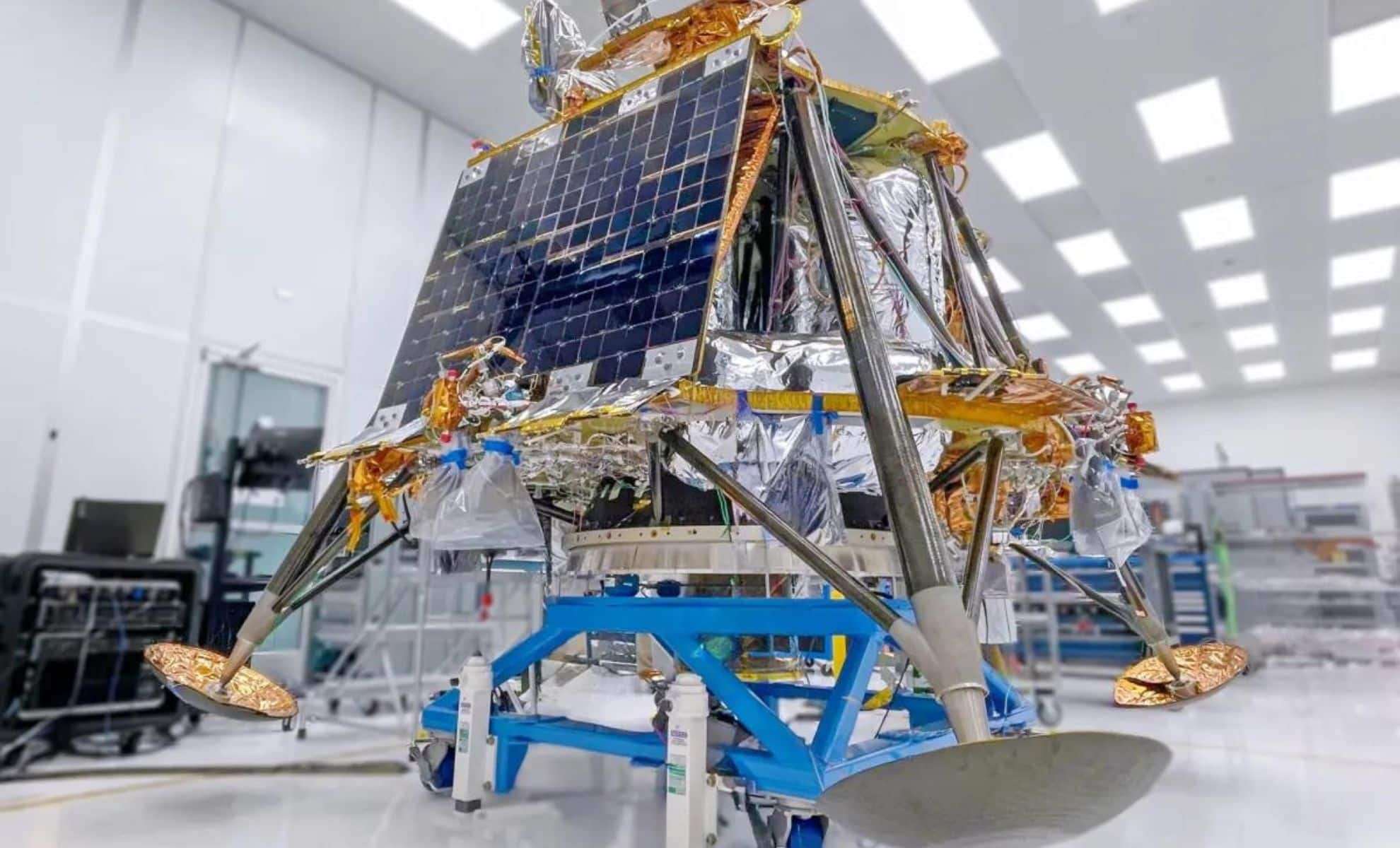
Firefly Aerospace advances toward its upcoming lunar expedition as the Blue Ghost lander commences crucial environmental testing at NASA’s Jet Propulsion Laboratory (JPL).
This phase is essential to confirm the spacecraft’s mission readiness within NASA’s Commercial Lunar Payload Services (CLPS) initiative. Designed to transport a variety of scientific instruments to the Moon, the lander is undergoing rigorous assessments to ensure it can endure the tough conditions of spaceflight and surface operations.
Rigorous Testing to Guarantee Mission Success
The Blue Ghost lander, Firefly’s inaugural lunar spacecraft, arrived at JPL following comprehensive evaluations at the company’s facility in Texas. These internal trials aimed to replicate the challenges of lunar touchdown and operation. Firefly’s team constructed a one-acre mock lunar landscape to evaluate the lander’s hazard detection and terrain-relative navigation systems. Nearly 100 drop tests were executed to verify the durability of its landing legs. Drones were also deployed to emulate descent maneuvers and assess the craft’s capability for autonomous navigation in simulated lunar conditions.

“Our testing is pushing industry boundaries,” stated Jana Spruce, Firefly’s vice president of spacecraft. She reflected, “While it’s emotional to see Blue Ghost leave our Texas facility, we’re fully prepared for this significant testing stage.”
Currently at JPL, Blue Ghost is undergoing a series of environmental evaluations including vibration, acoustic, thermal vacuum, and electromagnetic interference (EMI) trials. Vibration testing simulates the intense shaking expected during launch on a SpaceX Falcon 9 rocket. Acoustic tests ensure the lander can withstand the high noise levels during liftoff. Thermal vacuum assessments simulate the extreme temperatures and near-vacuum of space, whereas EMI experiments check for possible disruptions between the spacecraft’s electronics and external electromagnetic sources.
Firefly Aerospace’s interim CEO, Peter Schumacher, highlighted the significance of this phase: “Combining our extensive internal tests with these environmental exams at JPL drastically lowers risk and primes us for a soft landing. This process honors the legacy of NASA’s Surveyor landers from the 1960s, which underwent testing in the same venues.”
Playing a Pivotal Part in NASA’s Lunar Initiatives
Pending successful testing, Blue Ghost is scheduled to launch during the last quarter of 2024. Post-launch, it will orbit Earth for roughly one month for final system validations before embarking toward lunar orbit. Upon arrival, it will circle the Moon for about two weeks, confirming operational integrity before beginning its descent to the surface.
Targeting the Mare Crisium basin—located on the northeastern area of the Moon’s near side—the site was chosen for its relatively smooth terrain and distinctive geological properties. Blue Ghost will transport 10 payloads focused on science and technology demonstrations, such as an X-ray imager designed to study Earth’s magnetosphere, a system for sampling lunar regolith, and a receiver capable of detecting GPS and Galileo satellite navigation signals from lunar distances.
This mission supports NASA’s broader goal of expanding lunar exploration through the CLPS program, aimed at delivering scientific instruments and demonstrations to the Moon. Success here is vital to NASA’s Artemis program, which intends to return astronauts to the lunar surface by 2025 and establish long-term human presence. Firefly joins a select group of companies, alongside Astrobotic and Intuitive Machines, helping realize this vision.
Meeting Challenges and Preparing for the Future
Positioned to be the third company to attempt a lunar touchdown through CLPS, Firefly faces substantial pressure for mission success. Previous efforts illustrate the risks: earlier this year, Astrobotic’s Peregrine lander encountered a propulsion issue during launch, preventing a successful landing. Meanwhile, Intuitive Machines’ Odysseus lander managed to touch down but tipped over, limiting its capabilities.
Blue Ghost is built to operate through one full lunar day—lasting approximately 14 Earth days—and can continue operating for several hours into the lunar night. The mission will produce valuable insights and validate emerging technologies for upcoming lunar projects. Additionally, Firefly has secured a contract for a subsequent lunar mission, called Blue Ghost 2, destined for 2026 to attempt landing on the Moon’s far side. This follow-up mission will carry an astrophysics experiment alongside two extra payloads, advancing NASA’s lunar exploration objectives even further.
- Categories:
- Astronomy ,
- News ,
- Space ,
- Nasa






0 comments
Sign in to Comment