
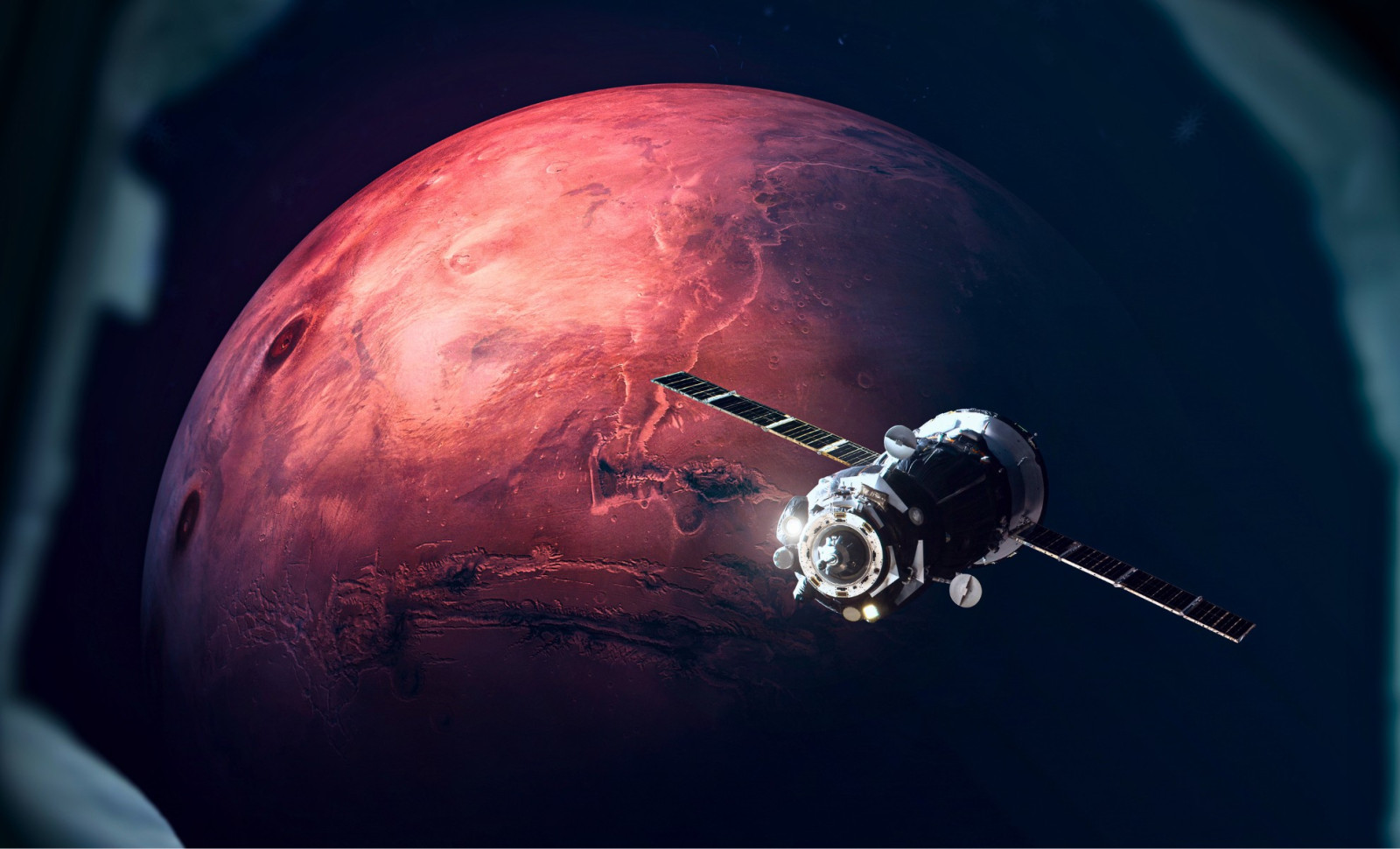
Imagine a mission launching from Earth on April 20, 2031, reaching Mars orbit in a mere 56 days. After spending five weeks exploring the Martian surface, the crew embarks on a return journey, splashing down back on Earth just 226 days after departure. Such a rapid round trip dramatically shortens the current typical mission timelines to the Red Planet.
Traditional crewed Mars expeditions usually require seven to nine months for the one-way trip, relying on standard chemical propulsion. However, a recent study published in Acta Astronautica reveals that this highly compressed 226-day round trip is feasible within the solar system’s orbital mechanics, unveiling an efficient trajectory hidden within planetary alignments.
Marcelo de Oliveira Souza, an astrophysicist at Brazil’s State University of Northern Fluminense, approached this challenge without inventing new engines or novel physics. Instead, he used the initial 2015 orbit data of asteroid 2001 CA21 as a geometric guide. This early orbit depicted a stretched, low-inclination ellipse intersecting both Earth’s and Mars’ orbital paths—a baseline for exploring extreme transfer trajectories.

He imposed a restriction: the candidate trajectories would remain within five degrees of the asteroid’s orbital plane. Testing several upcoming Mars opposition dates with a Lambert solver—an astrodynamics tool calculating travel paths—he found the 2027 and 2029 windows unsuitable due to energy constraints or unclosed return loops.
The 2031 window yielded promising results, producing two full round-trip trajectories departing Earth on the same day in April. One extreme option features a rapid 33-day outbound flight, a 30-day surface mission, and a 90-day return, totaling 153 days. The other balances a 56-day journey out, 35 days on Mars, and a 135-day return journey, making for a total of 226 days.
Unprecedented Speeds Surpassing Chemical Limits
Interplanetary travel velocity is often expressed as hyperbolic excess velocity, the speed a vehicle maintains after escaping Earth’s gravity. For the 56-day path, this reaches about 16.9 kilometers per second.
This implies launch energy roughly 15 times that of conventional Mars missions, and approximately 1.5 times the departure velocity used by NASA’s New Horizons spacecraft en route to Pluto. Since New Horizons was a relatively small unmanned probe, scaling this to a fully crewed spacecraft with life support and habitat systems significantly raises propulsion challenges.

The even swifter 33-day trajectory needs roughly 40 times the energy of a standard trip, with departure speeds hitting 27.5 kilometers per second—beyond the practical ceiling for any chemical propulsion system flown to date.
Entry speeds remain daunting too. The 56-day inbound approach results in Mars atmospheric entry at 16.6 kilometers per second and Earth re-entry at 15.1 kilometers per second, pushing protective shielding materials to their limits as they must endure heating rates far beyond lunar mission experience.
Nuclear Propulsion: The Key to Unlocking the Route
The study firmly concludes that chemical rockets cannot meet these energy requirements. Instead, it highlights nuclear thermal propulsion (NTP)—which utilizes a reactor to superheat liquid hydrogen, expelling it at about twice the efficiency of chemical engines—as the viable pathway.
Far from theoretical, NTP is actively being explored. In 2023, France’s research organization CEA initiated the Alumni program, collaborating with ArianeGroup and Framatome under the European Space Agency umbrella. Their goal, as detailed in CEA’s announcement, is to develop propulsion systems capable of shortening Mars missions and reducing astronaut radiation exposure.
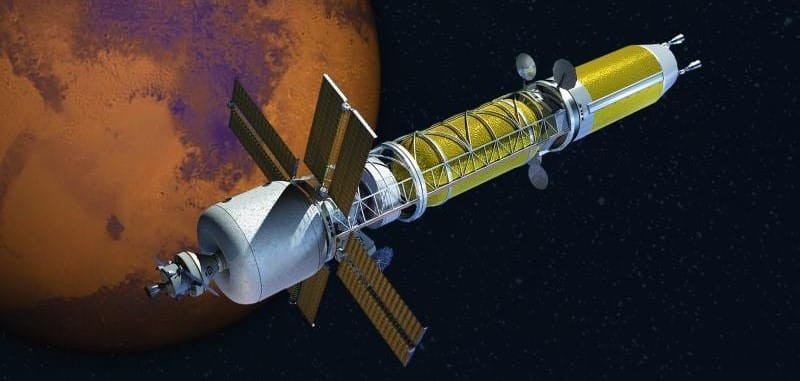
Additionally, CEA’s RocketRoll project investigates nuclear electric propulsion for deep space ventures where solar energy is insufficient. Both initiatives feed into a broader European roadmap aiming to demonstrate these technologies by around 2035, aligning closely with the critical 2031 launch opportunity.
“Le CEA est impliqué dans les études concernant le nucléaire spatial depuis les années 1980,” noted program manager Xavier Averty in 2023. This makes CEA the sole European institution concurrently developing both nuclear thermal and electric propulsion systems for spaceflight.
While the paper stops short of detailing spacecraft design, mass estimates, or re-entry strategies, it provides compelling numerical proof that a rapid Mars round trip geometry rooted in real orbital data exists—and that the 226-day plan holds up despite inherent uncertainties in early orbit observations.
Geometric Insight, Not a Destination
The asteroid orbit itself wasn’t the mission goal. Instead, de Oliveira Souza treated its early orbital plane like a map contour, revealing trajectory pathways that traditional optimization approaches might not uncover. Anchoring the search on this geometric constraint reveals energetic corridors otherwise overlooked.
An open question remains whether similar hidden trajectories exist among other early-observed asteroids. This broader investigation is left for future studies. For now, the 226-day round trip remains a theoretical possibility that demands propulsion technologies capable of meeting its significant energy challenges.
- Categories:
- Science










0 comments
Sign in to Comment